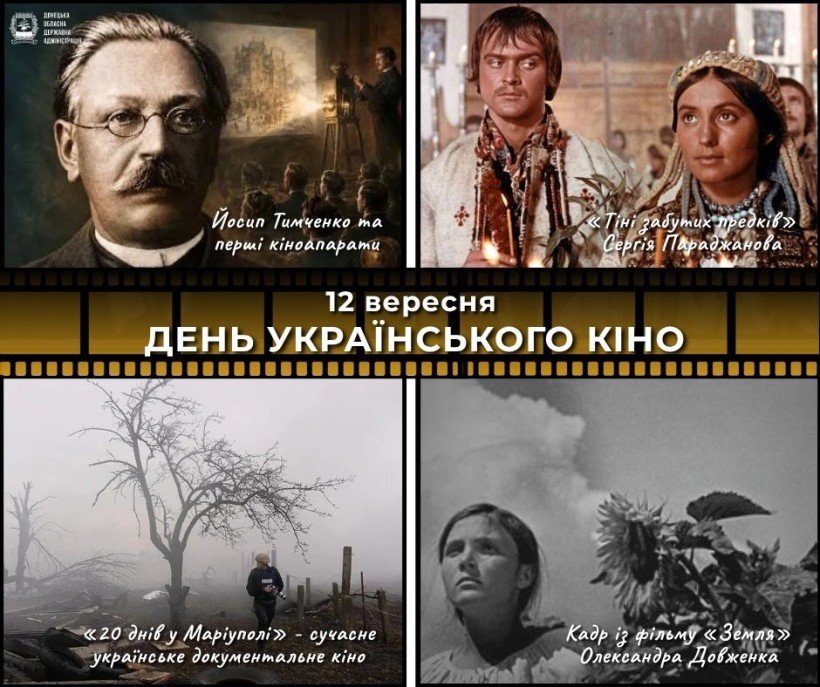
On September 12, 2026, Ukraine celebrates Ukrainian Cinema Day—a professional holiday for film industry workers. It was established by Decree of the President of Ukraine No. 52/96 dated January 12, 1996. The date is set as the second Saturday in September, so it falls on a different day of the calendar each year. This holiday highlights the role of cinema not only as an art form but also as an important tool for shaping national identity. It is Ukrainian films that help reinterpret history, address pressing social issues, and showcase the diversity of cultural traditions.
Ukrainian cinema dates back to the late 19th century, when, in 1893—three months before Edison and more than a year before the Lumière brothers—Yosyp Tymchenko, a mechanic at Odesa University, constructed a film camera and a film projector. A few years later, in Kharkiv, Alfred Fedetsky shot several short films and, on December 2, 1896, held Ukraine’s first public film screening at the Kharkiv Opera House (now the Regional Philharmonic). At the time of its invention, cinema was considered an attraction, a “moving photograph”; it borrowed heavily from literature and theater.
Starting in 1909, Ukraine began producing comedies, dramas, and vaudeville shows drawn from the repertoire and performed by actors from Ukrainian theaters: *Shelmenko the Orderly*, *The Magician from Moscow*, and *The Night Before Christmas*.
But the 1920s were truly revolutionary for Ukrainian cinema. Odessa became one of the key centers of its development. The first private film studios and production companies appeared there as early as 1907, and in the 1920s, the city became the main filming base for the All-Ukrainian Photo-Film Administration (VUFKU). In the 1920s, Ukrainian cinema developed not only as an art form but also as a full-fledged industry. VUFKU brought together film production, distribution, advertising, and film education, and its activities contributed to the emergence of a vibrant Ukrainian cinematic community. It was during this period that Dovzhenko’s films *Zvenygora* (1928), *Arsenal* (1929), and *Earth* (1930) were released.
With the advent of sound, Ukrainian cinema gained new life. In the 1930s, Ivan Kavaleridze directed *The Koliivshchyna Uprising* (1933), *Prometheus* (1935), *Natalka Poltavka* (1936), and *The Cossack Beyond the Danube* (1937). After World War II, despite strict censorship and pressure from the totalitarian state, films by Leonid Osyka, Sergei Parajanov, Kira Muratova, Yuri Illienko, and other prominent Ukrainian filmmakers began appearing in theaters, featuring the stellar acting talents of Ivan Mykolaychuk and Leonid Bykov, Larisa Kadochnikova and Ada Rogovtseva, Bogdan Stupka, and Konstantin Stepanov.
Ukrainian cinema developed in an environment where cultural activities were often subject to strict political control. Some artists were persecuted, their works were banned, their names were removed from the credits, or they were effectively prevented from working. That is why the history of Ukrainian cinema is not only the history of films and directors, but also the history of the struggle for the right to speak about Ukraine in one’s own language and from one’s own perspective.
As the popularity of international film festivals has grown, Ukrainian directors, screenwriters, and actors have increasingly gained international recognition. Films such as Sergei Parajanov’s *Shadows of Forgotten Ancestors*, Alexander Dovzhenko’s *Earth*, Myroslav Slaboshpytskyi’s *The Tribe*, Valentin Vasyanovich’s *Atlantis*, Mstislav Chernov’s “20 Days in Mariupol,” and many others have not only become masterpieces of cinema but have also drawn the attention of a global audience to Ukrainian life and culture.
Contemporary Ukrainian cinema is actively developing despite all the challenges. Following the Revolution of Dignity and the start of Ukraine’s War of Independence, many films began to reflect the country’s complex historical and political situation. Films such as Akhtem Seitablaev’s *Cyborgs*, Nariman Aliyev’s *Home*, and Zaza Buadze’s *Red* depict important moments in the national struggle and the formation of identity.
In recent years, the Donetsk region has become one of the key settings in contemporary Ukrainian cinema. However, it is important to note that contemporary films about the Donetsk region are not limited to depictions of war. Cinema can introduce viewers to the region through its people, cities, family stories, culture, and everyday life. Among such works are director Alisa Kovalenko’s documentary *We Will Not Fade Away*, Koryn Gritsyuk’s documentary *Eurodonbas*, and others. In this way, film becomes a means of preserving memory and resisting attempts to impose a different history on the Donetsk region.
Contemporary cinema captures the events witnessed by today’s generations of Ukrainians. Documentaries and feature films about the war are shaping a future archive of memory—preserving human stories, evidence of crimes, the experiences of military personnel and civilians, and the lives of cities and villages during the nation’s greatest trial.
Ukrainian Cinema Day reminds us of a simple yet important truth: a film can leave behind more than just footage. It can preserve a person’s voice, the appearance of a city, the memory of an event, and the truth about the era in which it was created. For Ukraine, and especially for the Donetsk region, this ability is particularly valuable today.