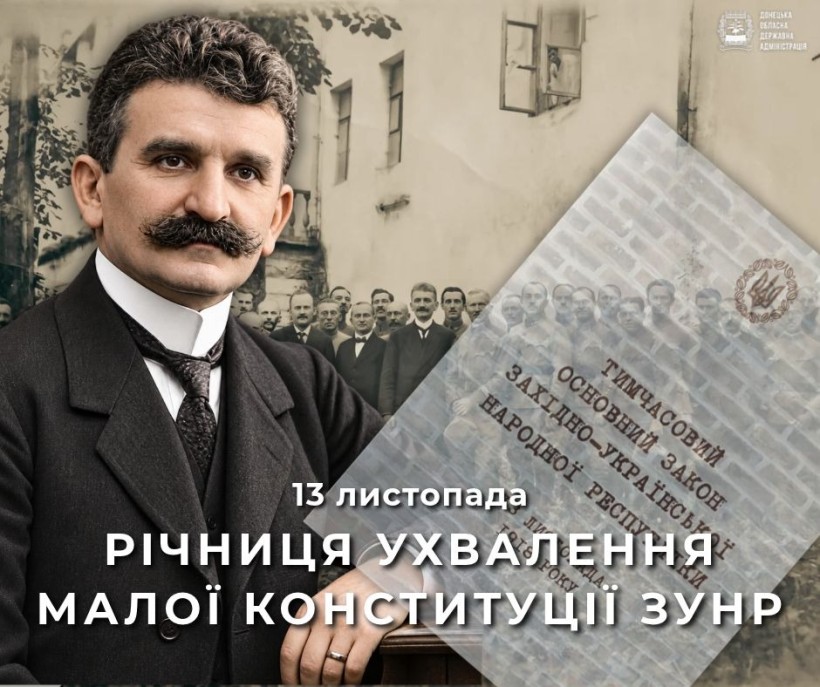
November 13, 2026, marks the 108th anniversary of the adoption of the “Small Constitution” of the West Ukrainian People’s Republic, which became one of the key milestones on the path to the legal establishment of Ukrainian statehood.
On October 16, 1918, Emperor Charles I, hoping to preserve statehood, issued a manifesto declaring Austria a federal state and granting its peoples the right to statehood. To establish its own governing bodies, a meeting was held in Lviv on October 18, attended by members of the Austrian Parliament, the Galician and Bukovinian Seims, the episcopate, and representatives of political parties, organizations, and associations from the ethnically Ukrainian territories that were part of Austria-Hungary; this gathering formed the Ukrainian National Council (UNR).
On October 19, the UNR proclaimed the establishment of a Ukrainian state across the entire Ukrainian ethnic territory of Galicia, Bukovina, and Transcarpathia, headed by Yevhen Petrushevych, a member of the Austrian Parliament, and announced its intention to assume governing authority. However, the following day, the governor of the Kingdom of Galicia and Volhynia, General Karl Georg von Huyn, responded with a refusal, announcing plans to transfer Galicia to the Kingdom of Poland.
To prevent Eastern Galicia from falling under the control of the resurgent Polish state, Ukrainian forces decided to act decisively. On the night of November 1, 1918, an uprising known as the November Uprising began in Lviv. In Lviv, the November Uprising faced active armed resistance from the city’s Polish population. The battles for Lviv lasted more than three weeks.
Despite this, on November 13, 1918—the day Emperor Charles I abdicated the throne—the UNR Council adopted the “Provisional Basic Law on the State Independence of the Ukrainian Lands of the Former Austro-Hungarian Monarchy,” pursuant to which the new state was named the West Ukrainian People’s Republic (ZUNR).
The document was adopted amid fierce street battles for Lviv between Ukrainian units and Polish forces. Despite the state of war, Ukrainian politicians sought to immediately bring the government into a legitimate legal framework.
The law was concise but extremely substantive. It consisted of only five articles, each of which defined the fundamental principles of the state’s structure:
Name of the State (Article I). The state proclaimed by the Ukrainian National Council was officially named the West Ukrainian People’s Republic (ZUNR).
Territory and Borders (Article II). The republic comprised Ukrainian ethnic lands within the borders of the former Austro-Hungarian Empire. This included Eastern Galicia, Northern Bukovina, and Transcarpathia, covering approximately 70,000 square kilometers with a population of nearly 6 million people.
State Sovereignty (Article III). This territory was proclaimed an autonomous, independent, and sovereign state.
Government Bodies (Article IV). Until the convening of the Constituent Assembly based on universal, equal, direct, and secret suffrage, the highest legislative authority was exercised by the Ukrainian National Council. Executive power was vested in the State Secretariat (government), headed by Kost Levytsky.
State Symbols (Article V). The coat of arms of the republic was established as a golden lion on a blue field, facing the heraldic right. The state flag was a blue-and-yellow banner, and the state seal featured the coat of arms with the inscription “Western Ukrainian People’s Republic.”
The author of the first draft of the law was the Basilian monk, public figure, and politician Father Platonid Filyas. Metropolitan Andrey Sheptytsky and Bishops Gregory Khomyshyn and Josaphat Kotsylovsky took an active part in finalizing the text.
This short constitution served as the foundation for the subsequent adoption of extremely progressive laws. National minorities (Poles, Jews, and Germans) were guaranteed the right to representation in parliament, their own schools, and the free use of their native languages in government institutions.
Unlike many neighboring regions of the former empire, where anarchy and pogroms reigned, the government of the West Ukrainian People’s Republic managed to quickly restore the functioning of the courts, the postal service, the railways, and the financial system, relying on the provisions of the adopted law.
The “Provisional Basic Law” became not merely a legal act, but a manifesto of the Ukrainian nation’s political maturity. Although the ZUNR lost control of its territory due to unfavorable foreign policy circumstances and the military superiority of its neighbors, the state-building traditions it established did not disappear. They became the intellectual foundation for the further development of Ukrainian constitutional thought in exile and in modern independent Ukraine.