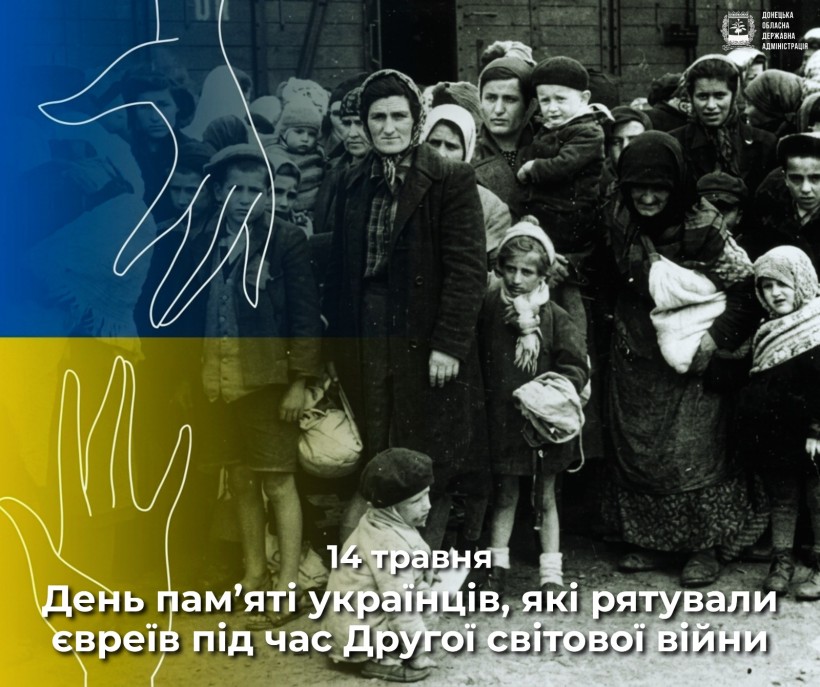
In honor of the Righteous Among the Nations and other rescuers of Jews who, at the risk of their own lives and those of their families, helped Jews escape Nazi terror during the Holocaust, Resolution No. 1178-IX of the Verkhovna Rada of Ukraine dated February 2, 2021, “On Honoring the Memory of Ukrainians Who Rescued Jews During World War II,” established in Ukraine the Day of Remembrance for Ukrainians Who Rescued Jews During World War II, which is observed annually on May 14.
Ukrainians have become one of the largest groups among the Righteous Among the Nations. This is an honorary title granted by the State of Israel through the Yad Vashem Holocaust Memorial. As of 2026, over 2,700 Ukrainian citizens have received this title for saving Jews in various regions—in cities and villages, in occupied territories, in the underground, and even within the ranks of Soviet and Polish partisan units.
Often these were ordinary people—farmers, priests, teachers, doctors—who sought no glory but were guided by conscience and compassion. Among the well-known rescuers are the Sukhoverko, Melnyk, Kozlenko, and Shevchenko families, as well as Dr. Maria Haidai, Father Omelian Kovch, and many others. Some of them paid for their help to Jews with the ultimate price—their own lives.
The date of this commemorative day was not chosen by chance—it was on May 14, 1942, in occupied Rivne, that the Sukhoverko family, who had been hiding a Jewish girl, was shot. Their heroic act became a symbol of the indomitable spirit of all Ukrainians who did not fear Nazi terror.
During the Nazi occupation of Ukraine from 1941 to 1944, the Nazi regime exterminated more than 1.5 million Jews—nearly 60% of Ukraine’s pre-war Jewish population. This was part of the pan-European plan for the “Final Solution to the Jewish Question,” initiated by Nazi Germany. The mass extermination of Jews on Ukrainian soil became one of the most tragic chapters of the Holocaust—the genocide committed against the Jewish people.
Unlike in Western Europe, where Jews were typically deported to concentration camps, in Ukraine a significant portion of them were killed on the spot, often right outside their homes. The Nazis carried out mass shootings conducted by Einsatzgruppen, the German police, and local collaborators.
Despite the potential consequences, under extremely difficult conditions, thousands of Ukrainians risked their own lives and those of their families to save Jews from Nazi extermination. They took them into their families, obtained new documents for them, provided temporary shelter and food, and helped them escape persecution.
The Holocaust in Ukraine had catastrophic consequences not only for the Jewish community but also for the country’s entire historical memory. Before the war, Jews constituted a significant portion of the population in many cities—playing a vital role in cultural, economic, and social life. Their mass extermination changed the ethnic map of Ukraine forever.
That is why preserving the memory of the Holocaust and honoring the Righteous Among the Nations from Ukraine is an important moral duty of modern society and a vital part of national memory, testifying to the humanity and dignity of the Ukrainian people even in the darkest times of history.