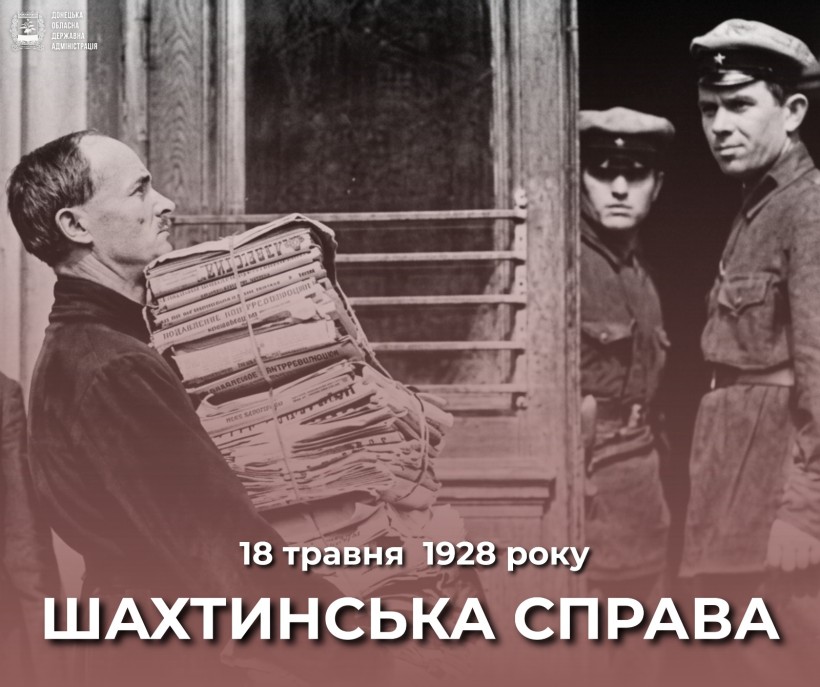
In March 1928, the bodies of the United State Political Administration of the Ukrainian SSR carried out an operation to “eliminate Ukrainian anti-Soviet elements,” resulting in the arrest of over 400 people. The fight against the “Ukrainian counterrevolution” involved an intensification of the Soviet authorities’ repression against Ukrainian peasants and the intelligentsia.
At the same time, at the April plenum of the Central Committee of the Communist Party of Ukraine (Bolsheviks), the thesis of an “economic counterrevolution” by “old” specialists was put forward in order to shift the blame onto them for industrial accidents and disasters resulting from forced industrialization.
In May 1928, Soviet state security agencies carried out an operation to arrest over 100 “saboteurs” in the Donbas coal industry, targeting pre-revolutionary technical personnel. This operation went down in history as the “Shakhty Case.”
As early as May 18, 1928, the trial in the “Shakhty Case” began in Moscow. The accused engineers were charged with “counterrevolutionary conspiracy” and “massive sabotage aimed at destroying the coal industry,” which was allegedly carried out simultaneously for the benefit of several states—Poland, France, and Germany.
The trial of the “Shakhty group” marked the beginning of the campaign against “saboteurs” throughout the Soviet Union. In 1928, similar “sabotage” organizations were exposed at “Pivdenstal,” Dniprobud, and elsewhere. The old technical intelligentsia became the target of repression.
The “Shakhty Case” became one of the most striking examples of theatrical trials in Soviet history, which was actively covered by journalists. Tickets were issued for this trial, and spectators could watch it as if it were a play in a theater. In addition to state prosecutors, 42 public prosecutors and 15 defense attorneys participated in the trial, and its proceedings were covered by 120 journalists, including foreign correspondents. Reports from the courtroom were broadcast on the radio, filmed for newsreels, and detailed accounts were published in newspapers. Over the course of two weeks, 30,000 spectators attended the court sessions, and workers held demonstrations demanding severe punishment for the “criminals.”
The “Shakhty Case” was used by the Soviet leadership to manipulate public opinion and subsequently organize rigged trials.
The court acquitted four of the 53 defendants and sentenced four others to suspended sentences. Nine people were sentenced to prison terms ranging from 1 to 3 years, while the majority of the defendants received sentences ranging from 4 to 10 years. Eleven people were sentenced to death by firing squad (five of them were executed on July 9, 1928; the Central Executive Committee of the USSR commuted the sentences of six).
Thus began the mass repression against the technical elite.