On April 1 (March 19), 1917, a mass rally of 100,000 people was held in Kyiv, at which the resolutions drafted by the Central Rada calling for the convening of a Constituent Assembly to resolve the issue of Ukrainian autonomy were endorsed. On the same day, the newspaper “News from the Ukrainian Central Rada” published an announcement about the convening of a congress to formulate the Central Rada’s program of action. The leaders of the Central Rada intended to hold the congress on the principle of representation of all Ukrainians, in order to transform the organization into a pan-Ukrainian one. “Ukrainians! Wherever you are, organize yourselves, elect one or two representatives from each organization, and let them go to Kyiv for the All-Ukrainian Congress,” the announcement urged.
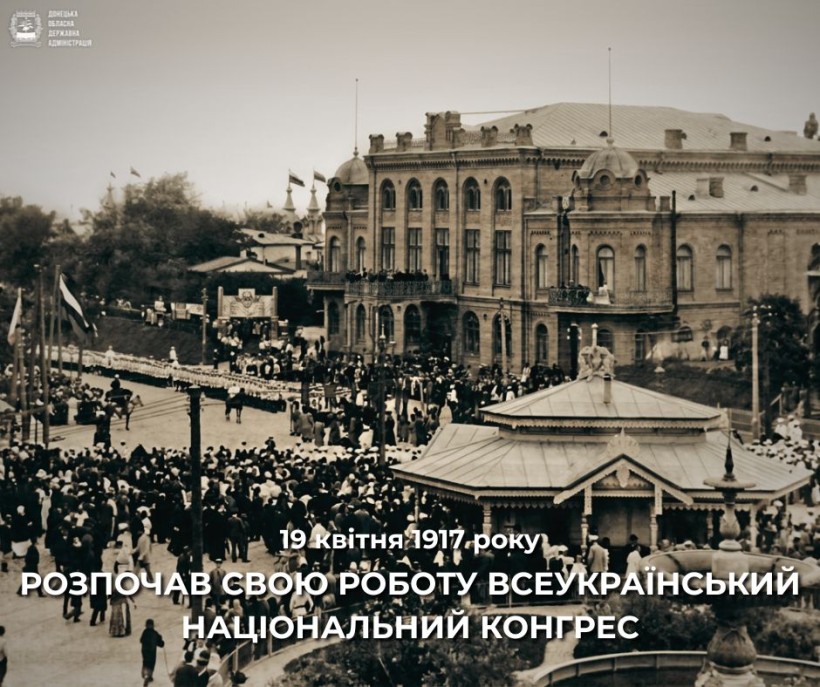
The Congress was scheduled for the Easter holidays—April 19–21 (April 6–8 according to the old calendar). Amid the unprecedented rise of the Ukrainian national movement, this was also perceived as a symbol of Ukraine’s resurrection.
The All-Ukrainian National Congress became the most significant event of the early stage of the Ukrainian Revolution, the first representative forum of the Ukrainian movement within Ukraine, which transformed the Ukrainian Central Rada from a Kyiv-based into a nationwide organization.
The Congress was widely attended by delegates from all Ukrainian provinces, various segments of the population, and many political parties (the Ukrainian Socialist-Revolutionary Party, the Ukrainian Social Democratic Labor Party, the Ukrainian Socialist-Folk Party, the “Independents,” civic movements, peasant unions, student communities, societies, and cooperative organizations).
In total, about 1,500 participants registered (delegates with voting and advisory rights, as well as guests). The sessions of the All-Ukrainian Congress were held in Kyiv in the hall of the Merchants’ Assembly.
The delegates’ activity can be described as intense—over the course of three days, there were more than 300 public speeches, not counting the vast number (over 350) of greetings sent to the congress from virtually every corner of Ukraine and beyond its borders.
Mykhailo Hrushevsky, who opened the congress, became the driving force of the forum. He was unanimously elected honorary chairman of the assembly and remained at the center of discussions throughout. Speakers and orators aligned themselves with his position; his ideas and theoretical conclusions were incorporated into the documents that were adopted.
Undoubtedly, the All-Ukrainian National Congress fulfilled the tasks entrusted to it by that historic moment. Following the Ukrainian demonstration on April 1 (March 19), 1917, it became a crucial step in the development of the Ukrainian Revolution, demonstrating to the Provisional Government established in St. Petersburg the seriousness and urgency of Ukrainian national demands, and after the congress, the Ukrainian people reached a qualitatively new level of national consolidation.
The Congress demonstrated the Central Rada leaders’ desire to ensure the legitimacy of the governing body of the Ukrainian movement and became the first real step toward the creation of a Ukrainian state. It played an important role in enhancing the authority of the Central Rada, transforming it into the supreme body, the center of Ukrainian political life and the national liberation movement, which was reaching new heights.
The All-Ukrainian National Congress marked the end of the process of forming the Central Rada and the beginning of the second phase of its activity—the struggle for Ukrainian autonomy.