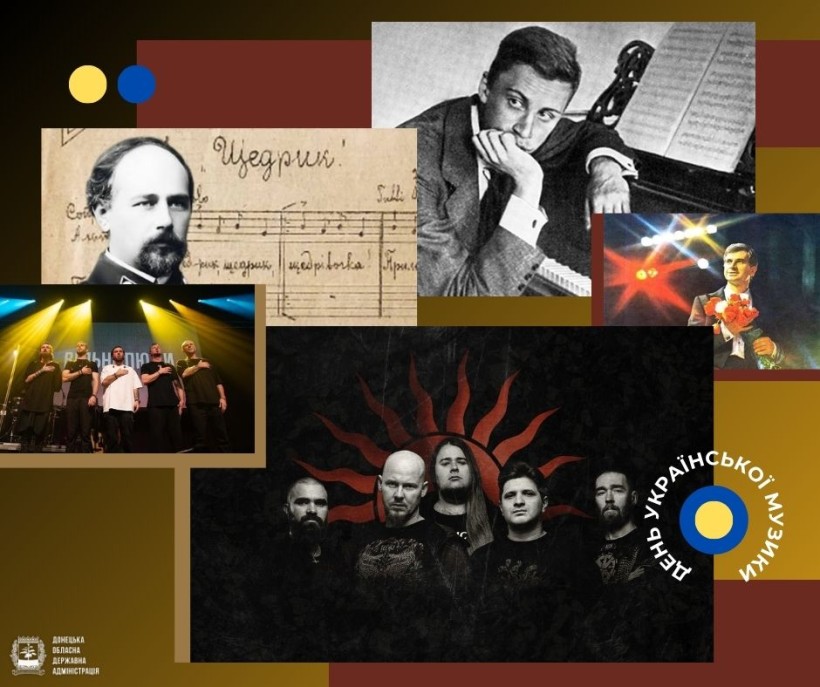
With the aim of strengthening national unity, preserving musical heritage, affirming statehood, and supporting Ukrainian musicians whose works continue to be performed in Ukraine and abroad, the Verkhovna Rada of Ukraine, by Resolution No. 4884-IX of May 27, 2026, established Ukrainian Music Day. The holiday will be celebrated annually on the third Saturday of September. This year marks the first celebration of the holiday, which falls on September 19.
Music has always been and remains a mirror of its era, directly reflecting social changes, political upheavals, technological progress, and humanity’s spiritual quests.
Ukrainian music is part of a cultural heritage that has been shaped over the centuries. Folk songs, the kobzar tradition, church chant, the professional school of composition, choral and symphonic music, contemporary pop, and singer-songwriter music—the various forms of Ukrainian musical art share a common trait: they preserve the experience of generations and reflect the changes that Ukrainian society has undergone.
Ukrainian music has repeatedly served as a means of asserting the existence of Ukrainian culture in places where attempts were made to restrict or supplant it. This was particularly evident in the early 20th century, when Ukrainian composers and performers worked to develop the national repertoire, recorded folk songs, formed choral ensembles, and presented Ukrainian art abroad.
The musical culture of the Donetsk region did not develop within a single cultural environment. Here, the traditions of the Ukrainian steppe, urban culture, professional music education, folk singing, and the cultural traditions of various communities intertwined. This diversity became part of the region’s musical identity.
It was in the Donetsk region that artists who laid the foundation for Ukrainian and world musical culture were born or came of age:
Sergei Prokofiev—one of the most influential composers of the 20th century.
Mykola Leontovych—although the composer was born in Podillia, his creative rise is closely linked to the Donetsk region. From 1904 to 1908, he lived and worked at the Hryshyne railway station (now Pokrovsk), where he founded Ukraine’s first choir of railway workers and worked on the iconic “Shchedryk.”
Anatoliy Solovyanenko—an outstanding Ukrainian tenor of international renown who became a symbol of the Ukrainian opera scene, celebrating Ukrainian song at the Metropolitan Opera and La Scala.
Ivan Karabits—an outstanding Ukrainian composer and conductor. His son, Kirill Karabits, is now a world-renowned conductor who actively promotes Ukrainian classical music in Europe.
In addition, the Donetsk School of Poetry and the classics of Ukrainian poetry—whose lives were connected to the Donetsk region—have gifted Ukrainian culture with dozens of powerful hit songs.
Mykhailo Petrenko, a 19th-century romantic poet who was born and lived in Sloviansk, is the author of one of the most famous Ukrainian songs in the world, “I Look at the Sky and Let My Thoughts Wander…” It has been performed by Anatoliy Solovyanenko, Muslim Magomayev, Oleksandr Ponomariov, and many others. This very song was the first to be played in space (it was sung by the first Ukrainian cosmonaut, Pavlo Popovich, in 1962).
One of Ukraine’s most tender lyricists, Volodymyr Sosyura—who spent his childhood and youth in the Donetsk region—gave Ukrainian culture the patriotic poem-testament “Love Ukraine,” which has been set to music by many composers. A modern version of the song based on Sosyura’s poem has been performed by bands such as “Tin Sontsia,” “KOZAK SYSTEM,” and others.
The lyrics of Vasyl Stus, one of the main symbols of the Donetsk region, are very popular among contemporary rock and indie artists: “U zali zagrav” by the band “Bez Obmezhen”; “Verny do mene, pam’yate moya” by the band “Taruta”; “Endure, Endure—Freedom Will Come” by the Lviv-based band “Plach Yeremii”; “The Harvest Is Not Yet Here” as interpreted by “Tin Sontsia,” and many others
Today, the Donetsk region continues to preserve and promote the region’s musical heritage. In particular, practitioners of authentic singing pass down traditional melodies, and certain examples of this musical heritage have been included in the regional list of intangible cultural heritage.
Ukrainian Music Day is about a voice that cannot be erased from history. Ukrainian music has endured bans, repression, wars, and forced silence, but it has always found its way back to the people. Today, it continues to resonate—and with it, Ukraine resonates as well.