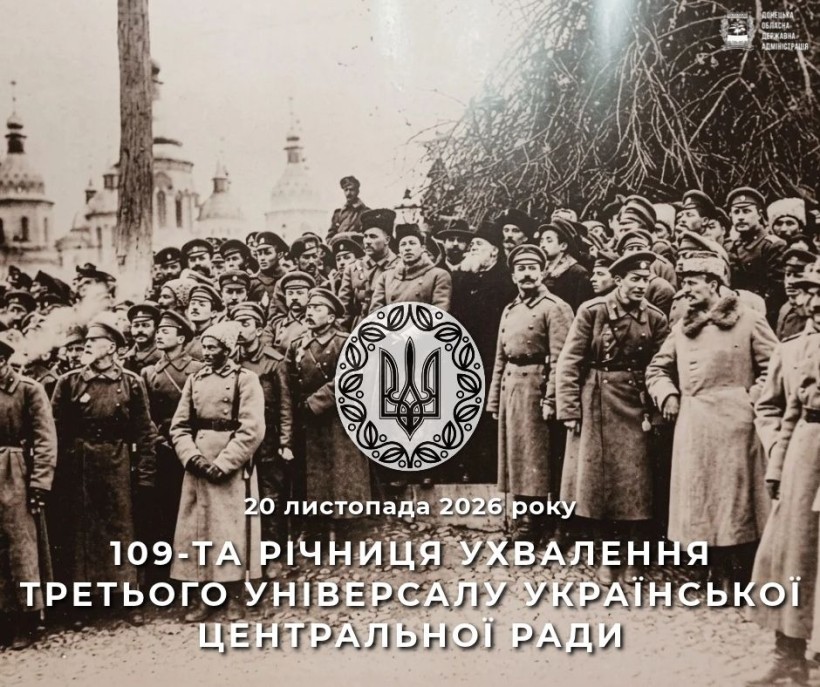
On November 20 (November 7, Old Style), 1917, the Ukrainian Central Rada adopted the Third Universal, proclaiming the establishment of the Ukrainian People’s Republic (UPR). This historic act marked a turning point in the Ukrainian Revolution of 1917–1921. It legally formalized the revival of Ukrainian statehood, defined the country’s borders, and laid the legal and democratic foundations of modern Ukraine.
The conditions leading up to the adoption of the document took shape amid the rapid collapse of the former Russian Empire and the deepening political crisis. Throughout the spring and summer of 1917, the Central Rada, led by Mykhailo Hrushevsky, conducted complex negotiations with the Provisional Government in Petrograd, gradually expanding the boundaries of Ukrainian autonomy. However, the situation changed dramatically in the fall. On November 7–8 (October 25–26 according to the old calendar) 1917, an armed Bolshevik coup took place in Petrograd, resulting in the overthrow of the legitimate Provisional Government.
“For regional authority to become true de facto authority, it must rest on a solid foundation, and this can only be achieved through the proclamation of the Ukrainian People’s Republic,” said Mykhailo Hrushevsky as he opened the session of the Small Council on November 20.
Two days later, a festive prayer service was held at St. Sophia Cathedral, and military units lined up in the square adjacent to it. In a solemn atmosphere, during a large public assembly, the text of the Universal was read aloud.
The document outlined the borders of the UPR, including Kyiv Oblast, Podillia, Volhynia, Chernihiv Oblast, Poltava Oblast, Kharkiv Oblast, Katerynoslav Oblast, Kherson Oblast, and Tavria (excluding Crimea). “The final determination of the borders… regarding the incorporation of parts of Kursk, Kholm, Voronezh, and neighboring provinces and regions where the majority of the population is Ukrainian, shall be established by the organized will of the people.” The Crimean Peninsula was not included within the territory of the UPR. Ukrainian politicians strictly adhered to the ethnographic principle and treated the national revival of the Crimean Tatars with respect; the Crimean Tatars were convening their Kurultai at that very time. Kyiv did not wish to impose its authority on the Crimean Tatar people, hoping instead for an equal union and good-neighborly negotiations.
It was also noted that, until the Constituent Assembly was convened, all power in the country belonged to the Central Rada and the General Secretariat. The preservation of a federal relationship with Russia was proclaimed, which would become a “federation of equal and free peoples.”
Private ownership of land belonging to landowners, appanages, monasteries, government offices, churches, and other entities was abolished. The Council promised to strive for the swiftest possible establishment of peace, the introduction of state control over production, and the establishment of an eight-hour workday.
Democratic rights and freedoms were proclaimed: freedom of speech, of the press, of religion, of assembly, of association, and of strike; inviolability of the person and the home; the right to use local languages in dealings with state institutions; the abolition of the death penalty; amnesty for all political prisoners; and an independent judiciary.
The principles set forth in this document were further developed and enshrined in specific laws of the UPR. In particular, in early December 1917, a series of laws on the reorganization of the courts were adopted, and on January 9, 1918, a law on the protection of the rights of national minorities was enacted.
The content of the adopted Universal was the result of a profound compromise between the leading Ukrainian socialist parties, which held a majority in the Rada, and supporters of immediate and complete independence. Of the 47 members of the Small Rada present, 42 voted “in favor” of the Universal, while five abstained. The Ukrainian People’s Republic had become a fait accompli.
And although the Third Universal repeatedly referred to a “federal Russia,” in reality the UPR was already a de facto independent state. After all, Ukrainian leaders did not recognize Bolshevik authority, and no alternative center of Russian democratic power existed.
Just six months after the First Universal, the Ukrainian People’s Republic emerged with its own parliament, government, military units, laws, and the will to live independently. That November evening in 1917 marked the emergence of the first Ukrainian republic of the 20th century.
Based on materials from the Ukrainian Institute of National Remembrance