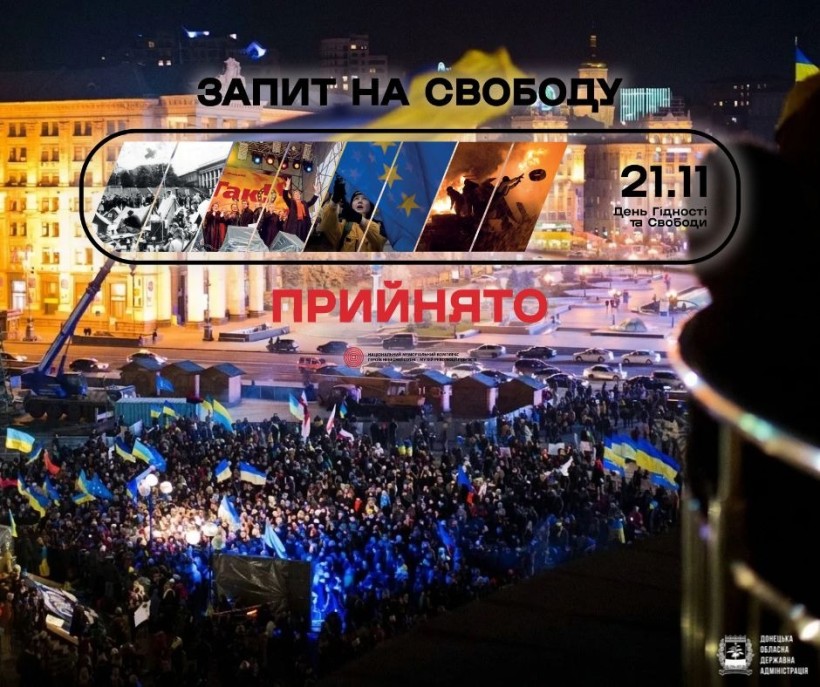
Dignity and Freedom Day is one of the most important national holidays in Ukraine’s modern history, celebrated annually on November 21 in accordance with Presidential Decree No. 872/2014 of November 13, 2014.
This date was established to promote the ideals of freedom and democracy in Ukraine, to preserve and convey to current and future generations objective information about the pivotal events of the early 21st century, as well as to properly honor the patriotism and courage of citizens who, in the fall of 2004 and from November 2013 through February 2014, stood up to defend democratic values, human rights and freedoms, the national interests of our state, and its European choice. Historically, this day unites two major events that took place on Kyiv’s Independence Square nine years apart.
The first milestone was the 2004 Orange Revolution, which erupted as a mass protest against blatant fraud during the presidential election and demonstrated Ukrainian society’s ability to peacefully defend its right to fair elections and democratic development.
The second, even more dramatic and defining event was the Revolution of Dignity of 2013–2014. It began on the evening of November 21, 2013, when the first few hundred protesters—mostly journalists, students, and civic activists—took to Kyiv’s main square, outraged by the then-government’s unexpected decision to suspend preparations for the signing of the Association Agreement between Ukraine and the European Union. What began as a peaceful Euromaidan in support of a civilizational choice transformed, following the brutal violent dispersal of students on the night of November 29–30, into a nationwide resistance movement against dictatorship, corruption, and systemic human rights violations. This struggle lasted three months amid severe winter cold, intense pressure from law enforcement agencies, and the adoption of repressive laws, and reached its tragic climax on February 18–20, 2014, when dozens of unarmed Euromaidan protesters were killed during shootings in central Kyiv; they went down in history as the Heroes of the Heavenly Hundred.
An important chapter in the Revolution of Dignity—which forever dispelled the propaganda myths about the passivity or unanimous pro-Russian sentiment of eastern Ukraine—was the Euromaidan in Donetsk. It began simultaneously with the one in Kyiv—on the evening of November 21, 2013. The square near the Taras Shevchenko monument became a focal point for patriotic Donetsk residents. As Yevhen Nasadyuk, the first protester at the Donetsk Maidan, recalls: “I felt strange there, alone with Shevchenko. At the time, I didn’t know if anyone else would show up.” However, within just a few days, the protest had gathered an active core of journalists, students, and civic activists. Kateryna Zhemchuzhnikova, a participant and organizer of the Donetsk protests, describes the region’s unique self-organization: “Our Maidan wasn’t political. Yes, political parties took part, but we agreed to fly only Ukrainian flags. So we designed and printed the Donetsk Euromaidan flag. We had our own branded symbols and ribbons.”
It was the Donetsk Euromaidan that served as a training ground for the future resistance: most of its activists were among the first to join volunteer battalions, become volunteers, or assist the Ukrainian army by providing intelligence on the occupation.
Amid Ukraine’s War for Independence, the Day of Dignity and Freedom took on existential significance, transforming from a day of remembrance into a symbol of daily armed resistance. The call for freedom has been answered. This phrase, common in the digital world, takes on new meaning, as it signifies the response to a society ready to defend its dignity, rights, and future. The fierce defense of the cities in the Donetsk region today is a direct continuation of the values for which Ukrainians fought on the Maidan, for now the state is defending its right to physical existence, freedom, and territorial integrity.