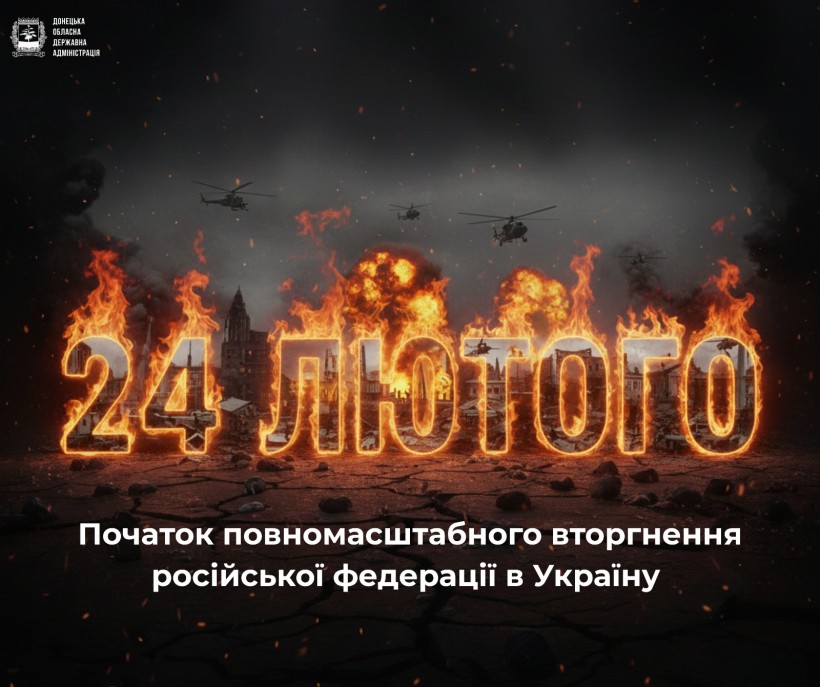
February 24, 2026, marks four years since the start of a full-scale aggressive war that the Russian Federation unleashed and is waging against Ukraine and the Ukrainian people in gross violation of international law, committing war crimes and crimes against humanity, using methods of terror and acts of genocide against Ukrainians.
In general, the war for Ukraine's independence has been going on for twelve years, since February 19-20, 2014, when the first acts of armed aggression against peaceful citizens took place in the center of the Ukrainian capital and the first recorded crossings of Ukraine's state border by Russian armed forces through the Kerch Strait on February 20, 2014.
During the eight years leading up to February 2022, Putin tried to convince the world that a "civil war" was going on in Ukraine. But Russia's full-scale armed aggression against Ukraine and its launch of the first continental war in Europe in the 21st century finally tore off the mask of Putin's aggressive regime, which since 2014 had been pretending to be a "peacemaker" and a "third party" in the war in eastern Ukraine.
On February 24, 2022, at around 4 a.m., Russian missiles attacked Ukrainian airfields and military facilities throughout Ukraine, and an open armed invasion by Russians from the territory of Belarus and the temporarily occupied Crimea began. The war for Ukraine's independence, started by Russia in 2014, entered a new acute phase.
In the first months of the war, the world was struck by the fact that residents of cities in the Kharkiv and Chernihiv regions took to the streets and squares, stopping Russian military equipment without weapons. When protests under Ukrainian flags continued for more than a month in the occupied cities of Kherson, Enerhodar, and Melitopol. When residents of Kyiv and Odesa collected bottles and filled them with Molotov cocktails. When people captured occupiers, armored vehicles, and weapons with their bare hands and handed them over to the Armed Forces of Ukraine. There are many such examples of struggle and heroism among Ukrainian civilians.
Unable to win on the battlefield, the Russian terrorist state resorts to barbaric shelling of Ukrainian cities and critical infrastructure. Most of the missile attacks were aimed at civilian targets. By destroying our energy sector, Russian terrorists seek to cause a humanitarian catastrophe and social chaos in Ukraine, destroy the economy, and deprive cities of life.
The war has tempered and united us. Today, we are united by the memory of those who have died, by our shared pain and responsibility, and by our desire to avenge all those killed and tortured by the enemy. To survive, we have only one option: victory.
After almost four and a half thousand days of war for Ukraine's independence, it has become clear that in historical and ideological discourse, this is no longer a "sprint" but a protracted "marathon." It is not a battle between two opponents with clear boundaries, but a protracted struggle that may have unpredictable developments and will undoubtedly affect the development of human civilization as a whole. It has highlighted the gap between democratic systems and authoritarian regimes, revealing the fragility of the modern international legal order.
During these truly unbreakable four years of struggle, faith, and unity, Ukraine has not only survived but has also become an agent of change in the world order. Ukraine's role in shaping the new security architecture of Europe and reforming international institutions (in particular the UN), where the old order is considered to be in crisis, has given new meaning to the term "diplomacy of the impossible."
The heroic resistance of Ukrainians is not only a struggle for the physical survival of the Ukrainian people and the freedom of the country. In this war, Ukraine is defending its European choice, its identity, and its values as part of Europe.