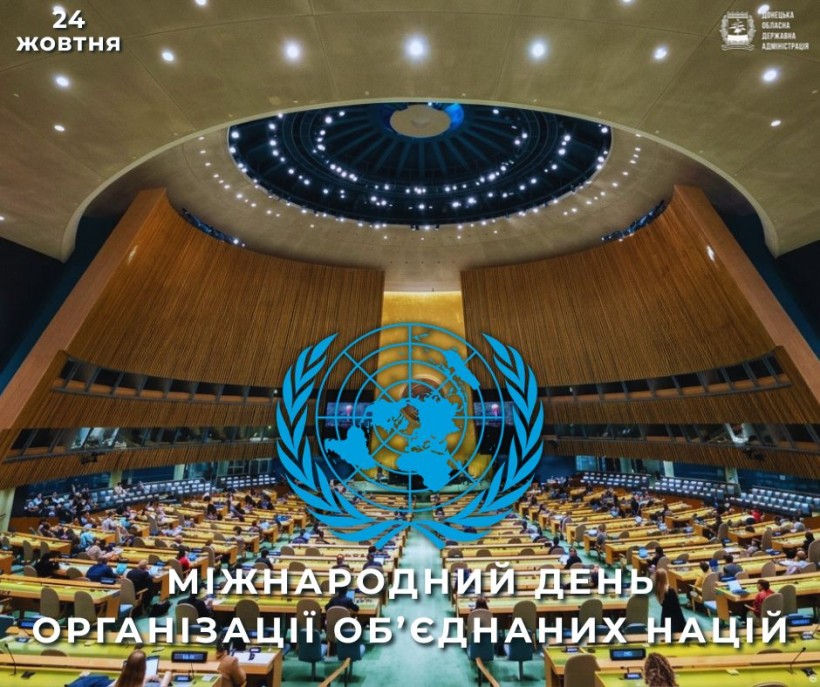
United Nations Day, celebrated annually on October 24, is a major international holiday symbolizing humanity’s aspiration for global peace, security, and cooperation. This year, the international community is marking the 81st anniversary of the founding of this global organization.
The idea for its creation arose during World War II. On June 26, 1945, in San Francisco, representatives of 50 states signed the UN Charter, but October 24, 1945, is considered the official date of the organization’s founding, when the Charter was ratified by a majority of the signatory states, including the five permanent members of the Security Council. This day has become a symbol of the international legal order.
The organization’s founding members included 51 states. Ukraine (then the Ukrainian SSR) was among the co-founding states; consequently, our country’s delegation took a direct part in drafting the text of the Charter in San Francisco.
The main goal of the UN is to maintain international peace and security and to foster friendly relations among nations based on respect for the principle of equal rights and self-determination of peoples.
The United Nations operates through its six principal organs (the General Assembly, the Security Council, the Economic and Social Council, the Secretariat, the International Court of Justice, and the Trusteeship Council) and dozens of specialized agencies (UNICEF, UNESCO, WHO, IAEA, etc.).
Throughout its history, the UN has served as a platform for dialogue and cooperation among nations in the global community, helping to address global challenges such as conflicts, poverty, hunger, climate change, and inequality. Today, more than ever, we recognize the importance of joining forces to combat these challenges. Under the auspices of the UN, a significant number of bodies and agencies operate, working in various fields to build a just, sustainable, and humane world.
In September 2015, as part of the 70th session of the UN General Assembly in New York, the UN Summit on Sustainable Development and the adoption of the Post-2015 Development Agenda took place, at which new development guidelines were adopted. The Summit’s outcome document, “Transforming Our World: The 2030 Agenda for Sustainable Development,” established 17 Sustainable Development Goals and 169 targets. Ukraine, like other UN member states, has joined the global effort to ensure sustainable development. To establish a strategic framework for Ukraine’s national development through 2030 based on the principle of “Leaving No One Behind,” an inclusive process was launched to adapt the Sustainable Development Goals. Each global goal was reviewed with due consideration for the specific context of national development.
Ukraine is actively using the UN’s highest judicial body to hold the Russian Federation accountable for violations of the conventions on genocide and the financing of terrorism. The court’s decisions are binding and legally establish Russia’s status as a violator.
The UN General Assembly has adopted a series of historic resolutions that clearly condemn Russian aggression, reaffirm Ukraine’s sovereignty and territorial integrity, and demand the immediate withdrawal of Russian troops. This establishes the legal foundation for international sanctions and future reparations.
Today, Ukraine remains committed to the principles of the UN Charter and is fighting to ensure that international law truly protects the weaker parties from the arbitrariness of aggressors.