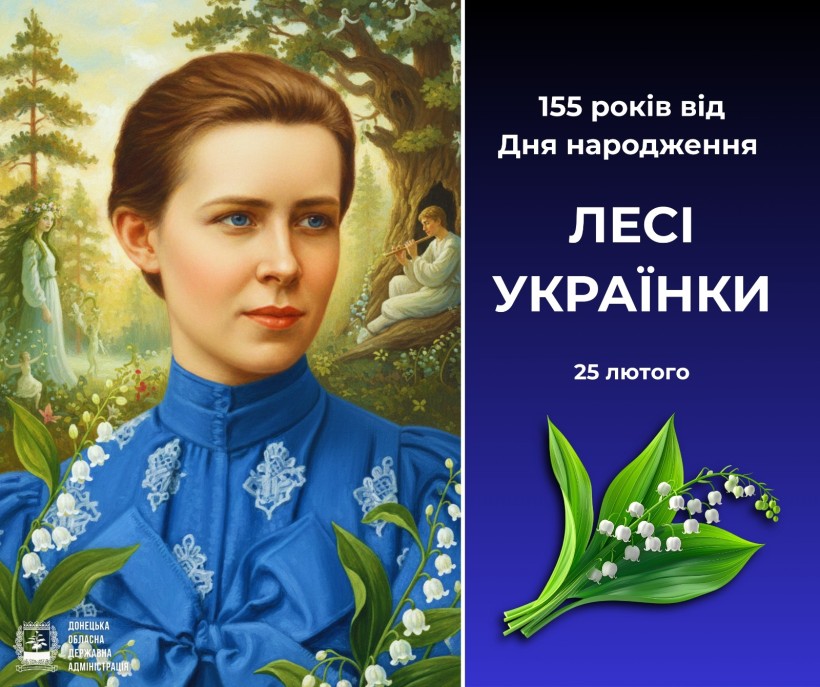
On February 25, 1871, Larisa Kosach was born in Novograd-Volynskyi, who went down in history under the pseudonym Lesya Ukrainka. She became one of the central figures of Ukrainian culture and raised it to the European level. However, the global significance of the writer's work was long underestimated, and her image was distorted.
Larisa was the second of six Kosach children. Lesya's father and mother came from noble families: Petro Kosach was from a wealthy Ukrainian Cossack noble family that had its own coat of arms and, after the liquidation of the Hetmanate, received the rights of Russian nobility, while Olena Pchilka was from the Dragomanov family, which belonged to the Cossack elite.
Lesya Ukrainka's uncle was the well-known Ukrainian scientist, founder of Ukrainian socialism, Professor Mykhailo Dragomanov, who fought against pseudo-nationalism, provincialism, and the limitations of literature. Through his work, he sparked interest in oral folk art, ethnography, and Ukrainian mythology. He signed some of his works under the pseudonym Ukrainets. It was Dragomanov who influenced Lesya Ukrainka's development as a writer.
Lesya was extremely gifted. At the age of four, she learned to read, at five — to play the piano, at nine — to write poetry, and at 12 — her works began to be published in magazines. At the same time, she fell ill with bone tuberculosis, which forced her to give up music for good.
She studied languages on her own. She translated works by Homer, Hugo, Byron, Heine, and Shakespeare. She wrote over 100 poems and 20 plays. She published three collections. Lesya Ukrainka was under the unofficial surveillance of the police, and her works were repeatedly banned by censors. The poet published most of her works abroad.
Her contemporaries criticized Lesya Ukrainka for writing many plays on early Christian and ancient themes and demanded more works on Ukrainian history. But in fact, when Lesya Ukrainka wrote about Greece conquered by Rome, she meant Ukraine, and in the drama "Babylonian Captivity" she spoke about the enslaved Ukrainian people who had to endure trials and tribulations. Lesya Ukrainka took a historical background, but spoke about her own time.
Larysa Kosach lived and worked while ignoring her incurable illness—bone tuberculosis, and later kidney disease. This caused her severe pain and forced her to spend long periods of time at resorts, delaying the inevitable. But the writer was outraged when she was considered a "sick, weak girl."
During the Soviet era, the significance of Lesya Ukrainka's work was downplayed. The image of a "sick, exhausted girl in a wreath" was firmly attached to the writer. Thus, she was marginalized as a woman and a Ukrainian.
Lesya Ukrainka, along with Olena Pchilka, Nataliya Kobrynska, Olha Kobylianska, and other writers, had a huge influence on the development of the feminist movement in Ukrainian literature. Her female characters are free in their choices, self-sufficient, proud, and independent, which was an absolute challenge at the time, especially in the Russian Empire. She was published in the women's almanac "First Wreath," founded in 1887 by Nataliya Kobrynska and Olena Pchilka. She supported emancipation and women's movements that advocated for greater opportunities for women's self-realization.
Her whole life was a struggle: with illness, with social dogmas, for the right to be Ukrainian, to have her own opinion, to live by her own mind, not to be dependent on anyone. Ivan Franko called Lesya Ukrainka "the only man in our literature."
The writer spent her last years in Egypt and various cities in Georgia, where her husband, Klyment Kvitka, was transferred for work. She died on August 1, 1913, in the Georgian village of Surami, exhausted by illness and kidney failure. She was buried in Kyiv at the Baikove Cemetery next to her father and brother Mykhailo. Six women carried Lesya Ukrainka's coffin to the cemetery.