…Everywhere and always, I have had one guiding principle—
to serve the interests of my native people…
I. Franko
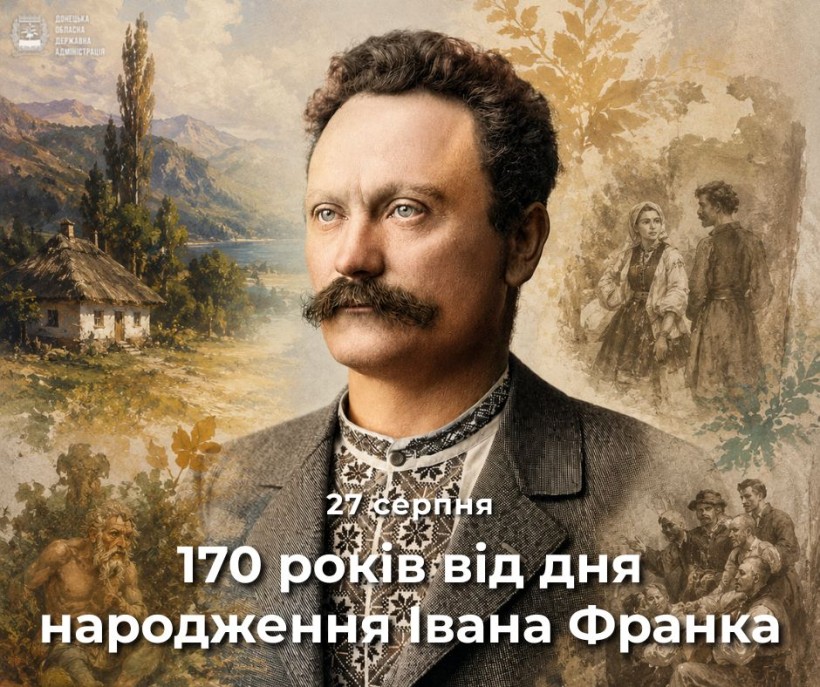
This year marks the 170th anniversary of Ivan Yakovych Franko’s birth. It is difficult to find anyone in world culture with such a boundless creative range as Ivan Franko. He was an outstanding Ukrainian writer, poet, playwright, translator, literary critic, literary scholar, public figure, journalist, folklorist, ethnographer, publicist, publisher, philosopher, linguist, economist, historian, and theorist of literature, theater, and art. Franko left us a colossal artistic and scholarly legacy—the golden fund of Ukrainian culture and spirituality.
Ivan Yakovych was the first among Ukrainian writers to earn his living by the pen. He led the first Ukrainian political party. And he was the first to combine the vyshyvanka with European attire. Franko is not only the “eternal revolutionary” and the “Ukrainian Kamenyar,” but also a figure who is stylish and relatable to modern Ukrainians.
Ivan Franko was born on August 27, 1856, in the village of Nahuyevychi, Drohobych County, into the family of a wealthy village blacksmith, Yakiv Franko. His mother, Maria Kulchynska, came from a family of impoverished nobility bearing the Sas coat of arms.
His father died in 1865, when Ivan—the eldest of the children—was 9 years old. His mother remarried Hryhorii Havrylyk—he took good care of the children, and Franko maintained a friendly relationship with him throughout his life, even after his mother died in 1872 and his stepfather married a second time.
In 1862, six-year-old Ivan began attending elementary school, where he was taught the basics of mathematics, as well as how to read and write in Ukrainian, Polish, and German.
Even as a gymnasium student, Franko demonstrated his phenomenal aptitude for science and creativity. He could repeat his teachers’ lectures to his classmates almost word for word, knew the entire *Kobzar* by heart, often completed his Polish homework assignments in poetic form, read many works by European classics, translated the Old Russian *The Tale of Igor’s Campaign*, several chapters of the Bible, and works by ancient authors—Sophocles and Euripides. He also diligently studied works on cultural studies and the philosophy of history, as well as popular books on natural science topics; he began collecting folklore and building his own library, and writing poetry, prose, and his first plays.
In the fall of 1875, Ivan Franko enrolled in the Faculty of Philosophy at Lviv University—where he studied, first and foremost, classical philology and the Ukrainian language and literature. It is known that he was an active participant in youth circles and civic organizations, where discussions took place about the problems and injustices of the social order, and this brought him to the attention of the police.
In total, Ivan Franko was imprisoned by the Austrian authorities four times due to his political and civic activities: in 1877, 1880, 1889, and 1892. After his first arrest, the “unreliable” student was expelled from the university, and the doors of some scientific and literary societies were closed to him. Franko managed to resume his studies at the university only briefly in 1878.
He completed the full higher education required for a doctorate only 15 years later, first at the University of Chernivtsi and later at the University of Vienna, where he defended his dissertation and earned a Doctor of Philosophy degree. In 1895, after a brilliant inaugural lecture at Lviv University, the faculty senate appointed him to the chair of Ukrainian and Old Russian literature. Franko was delighted that he would finally be able to throw off the “yoke of serfdom”—as he called his compulsory work for Polish newspapers to earn a living for himself and his family—and devote himself entirely to scholarly work and literary creation. However, the Galician governor, Count Kazimierz Baden, refused to approve the appointment of a man who had “been imprisoned three times.”
In 1890, Ivan Franko became a co-founder of the Rus-Ukrainian Radical Party, drafted its platform, and published the bimonthly journal *Narod* until 1895. The Radical Party nominated him three times (in 1895, 1897, and 1898) in elections to the Vienna Parliament and the Galician Sejm, but due to administrative manipulation and provocations by ideological and political opponents, he was never elected. When a crisis erupted within the Radical Party in 1899, Franko, together with representatives of the right wing of the Narodovtsy, founded the National Democratic Party. And in 1904, he withdrew from active participation in political life, focusing instead on literary and scholarly work.
In 1899, with Franko’s active participation, the “Ukrainian-Rus’ Publishing Association in Lviv” was established. The association’s “small” series published 117 books, while the “large” series published over 150 books of Ukrainian and foreign literature. From 1898 to 1901 and from 1903 to 1912, he headed the philological section and the ethnographic commission of the Taras Shevchenko Scientific Society and served as co-editor of the journal *Literary and Scientific Herald*.
Beginning in 1908, the writer’s health—already weakened by several periods of imprisonment and hard labor—deteriorated significantly; nevertheless, he continued to work—writing new works, traveling through Galicia and Bukovina, meeting with his fellow countrymen, recording folk songs, and giving lectures. In 1913, all of Ukraine celebrated the 40th anniversary of Franko’s literary career. Celebrations also took place in those parts of the world where there was an active Ukrainian diaspora.
On May 28, 1916, the life of this outstanding writer and scholar came to an end. Newspapers in many countries spread this sad news throughout the world in their obituaries. A solemn farewell attended by several thousand people was held for Ivan Franko at the Lychakiv Cemetery in Lviv.
Ivan Franko’s literary legacy represents an entire era in Ukrainian literature. His work in literary criticism contributed to the development of Ukrainian literature, while his translations introduced Ukrainian readers to the finest achievements of world culture. Today, he is considered one of the five Ukrainian writers who have been nominated for the Nobel Prize in Literature. The Swedish Academy’s archives contain Document No. 19 from 1916, in which Franko is listed as No. 4. The likelihood that Ivan Franko would win this prize was high, but the writer’s death prevented this from happening.
Ivan Yakovych’s ideas, creative work, and civic stance continue to inspire Ukrainians today, serving as a reminder of the strength of the Ukrainian spirit. Let us preserve and honor the legacy of the Great Stonemason, for it is an integral part of our history and culture.