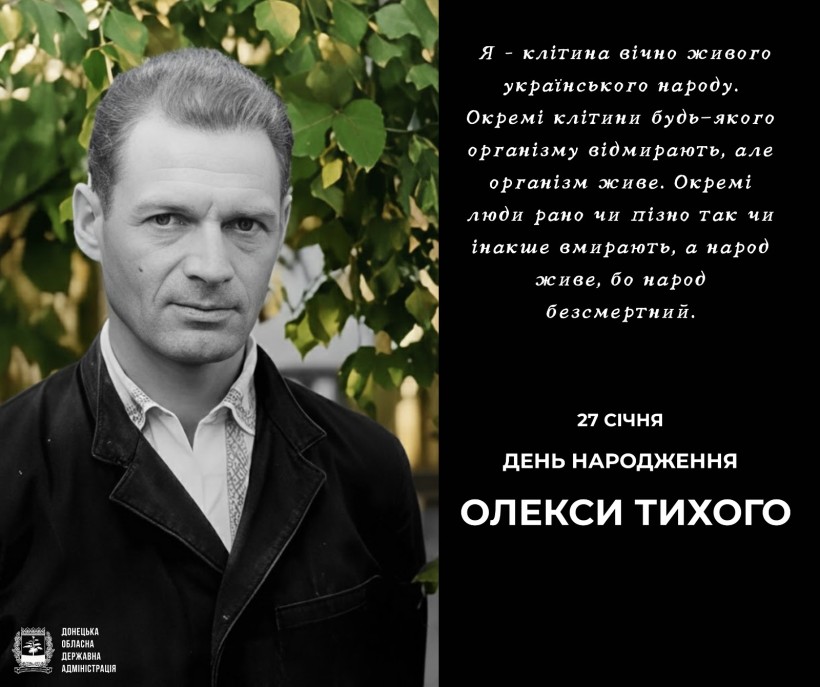
On January 27, 1927, Oleksa Tykhyi was born in the village of Yizhivka in Donetsk Oblast. He was a consistent and uncompromising fighter against the Russification of Ukraine and a founding member of the Ukrainian Public Group for the Promotion of the Helsinki Accords (UGG).
In 1943, Tykhyi graduated from the Oleksiyevo-Druzhkivka School. He studied at the Zaporizhzhia Agricultural Institute and the Dnipropetrovsk Institute of Transport Engineers. Thanks to his abilities, he was admitted to the Faculty of Philosophy at Moscow University. Even then, at the age of 21, he almost ended up in prison for criticizing the lack of choice in elections in the USSR, which had only one deputy.
He taught in schools in the Zaporizhzhia and Donetsk regions. Tykhyi consciously chose to work as a rural teacher in order to teach Ukrainian children "to do good to people, to raise their material and cultural level, to seek truth, to fight for justice, human dignity, and civic responsibility," so that "man does not live by bread alone."
Oleksa Tykhy emphasized that the state cannot impose a language of communication, how to spend leisure time, what books to read, and what interests to have. He was convinced that without meaningful education, learning about the world through the works of world classics (not only those recognized by the Soviet regime), travel, and new ideas, it is impossible to raise decent people and a decent nation, where the percentage of scientists would reach 20-50%.
During the Hungarian Revolution of 1956, more than 20,000 protesters suffered from Soviet intervention. Oleksa Tykhyi publicly criticized the crackdown on protesters and wrote in a letter that "communism is not being built in the USSR." For this, he was sentenced to 7 years in prison camps and 5 years of deprivation of civil rights. The court's verdict stated: "He slandered the Communist Party of the Soviet Union and Soviet reality. He justified the actions of Hungarian counterrevolutionaries and rebels and called for the overthrow of the state system in the USSR." He was sent to Vladimir Prison and then to Dubovlag.
After his prison term, Tykhyi was unable to find work as a teacher. He worked in libraries, took retraining courses, traveled to historical sites, and supported his friends who were prisoners. He wrote extensively about the Russification of Donetsk Oblast, the need to restore Ukrainian culture, and the return of the Ukrainian language to universities and schools.
In January 1972, Tykhy sent an article entitled "Reflections on the Ukrainian Language and Culture in Donetsk Oblast" to the editorial office of the newspaper Soviet Donetsk Oblast, and in early 1973, he sent a letter entitled "Thoughts on My Native Donetsk Region" to the Presidium of the Supreme Soviet of the Ukrainian SSR (in April, the letter was sent to the Chairman of the Presidium of the Supreme Soviet of the Ukrainian SSR, I. Hrushetsky). In 1974, he wrote an essay entitled "Rural Problems" and reflections entitled "You and Us," in which he opposed the process of Russification and defended the Ukrainian language. He also compiled a dictionary of irregularities in the Ukrainian dialects of Donbas and a collection of statements by prominent people entitled "Language is the People." The text of this collection was confiscated from Tykhyi during a search in June 1976, and he was held in custody for two days "on suspicion of robbing a store."
Oleksa Tykhyi was against discrimination based on nationality, while at the same time advocating for the protection of the Ukrainian language and culture in Donbas.
With such convictions, Oleksiy Ivanovych could not help but support Ukrainian dissidents and human rights activists who, in November 1976, proclaimed the creation of the Ukrainian Helsinki Group to promote the implementation of the Helsinki Accords. He became its co-founder along with Mykola Rudenko, Oksana Meshko, and others.
Punishment for legal human rights activities in a country "where people breathe so freely" was not long in coming. Oleksa Tykhy was sentenced to 10 years in prison on charges of "anti-Soviet agitation and propaganda." That was in 1977. As members of the UHG noted, for a 50-year-old man who had already served 10 years in camps and ruined his health, such a sentence was fatal.
In the camps, Oleksa Tykhy suffered from harsh conditions of detention, which seriously undermined his health. He underwent several operations, one of which made the digestive process unbearably painful. Despite all the difficulties, he did not renounce his beliefs. On May 6, 1984, Oleksa Tykhy died in a prison hospital, remaining faithful to his ideals until the end.
In 1989, his fellow prisoners and the public reburied Oleksa Tykhyi alongside Vasyl Stus and Yurii Lytvyn in Kyiv, honoring the memory of these outstanding fighters for freedom and human rights.
Oleksa Tykhyi remains a symbol of the struggle for the Ukrainian language, culture, and independence. His life and work inspire many Ukrainians to preserve their national identity and defend human rights.