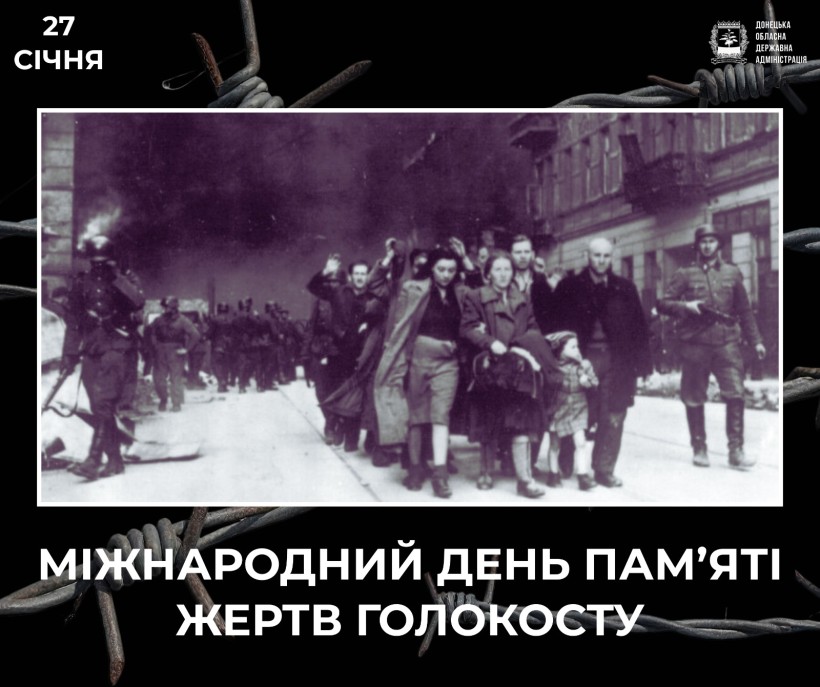
January 27 marks International Holocaust Remembrance Day. This date was established by UN General Assembly Resolution No. 60/7 of November 1, 2005, "Holocaust Remembrance." Since 2012, Ukraine, along with the rest of the world, has honored the victims of the Holocaust at the state level.
On this extremely important day, we remember and honor the millions of victims of the Holocaust perpetrated by the Nazis—children, women, and men whom the shameful mechanism of mass murder condemned to terrible suffering and injustice.
During the Holocaust, approximately six million Jews were killed, including 1.5 million children. Millions of people from persecuted groups were also killed: representatives of different cultures, religions, and social classes.
Six death camps in Auschwitz-Birkenau, Belzec, Chelmno, Majdanek, Sobibor, and Treblinka were specially equipped for mass murder. In Auschwitz alone, which has become a symbol of the Holocaust, genocide, and terror for the whole world, about one million Jews were killed. Millions more were imprisoned, abused, and murdered in a vast network of other concentration camps, where they were forced into slave labor, including sexual slavery, and medical experiments.
During the Holocaust, Ukraine lost 1.5 million Jews who were exterminated directly on its territory, in pits and ravines on the outskirts of towns and villages. One of the most famous symbols of the Holocaust in Eastern Europe is Babyn Yar. Between 1941 and 1943, the Nazis shot more than 100,000 people there, mainly Jews, but also Roma, Soviet prisoners of war, and Ukrainian nationalists. However, according to researchers' estimates, there are up to 2,000 "smaller Babyn Yars" in Ukraine — places where the Nazis killed Jews.
In the Donetsk region, about 30,000 Jews were killed between 1941 and 1942. On October 20-21, 1941, the first shooting of Jews in the region was recorded in Mariupol: 8,000 people were executed. During November and December, shootings took place in the village of Zatyshne in the Volnovakha district and in the cities of Sloviansk and Kostyantynivka; the first executions of Jews took place in Donetsk, Kramatorsk, and Makiivka. In January-February 1942, the Nazis exterminated Jews in Avdiivka, Horlivka, Hryshyne, Kramatorsk, Makiivka, Mariinka, Pokrovsk, and other settlements.
In 1942, there was a Jewish ghetto in the city of Donetsk, through which thousands of Jews passed, but their exact number remains unknown to this day. The bodies of thousands of people were thrown into the shaft of mine No. 4/4-bis. In addition to Jews, Soviet prisoners of war and civilians of other nationalities are buried in the mine.
By mid-1942, the Nazis had exterminated virtually the entire Jewish population of the region. The most massive sites of extermination of Jews in the region are:
- Mariupol – about 16,000 people were killed. The most massive shootings took place near the village of Agrobaza.
- Kramatorsk – about 7,000 residents of the city were killed. They were shot in a stone quarry (in the village of Ivanivka), a clay quarry, near Chervona Skala, and in the village of Yasnogirka.
- Kostiantynivka – about 5,000 people were killed. The most common place for shootings was Serhiivska Balka.
- Bakhmut – in the alabaster mine of the Artemivsk Champagne Factory, more than 3,000 residents of the city, most of whom were members of the Jewish community, were walled up alive in cell No. 46.
Part of the Jewish population of Donetsk Oblast survived thanks to their fellow countrymen – the Righteous Among the Nations.
The Holocaust is a tragedy that cannot be forgotten. It obliges us to remember the lessons of history so that such crimes never happen again.