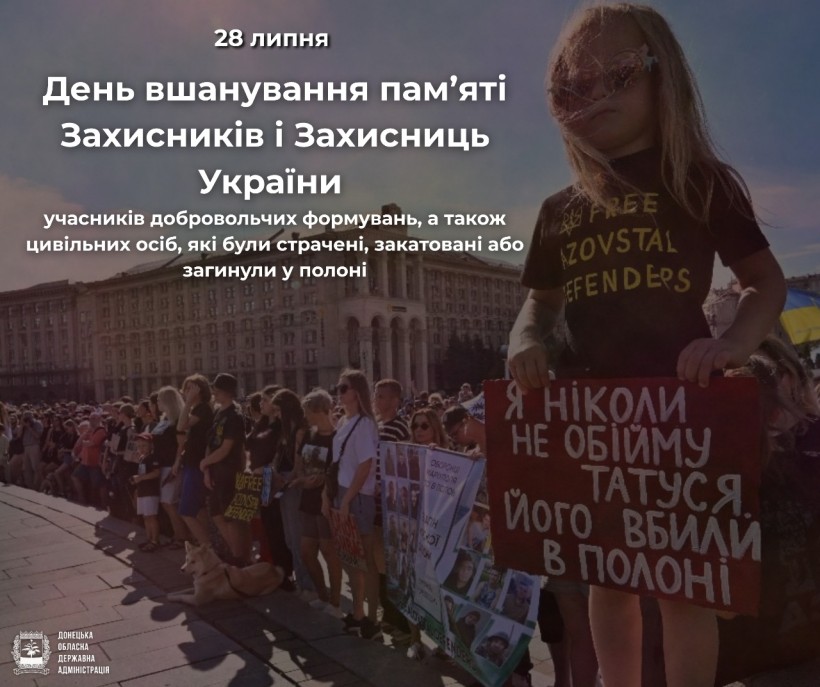
Today, for the first time at the official level, Ukrainians honor the memory of the Defenders of Ukraine, members of volunteer formations, as well as civilians who were executed, tortured, or died in captivity. The corresponding resolution was adopted by the Verkhovna Rada of Ukraine on July 22, 2025.
The commemorative day was established in support of public initiatives as a reminder of the tragic events that occurred during Russia's full-scale aggression against Ukraine.
The date was not chosen at random—it was on the night of July 28-29, 2022, that Russian troops shelled the Volnovakha correctional colony near Olenivka, where the defenders of Azovstal were being held. This is one of the most horrific terrorist acts committed by Russia against prisoners. The crime against Ukrainian defenders was a gross violation of international humanitarian law, which clearly regulates the humane treatment of prisoners of war and obliges the state holding them to ensure their safety and life.
However, since the beginning of Russia's full-scale invasion of Ukraine, not only military personnel but also civilians have become victims of Russian war crimes.
The scale and systematic nature of the aggressor's war crimes are confirmed by information from the Office of the Prosecutor General of Ukraine: as of December 2024, Ukrainian law enforcement agencies had registered more than 146,000 criminal offenses under Article 438 of the Criminal Code of Ukraine (“War Crimes”).
According to the annual report of the Ukrainian Parliament Commissioner for Human Rights on the state of observance and protection of human and civil rights and freedoms in Ukraine in 2024, as of June 2024, 186 places of detention of Ukrainian prisoners of war and 29 places where military and civilian prisoners are tortured and brutally treated were identified. Systematic torture and cruel treatment are widespread in places of detention, accompanying prisoners at all stages throughout their captivity.
According to the Office of the Prosecutor General of Ukraine, since February 24, 2022, Ukrainian law enforcement agencies have registered more than 1,720 criminal offenses involving torture or cruel treatment of Ukrainian prisoners of war and civilians. More than 3,800 civilians and
more than 2,200 prisoners of war have already been recognized as victims of torture and inhuman treatment.
Torture was mostly used to force confessions of crimes against the civilian population (shelling, looting, rape).
The most common methods included severe beatings, electric shocks, suffocation, prolonged exposure to stressful positions, excessive physical exertion, sleep deprivation, mock executions, threats of severe violence against prisoners of war or their families, and humiliation.
From February 24, 2022, to the end of October 2024, the bodies of 184 Ukrainians who died in captivity were returned to Ukraine. Among them were 169 military personnel and 15 civilians.
According to the head of the forensic medical examination department of the SME bureau, “80% of the bodies returned from detention centers, prisons, and so on show signs of torture.”
Ukraine is working tirelessly to return the captives. According to the Coordination Headquarters for the Treatment of Prisoners of War, as of May 2025, 5,757 military personnel and civilians have returned to Ukraine through exchanges and special measures. In addition, 9,744 bodies of the deceased have been returned to their homeland as part of repatriation measures.
In a report presented at the 55th session of the UN Human Rights Council in March 2024, the UN Independent International Commission of Inquiry on Ukraine confirmed with new evidence its previous findings that torture of prisoners of war and illegally detained civilians by Russian authorities in Ukraine and the Russian Federation are widespread and systematic. And in the report presented in October 2024 during the 79th session of the UN General Assembly, based on the results of its work, the Commission concluded for the first time that the torture committed by the Russian Federation on a massive and systematic scale against Ukrainian prisoners of war and illegally detained civilians is a crime against humanity under international law.
Today's memorable date is an important part of society's work to preserve historical memory and shed light on the tragic events of the past. It is not only a day of mourning, but also a symbol of the indomitability of the Ukrainian people, gratitude for their courage, and a call for justice and punishment for those guilty of crimes against humanity.
We bow our heads in mourning to honor the memory of the heroes whose bright lives were taken by enemy captivity.