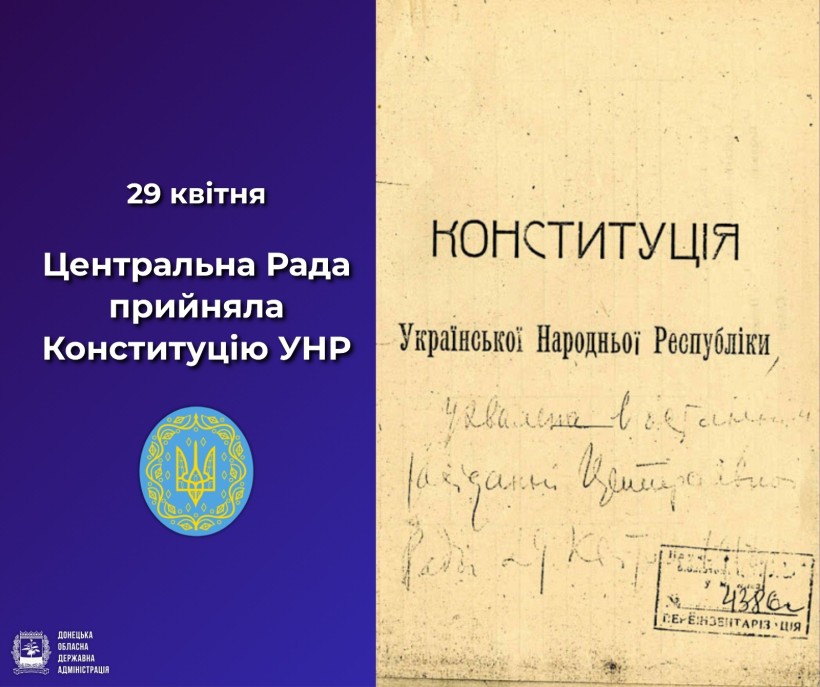
During the Ukrainian Revolution of 1917–1921, the constitutional process began immediately after the proclamation of the First Universal. A constitutional commission headed by Mykhailo Hrushevsky was established. It was planned that the Constitution would be adopted at the All-Ukrainian Constituent Assembly; however, the October Revolution of 1917 and the military aggression of Bolshevik Russia against Ukraine disrupted this process.
The “Statute on the State Structure, Rights, and Freedoms of the UPR” (this was the document’s official title) was adopted at a session of the Small Council on April 29, the last day of the Central Rada’s existence. The first draft was adopted unanimously. Minor editorial amendments were made during the article-by-article reading.
The Constitution of the UPR contained 83 articles, grouped into 8 sections. The UPR was proclaimed a sovereign state, “autonomous and independent of anyone.” The Constitution guaranteed the equality of citizens (including a provision on the equality of men and women before the law, which was progressive for that time) and contained a wide range of guarantees of individual rights. The death penalty was abolished, and corporal punishment was prohibited. Legislative power belonged to the National Assembly, executive power to the Council of People’s Ministers, and judicial power was headed by the General Court of the UNR. The foundations of decentralization were also laid: “Without violating its own unified authority, the UNR grants its lands, volosts, and communities the right to broad self-government, adhering to the principle of decentralization.”
Despite its many positive features, the Constitution of the Ukrainian People’s Republic also had a number of shortcomings. This, in particular, concerned the symbols of the UNR. This was explained by the fact that the Chairman of the Central Rada, Mykhailo Hrushevsky, did not consider this issue particularly urgent. Furthermore, the Constitution of the UPR did not define the borders of the UPR’s territory and did not contain provisions on the abolition of private land ownership, which the peasants had so eagerly anticipated and which would undoubtedly have strengthened the Central Rada’s authority and influence within the UPR. At the same time, an excessively broad scope of powers was granted to the state’s parliament—the People’s Assembly of the UPR. The broad powers granted to it in all spheres of socio-political life did not contribute to the effective formation and operation of a system of checks and balances, unlike in other democratic states of the world. They created an imbalance in the system of state power, reduced the effectiveness of its work, and increased the dependence of other branches of government on the state’s legislative body. Furthermore, enshrining in the Constitution the right of each nation to national-personal autonomy also had a negative impact on the state-legal mechanism and carried the threat of separatism from certain national minorities residing within the territory of the UNR.
Despite these shortcomings, which were due to the historical circumstances of the time as well as the realities under which the Basic Law of the Ukrainian People’s Republic was adopted, the Constitution of the UPR was of paramount importance for the further political and legal development of the Ukrainian state. The Constitution of the UPR proclaimed the Ukrainian People’s Republic a sovereign, democratic, parliamentary state with the separation of state power into legislative, executive, and judicial branches. It introduced and implemented legal regulations of principles that were entirely new to the Ukrainian legal system of the time, including: the recognition of the people as the primary source of power, the decentralization of power, the principle of equality of political and civil rights, and others.
The Constitution of the UPR established new institutions within the legal framework for the Ukrainian legal system, including the institutions of administrative-territorial division, citizenship, and parliamentary immunity, among others.
The Basic Law of the UPR enshrined democratic values and principles in a substantive, rather than merely declarative, manner. A significant portion of these were utilized during the drafting of the Constitution of the independent Ukrainian state, adopted on June 28, 1996.
Unfortunately, the dissolution of the Ukrainian Central Rada and the establishment of Hetman P. Skoropadsky’s regime resulted in the provisions of Ukraine’s first Constitution of 1918 not being implemented.