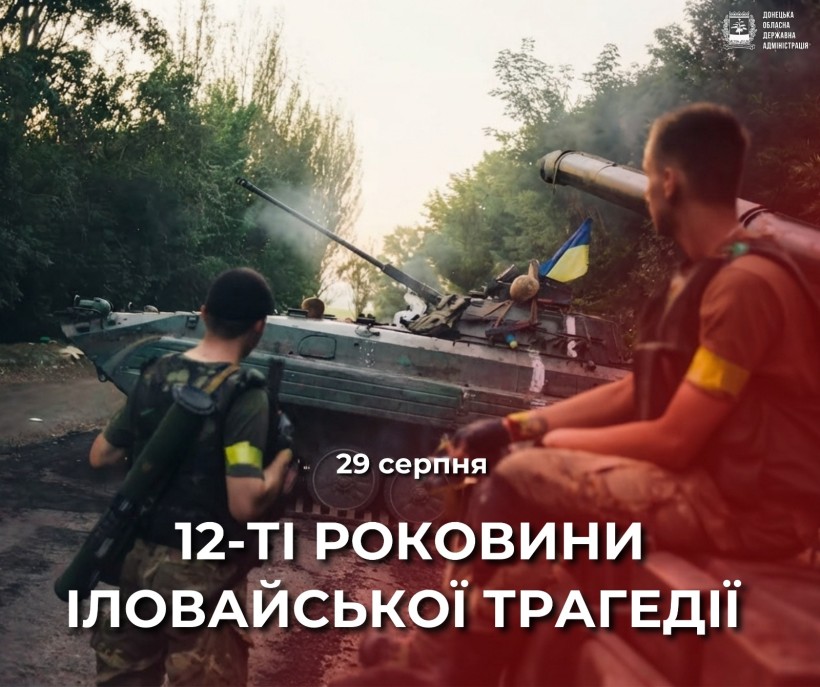
In August 2014, one of the most devastating battles for the Ukrainian army in the war in eastern Ukraine unfolded near the town of Ilovaisk.
Ilovaisk was a strategically important town in the Donetsk region. The battle for it took place concurrently with the assaults on Savur-Mohyla and the towns of Antratsyt and Khrustalnyi. The fighting lasted nearly a month, from August 6 to 29, and went down in history as the “Ilovaisk Cauldron,” becoming one of the most tragic chapters of the Russian-Ukrainian war.
On August 10, Ukrainian volunteer units made their first attempt to liberate the city, but the attack was repelled.
On August 18, during fierce fighting, Ukrainian forces—composed largely of volunteer battalions—entered Ilovaisk. They managed to take control of part of the city. However, holding their positions proved extremely difficult due to the intense mortar and artillery fire from the Russian Federation’s army using “Grad,” “Smerch,” and “Uragan” systems.
Ultimately, realizing that its plans to seize Ukrainian territory were falling apart, the Russian leadership resorted to deploying a large military force into Ukrainian territory. According to materials from the Prosecutor General’s Office of Ukraine regarding the investigation into the Ilovaisk tragedy, on the night of August 23–24, 2014, the largest-scale invasion by the Russian Armed Forces took place, involving nine battalion-tactical groups: 3,500 personnel; up to 60 tanks; up to 320 BMDs (BMPs); up to 60 artillery pieces; up to 45 mortars; and 5 anti-tank missile systems, which entered the administrative territory of Ukraine in the area of the settlements of Pobeda and Berestove in the Starobeshivsky District of Donetsk Oblast, and subsequently advanced toward the Ilovaisk area. Tactical markings were removed or camouflaged from the Russian military equipment in advance, and the equipment was marked with the identification insignia of Ukrainian units.
As early as August 24–25, the Ukrainian Ministry of Internal Affairs battalions “Dnipro-1,” “Myrotvorets,” “Svitiaz,” “Kherson,” and “Ivano-Frankivsk,” the National Guard’s “Donbas” battalion, and forces from Sector “B” found themselves surrounded by the enemy. The Ukrainian command had planned to relieve them using ATO reserve forces. However, the units assigned to this task were composed primarily of recently mobilized soldiers who lacked proper training. By August 28, the situation for our troops had become critical.
Negotiations took place between the ATO leadership and the General Staff of the Russian Armed Forces regarding guarantees for safe humanitarian corridors to allow Ukrainian troops to exit the encirclement via agreed-upon routes.
On August 29 at 8:15 a.m., Ukrainian troops began moving out of the city in organized columns along routes previously agreed upon with the Russian side. At first, the Ukrainian columns moved unhindered past Russian fortified positions, but after a short while, the occupiers opened fire, shooting at the columns as they marched.
According to data from the National Military History Museum and the Office of the Prosecutor General of Ukraine, 366 Ukrainian soldiers were killed during the entire Ilovaisk operation from August 6 to August 31, with more than 250 killed while exiting the corridor on August 29, 2014. More than 400 soldiers were wounded, and about 300 were taken prisoner. The Ukrainian defenders were then executed along with captured Russian servicemen, who were also marching in a column and were supposed to serve as a guarantee that the Russians would adhere to the terms of the “corridor.”
Among those killed in the battles for Ilovaisk and during the breakout from the encirclement were natives of the Donetsk region: volunteers from the Ukrainian National Guard’s “Donbas” Battalion—Vasyl Bilyi, Serhiy Dyatlov, Vladyslav Stryukov, Yaroslav Tenditnyk, Dmytro Timoshenkov, and Artur Cholokyan; Vladimir Brazhnik, a soldier of the 42nd Territorial Defense Battalion “Resistance Movement”; Dmitry Golitsyn, a fighter of the “Shakhtarsk” volunteer battalion; volunteers of the “Dnipro-1” police battalion Vyacheslav Makarenko and Yuriy Matushchak, a fighter from the 93rd Separate Mechanized Brigade, Serhiy Neshcheret, and a soldier from the 92nd Separate Mechanized Brigade, Serhiy Chornyi.
Until February 2022, the Ilovaisk tragedy remained the largest single-day loss suffered by the Armed Forces of Ukraine in the history of independent Ukraine and had a significant impact on the situation in the Anti-Terrorist Operation. Shortly after those events, in early September 2014, the Minsk Protocol was signed, followed by the Minsk Agreements, which Russia manipulated and used to pressure Ukraine right up until the start of the full-scale invasion in February 2022.
Despite everything, Ilovaisk is not only a tragedy but also a chapter in Ukraine’s resilience; it is a testament to the courage and heroism of the Ukrainian military. Let us remember that despite the losses and the enemy’s deceit, our soldiers did not give up but continued to break out of the trap and fight on.
The war continues… August 29—in honor of the valor of the Ukrainian soldiers who fell at Ilovaisk—has been designated as the Day of Remembrance for the Defenders of Ukraine who died fighting for the independence, sovereignty, and territorial integrity of our state.