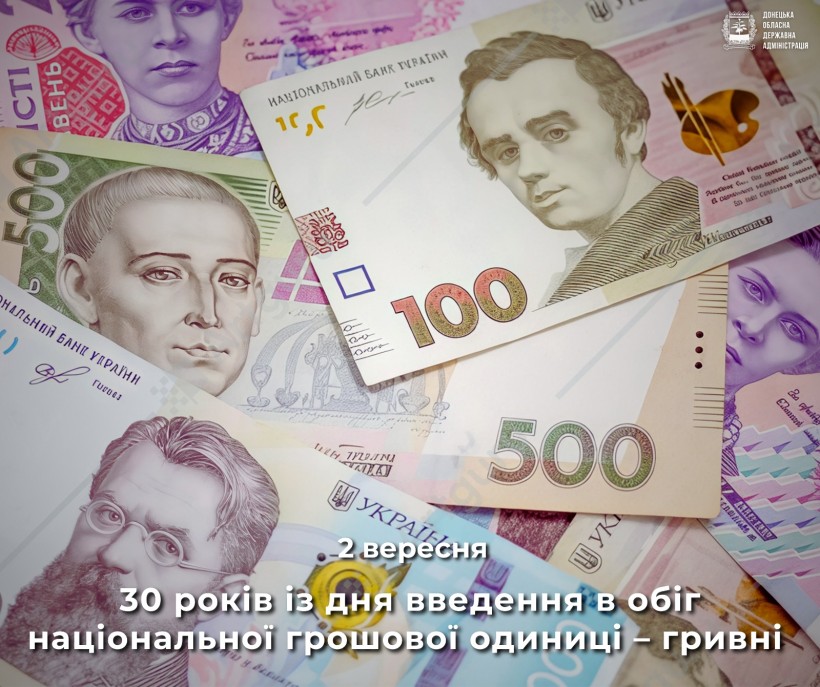
September 2, 2026, marks the 30th anniversary of the introduction of Ukraine’s national currency—the hryvnia. Its introduction was one of the key milestones in the development of an independent Ukrainian state and the establishment of its own financial system.
Ukraine’s aspiration to have its own currency was established early in the process of state restoration. On December 10, 1991, the Presidium of the Verkhovna Rada of Ukraine designated the hryvnia as Ukraine’s currency unit and the kopiyka as one-hundredth of a hryvnia. At the same time, following the declaration of independence, the country needed a transitional mechanism to ensure the functioning of the monetary system. Starting in January 1992, the National Bank of Ukraine began putting Ukrainian reusable coupons into circulation, which later became the basis for the Ukrainian karbovanets. As of November 12, 1992, the Ukrainian karbovanets became the sole means of payment in both cash and non-cash transactions in Ukraine.
Prior to the introduction of the hryvnia, the Ukrainian economy went through a difficult period of hyperinflation and rapid currency devaluation. In 1995 and the first half of 1996, the situation gradually stabilized: inflation rates declined, the exchange rate of the Ukrainian karbovanets stabilized, and the conditions for monetary reform were established.
On August 25, 1996, the President of Ukraine issued Decree No. 762/96 “On Monetary Reform in Ukraine.” The document provided for the introduction, effective September 2, of a new national currency—the hryvnia—and its hundredth part—the kopeck—as well as the cessation of the issuance of Ukrainian karbovanets and their exchange for hryvnias.
The first series of hryvnia banknotes consisted of denominations of 1, 2, 5, 10, 20, 50, and 100 hryvnias. At the same time, coins in denominations of 1, 2, 5, 10, 25, and 50 kopecks were introduced. The designs for the first Ukrainian banknotes were created by artists Vasyl Lopata and Boris Maksimov. Due to the lack of the necessary production facilities in Ukraine at the time, the first banknotes were manufactured abroad—specifically in Canada and the United Kingdom—while some of the coins were minted in Italy and at the Luhansk Machine-Tool Plant.
At the same time, Ukraine was developing its own infrastructure for the production of banknotes. In March 1994, the first phase of the Banknote Factory was put into operation; in 1997, the Banknote Paper Factory began operations; and in 1998, the Mint was established. Subsequently, the production of Ukrainian currency was centralized at the National Bank of Ukraine’s own Banknote and Mint Facility.
Over the course of three decades, the National Bank of Ukraine has repeatedly updated the design of banknotes and strengthened their protection against counterfeiting. In 2019, a 1,000-hryvnia banknote featuring a portrait of the distinguished Ukrainian scientist Volodymyr Vernadsky was introduced into circulation. At the same time, economic development and changing needs in cash circulation led to a further expansion of the denomination range.
Thus, on September 4, 2026, the National Bank of Ukraine will introduce a new 2,000-hryvnia banknote into circulation. It will become the highest denomination of the national currency. The new banknote holds special significance not only from an economic perspective but also from a historical and cultural one. The front side features a portrait of Vasyl Stus—a Ukrainian poet, translator, publicist, human rights activist, political prisoner, one of the most active representatives of the Ukrainian dissident movement, and a fighter for Ukraine’s independence in the 20th century. The reverse side depicts the building of the Faculty of Philology at Donetsk National University, where the poet studied. The introduction of a banknote featuring Vasyl Stus and Donetsk National University serves as a powerful reminder that the Donetsk region is an integral part of Ukraine’s historical and cultural landscape.
The date of the new banknote’s introduction is also symbolic. It was on September 4, 1965, during the premiere of the film *Shadows of Forgotten Ancestors* at the “Ukraine” movie theater in Kyiv, that Vasyl Stus, together with Vyacheslav Chornovil and Ivan Dziuba, openly spoke out against the political repression of the Ukrainian intelligentsia. And on September 4, 1985, the poet died in captivity at a maximum-security camp. Thus, the date of the banknote’s introduction links the economic development of modern Ukraine with the memory of the struggle for freedom and human dignity.
The introduction of the hryvnia in 1996 was not merely a technical monetary reform. The national currency became one of the hallmarks of Ukrainian statehood and a tool for conducting an independent monetary policy. Over the past thirty years, the hryvnia has changed its design, denominations, and security features, but it has retained its primary purpose—to serve as the currency of an independent Ukraine.
The 30th anniversary of the hryvnia is an opportunity to see beyond the ordinary means of payment and recognize a much broader process: Ukraine’s journey from the transitional karbovanets to a fully-fledged national currency capable of evolving alongside the state and reflecting its history. Over the course of three decades, the hryvnia has become one of the visible symbols of Ukrainian statehood, economic independence, and the continuity of independent Ukraine.