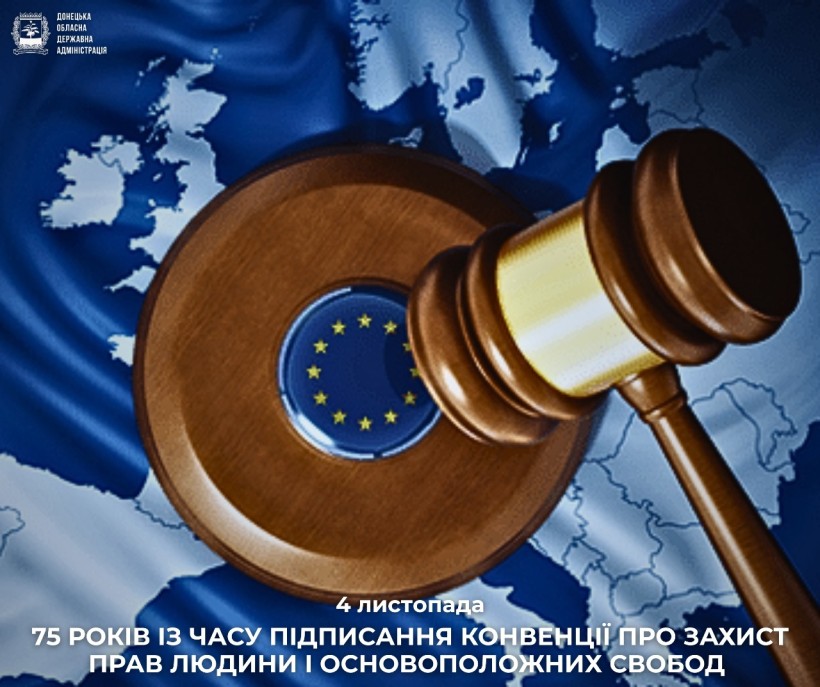
November 4, 2025 marks the 75th anniversary of the signing of the Convention for the Protection of Human Rights and Fundamental Freedoms, better known as the European Convention on Human Rights (ECHR). It was adopted in accordance with the Universal Declaration of Human Rights and signed in Rome on November 4, 1950, by 12 member states of the Council of Europe and entered into force on September 3, 1953.
The Convention was the first treaty-based legal instrument to specify and make legally binding certain rights proclaimed in the Universal Declaration of Human Rights. It was also the first treaty to establish, in 1959, the supranational jurisdiction of the European Court of Human Rights to ensure compliance with the obligations of the signatory countries.
This international document guarantees a wide range of rights, such as the right to life, liberty, and security of person, the right to a fair trial, freedom of expression, the right to privacy, and protection from torture and inhuman treatment. These rights form the basis for the protection of citizens, particularly in situations of armed conflict, when there is an increased risk of their violation.
Unfortunately, today we must acknowledge that for many years the Russian Federation has been causing unprecedented damage to the principle of respect for all human rights and fundamental freedoms, particularly in the territories of Ukraine, Georgia, and the Republic of Moldova that it has temporarily occupied.
Through its actions in Ukraine, the aggressor state demonstrates blatant disregard for the principles enshrined in the Universal Declaration of Human Rights. In the temporarily occupied territories of the Autonomous Republic of Crimea, the city of Sevastopol, and parts of the Donetsk, Zaporizhzhia, Luhansk, and Kherson regions of Ukraine, the enemy is committing crimes and violations of international humanitarian law that have no place in the 21st century: illegal deportation and forced displacement of the Ukrainian civilian population, including children, sexual violence, torture and inhuman treatment of civilians and prisoners of war, filtration camps, complete lawlessness and absence of justice.
Today, the individual rights of all Ukrainians are under constant Russian threat. Daily terrorist attacks on Ukrainian cities deprive peaceful Ukrainians of their most precious right—the right to life.
Against the backdrop of Russian aggression, the only way to restore the rights of our citizens and achieve comprehensive, just, and sustainable peace in Ukraine is to compel the aggressor state to comply with international law.
After all, it is universally recognized that respect for and observance of human rights is a necessary prerequisite for peace and security.