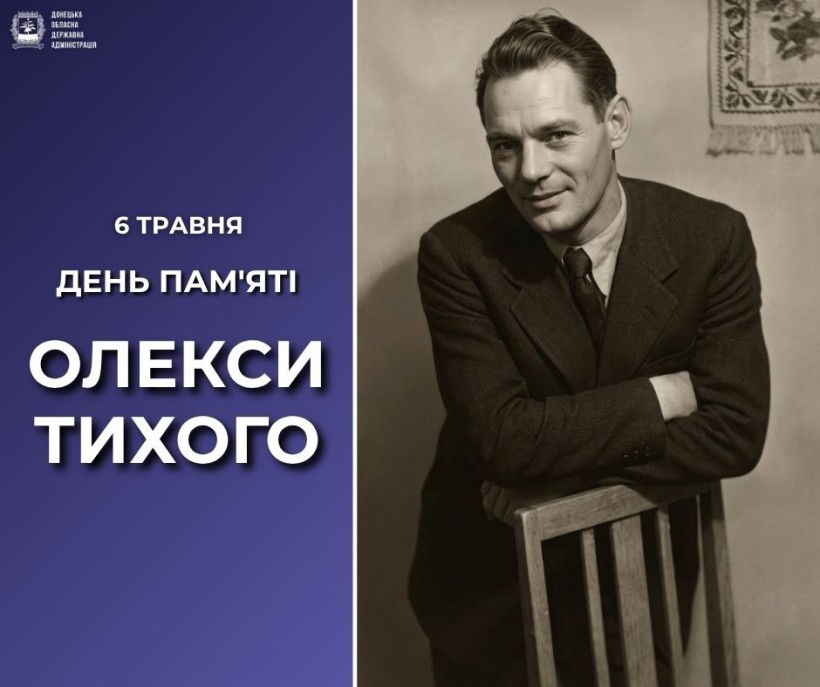
Every year on May 6, we honor the memory of Oleksa Tykhyi, an outstanding Ukrainian dissident, human rights activist, educator, philosopher, linguist, and one of the founders of the Ukrainian Helsinki Group.
He was born on January 27, 1927, in the village of Izhivka in the Donetsk region. After graduating from the philosophy department of the university, Tykhyi taught in schools in Zaporizhzhia and the Donetsk region. He was imprisoned on multiple occasions for critical remarks about the Soviet regime, for protests against the Soviet occupation of Hungary, and for opposing the then-ongoing “creeping” Russification of Ukraine’s eastern regions.
In 1948, Tykhyi was arrested for the first time—for criticizing the sole candidate for parliament. Fortunately, the case did not result in a prison sentence; the punishment was limited to a “re-educational” conversation. But Oleksa Tykhyi could not remain silent, seeing all the injustice of the education system of the time, which imposed a covert but widespread Russification.
In 1964, Tykhyi wrote several articles about the Russification of the Donbas, the deplorable state of the Ukrainian language and culture in the region, and the dire situation in Ukrainian villages, where he proposed granting more freedoms to the common people.
On February 5, 1977, he was arrested once again on charges of “anti-Soviet agitation and propaganda” and “illegal possession of weapons”: someone had sealed an old German rifle with clay in the attic of a barn during the war.
The trial of Oleksa Tykhyi and Mykola Rudenko, held in the summer of 1977 in Druzhkivka, sentenced Tykhyi to 10 years in a maximum-security labor camp and 5 years of exile. Designated a “particularly dangerous repeat offender,” he was transported to a maximum-security labor camp in Mordovia.
However, even in captivity, Tykhyi actively participated in prisoners’ protests.
Although his time in captivity did not break his spirit, it ultimately ruined Oleksa Tykhyi’s health. He underwent surgery for a duodenal ulcer and endured excruciating pain, but, according to the recollections of his fellow political prisoners, he would greet his interlocutors with a friendly yet painfully forced smile.
In the Perm camp, he was diagnosed with stomach cancer that had metastasized. They offered him painkillers in exchange for repentance. Oleksa Tykhyi told his friends: “I know I will die, but someone has to be the first.”
On May 6, 1984, 57-year-old Oleksa Tykhyi died in a cell at the prison hospital in Perm.
Oleksa Tykhyi was buried at the Severnoe Cemetery in Perm in the presence of his son Volodymyr. His son wanted to take his father back to his homeland, but he was told: “If you insist, the results of the bacteriological analysis may show hepatitis, and then you will never be able to take him.”
On November 19, 1989, Tykhyi’s remains, along with those of Vasyl Stus and Yuriy Lytvyn, were transported to Kyiv and reburied with full honors at the Baikove Cemetery.
Now, as the entire Ukrainian people, from west to east, courageously defend their homeland against Russian invaders amid a full-scale armed invasion by the Russian Federation, Oleksa Tykhyi’s ideas have taken on special meaning and power. In today’s circumstances, Donetsk Oblast needs true heroes whose example is worthy of emulation. Oleksa Tykhyi is precisely such a true hero.