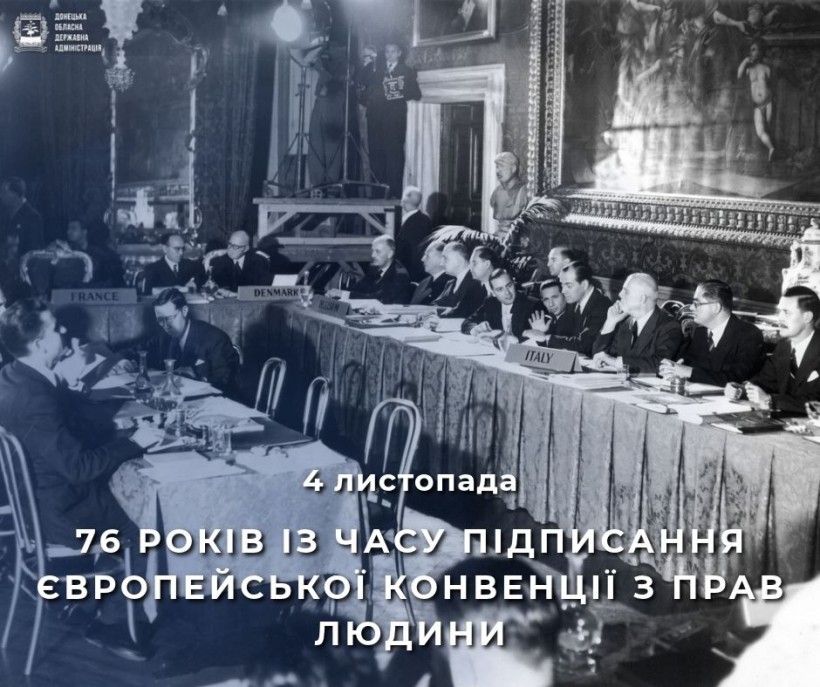
On November 4, 1950, the Convention for the Protection of Human Rights and Fundamental Freedoms was signed in Rome, becoming a fundamental cornerstone for building a new, democratic, and humane Europe. This historic document, known worldwide as the European Convention on Human Rights, emerged from the ruins of World War II as a collective response by the peoples of Europe to the horrors of totalitarianism and the mass disregard for human dignity.
The Convention’s primary uniqueness and revolutionary nature lay in the fact that it did not merely proclaim abstract ideals of humanism but transformed them into clear, legally binding norms of international law. Moreover, the document established an unprecedented institutional mechanism for protection—the European Court of Human Rights in Strasbourg—which gave citizens of the member states a unique opportunity to sue their own governments in the event of a violation of their fundamental freedoms. Throughout its existence, the Convention has served—and continues to serve—as the primary legal shield ensuring the rule of law on the continent.
The catalog of rights enshrined in the Convention and its Protocols encompasses vital freedoms without which the existence of a free individual and a healthy society is impossible. These include the absolute and inviolable right to life, the complete prohibition of torture, slavery, or inhuman treatment, the right to liberty and personal integrity, as well as the right to a fair trial, which is the foundation of any state governed by the rule of law.
The Convention also protects freedom of thought, conscience, religion, and expression, as well as the right to peaceful assembly, while guaranteeing respect for private and family life and prohibiting all forms of discrimination. Over time, this list has expanded through additional protocols that enshrined the right to peaceful enjoyment of property, the right to education, free elections, and the abolition of the death penalty. All these provisions have formed a unified European legal space where state sovereignty can no longer serve as a justification for human rights violations within a country.
For Ukraine, the Convention holds special, fateful significance, as its ratification in July 1997 became a symbol of our country’s definitive civilizational choice and its return to the European family of nations. Since this document entered into force for Ukraine in September 1997, a large-scale transformation of the entire national legal system has been underway, as the Convention’s provisions and the case law of the Strasbourg Court have become an official source of law in the country. This compelled Ukrainian lawmakers and judges to completely rethink their approaches to justice, guided by high European standards.
The application of the Convention took on particular significance in the context of Ukraine’s War of Independence. On July 9, 2025, the European Court of Human Rights issued its judgment in the case of Ukraine and the Netherlands v. Russia. This event marked a historic milestone in the legal sphere for assessing the consequences of the armed conflict on Ukrainian territory. The entire proceedings lasted 11 years, during which other complaints filed by our state were added to the initial application regarding systemic violations in eastern Ukraine since 2014, including those concerning events following the Russian Federation’s full-scale invasion of Ukrainian territory in 2022. It also included a submission by the Netherlands regarding the crash of Flight MH17 in July 2014 in the Donetsk region.
The ECHR emphasized that the Russian Federation’s actions in the occupied territories constitute a systematic policy that grossly violates fundamental human rights and the principles of the international legal order. The Court held the Russian Federation responsible for systematic violations of the articles of the European Convention and Protocol No. 1, including the right to life, liberty, protection against torture, freedom of expression, education, and protection of property.
This legal recognition is of immense significance, as it holds the aggressor state fully responsible for systematic violations of the Convention in these territories, providing the residents of Donetsk Oblast and all of Ukrainian society with a legal tool to restore justice and hold the perpetrators accountable.
Today, the European Court of Human Rights continues to hear thousands of individual and inter-state complaints regarding mass crimes committed by Russia on Ukrainian territory. Despite Russia’s withdrawal from the Council of Europe, the Court retains full jurisdiction over crimes and violations committed by the aggressor state up until the termination of its membership in the Convention.
Seventy-six years after its signing, the European Convention remains for Ukraine not merely a collection of legal rules, but a living, dynamic instrument and a moral compass that helps us fight every day for a future where human dignity and freedom are the state’s highest priorities.