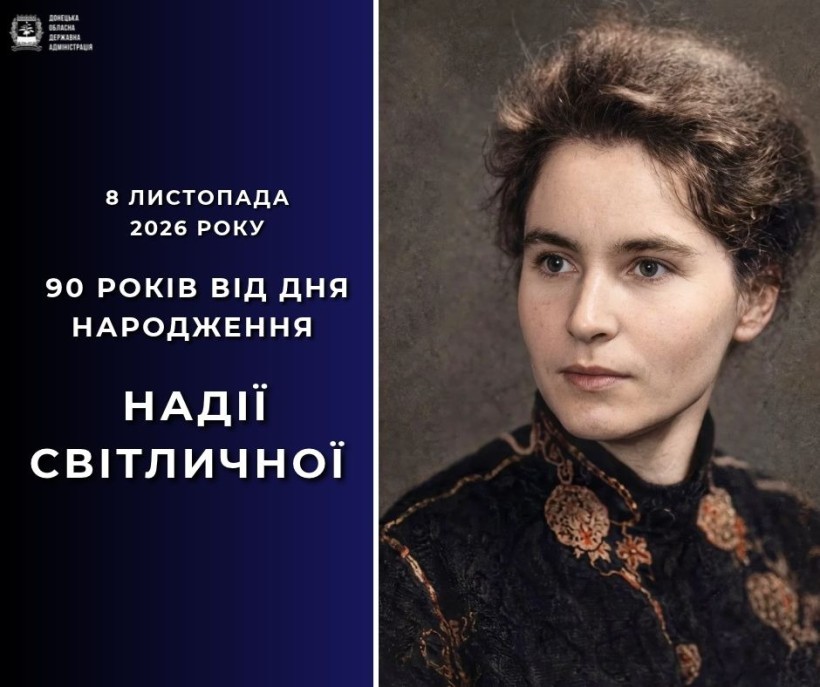
November 8 marks the 90th anniversary of the birth of Nadiya Svitlychna—an outstanding Ukrainian human rights activist, dissident, member of the "Sixties" movement, publicist, and journalist, and a member of the Overseas Representative Office of the Ukrainian Helsinki Group.
Nadiya Oleksiyivna Svitlychna was born on November 8, 1936, in the village of Polovinkine in the Luhansk region. In a rural family with three children (her brother Ivan and sister Maria), Nadiya was the youngest. She received her secondary education at Starobilsk Secondary School No. 1 (the only Ukrainian-language school among the six schools in the district center).
Immediately after graduating from high school, from 1953 to 1958, she studied at the Faculty of Philology of Kharkiv University, Department of Ukrainian Language and Literature (now V. Karazin Kharkiv National University). After graduation, she was assigned to work in Antratsyt, first as a teacher, then—six months later—as the deputy principal, and eventually as the principal.
In 1964, Nadiya Svitlychna moved to Kyiv to live with her brother Ivan Svitlychny, where she met Ivan Drach, Alla Horska, Mykola Vingranovsky, Iryna Zhylenko, Vasyl Symonenko, Nadiya Surovtseva, Vasyl Stus, and other representatives of the progressive intelligentsia.
At that time, Nadiya Svitlychna worked in the publishing department of an agricultural technical school (Boyarka), at the “Soviet School” publishing house, for the magazines “Light Industry” and “Woodworking Industry,” as a research associate at the Institute of Pedagogy, and as a teacher at an evening school in Darnytsia (Kyiv). She sang in the “Zhayvoronok” choir and later in the “Homin” choir.
In January 1972, following the second arrest of her brother and his fellow activists—Danylo Shumuk, Vasyl Stus, Yevhen Sverstiuk, Vyacheslav Chornovil, and others—36-year-old Nadiya Svitlychna came under the surveillance of the KGB.
From May 18 until the end of 1972, she was imprisoned in a KGB detention center, and her two-year-old son, Yarema, was sent to an orphanage (Vorzel). Thanks to her brother’s wife, Leonida Svitlychna, the child was sent to live with his grandmother in the Luhansk region, but custody was granted to Nadiya’s sister, Maria.
In December of that same year, she was admitted to the Pavlivsky Psychiatric Hospital (Kyiv). On March 24, 1973, she was sentenced to four years in a strict-regime penal colony for anti-Soviet agitation and propaganda. She served her sentence in Mordovia, where she was joined by artist Stefa Shabatura, microbiologist Nina Strokata (Karavanska), poet Iryna Kalynets, and other Ukrainian women’s rights activists.
Nadiya Svitlychna was released on May 18, 1976. After her release, she lived with her son at the home of her brother’s wife, Leonida Svitlychna. For a long time, she was unable to find work. In the fall of 1976, Nadiya Svitlychna decided to renounce her citizenship and filed a petition to leave the country.
In the fall of 1978, she received permission to emigrate. In November of that year, she arrived in the United States. She worked as a translator at Harvard University. While in exile, she joined the Ukrainian Helsinki Group’s representative office. She worked at the Ukrainian Museum in New York and edited the women’s magazine *Vira*. Until 1985, she regularly published *Bulletin of Repressions in Ukraine* with funding from the Ukrainian diaspora.
From 1983 to 1994, she worked in the Ukrainian editorial office of Radio Liberty in New York. In 1990, Nadiya Oleksiivna arrived in Ukraine and supported the student hunger strike during the Revolution on Granite. She helped establish the Museum of the Sixties in Kyiv.
In 1994, Nadiya Svitlychna was awarded the Taras Shevchenko National Prize of Ukraine for her active work as a journalist and publicist. In 2005, she was awarded the Order of Princess Olga, Third Class. Posthumously, in November 2006, she was awarded the Order “For Courage,” First Class.
Nadiya Svitlychna died on August 8, 2006. In accordance with her will, she was buried in Kyiv.