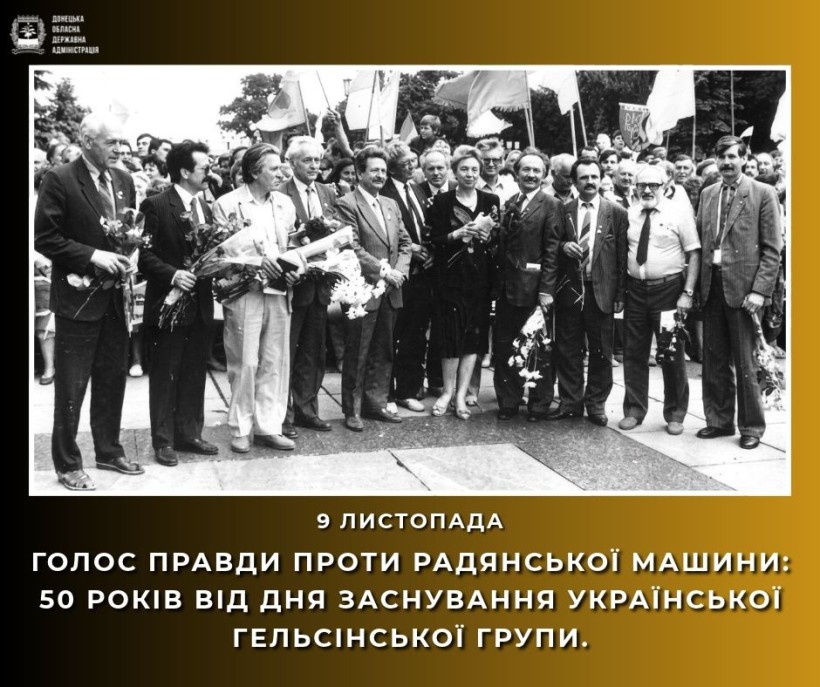
November 9 marks the 50th anniversary of the founding of the Ukrainian Helsinki Group (UHG)—the first legal human rights organization in Soviet Ukraine to openly challenge the Kremlin’s totalitarian system. The establishment of the UHG in 1976 marked a turning point in the history of the Ukrainian national liberation movement, as dissidents transformed the underground struggle for independence into legal human rights activism grounded in international law.
On November 9, 1976, Ukrainian writer and philosopher Mykola Rudenko announced the creation of the Ukrainian Public Group for the Promotion of the Implementation of the Helsinki Accords, and the founding members included 10 courageous activists, among them Mykola Rudenko as leader, Oles Berdnyk, Petro Hryhorenko, Ivan Kandyba, Levko Lukyanenko, Oksana Meshko, Myroslav Marynovych, Mykola Matusevych, Nina Strokata-Karavanska, and Oleksa Tykhyi. The group’s main goal was to familiarize the Ukrainian public with the UN Universal Declaration of Human Rights and to monitor the Soviet Union’s compliance with the humanitarian provisions of the Helsinki Accords. Group members collected evidence of human rights violations in the Ukrainian SSR: instances of political repression, religious persecution, Russification, and unlawful imprisonment. These documents and memoranda were secretly transmitted abroad to foreign governments and the Western press, piercing the Iron Curtain with the truth about Soviet camps.
The KGB’s reaction was immediate and brutal: on the very day the group was founded, Rudenko’s home was pelted with stones, injuring Oksana Meshko, and later, mass crackdowns against UHG members began.
Soviet courts handed down maximum prison terms under articles on “anti-Soviet agitation and propaganda,” sentencing Mykola Rudenko and Oleksa Tykhyi to 12 and 15 years in camps and exile, respectively. In total, 41 members of the UHG endured imprisonment, exile, and forced punitive psychiatric treatment, and such prominent members of the group as Vasyl Stus, Oleksa Tykhyi, Yurii Lytvyn, and Valerii Marchenko perished in the camps. Despite the arrests of its leaders, the organization did not cease to exist, as new human rights activists stepped in to replace those who had been convicted.
The efforts of the dissidents of the past were not in vain, and in 1988 they resumed their activities, transforming the group into the Ukrainian Helsinki Union (UHU) under the leadership of Levko Lukyanenko, which became the foundation for achieving independence in 1991.
Today, the Ukrainian Helsinki Human Rights Union (UHHRU) carries on these traditions, waging a legal battle on the international stage to demonstrate that the struggle for freedom and human dignity—which began half a century ago—continues, and that the Ukrainian people are once again showing the same resilience in the face of a totalitarian enemy.
Drawing a parallel with the present day, it becomes clear that the nature of the Kremlin regime has not changed at all in half a century, as Russia continues to use the same methods of repression and terror today. Just as in 1976, when dissidents documented the USSR’s crimes against its own people, today Ukrainian human rights defenders are documenting mass human rights violations, political show trials against Ukrainians in the occupied territories, and the Russian army’s bloody war crimes. Back then, the USSR tried to stifle Ukrainian identity through Russification and the Gulag, and now modern Russia seeks to destroy Ukraine, once again setting itself against the entire civilized world and international law.