Many communities across the country already have specialists who provide support to war veterans.
They help demobilized defenders understand the legal nuances of their new status and receive the support provided by law in terms of employment, housing, legal, and medical assistance.
The main task of support specialists is to become a reliable guide for veterans on their way back to civilian life.
Today, more than 1,300 such specialists are already working in various regions. This is the first large-scale initiative in Ukraine aimed at addressing the individual needs of veterans.
We share how a support specialist can become the second pillar of support for a demobilized defender after their family, based on the experience of 19-year-old war veteran Maksym Nikolaychuk and his support specialist Yulia Ilyash from the Kyiv region.
At 18, he volunteered to go to the front: "I want to defend my country now."
Since childhood, Maksym dreamed of becoming a soldier. In September 2023, he turned 18, and in February 2024, the young man from the village of Bzov in the Kyiv region was already in combat positions in the Luhansk region: he signed a contract for military service in the Armed Forces of Ukraine and chose the 3rd assault unit. His family was against it, but the young man stood his ground: "I want to defend my country now, not wait for mobilization at the age of 25."
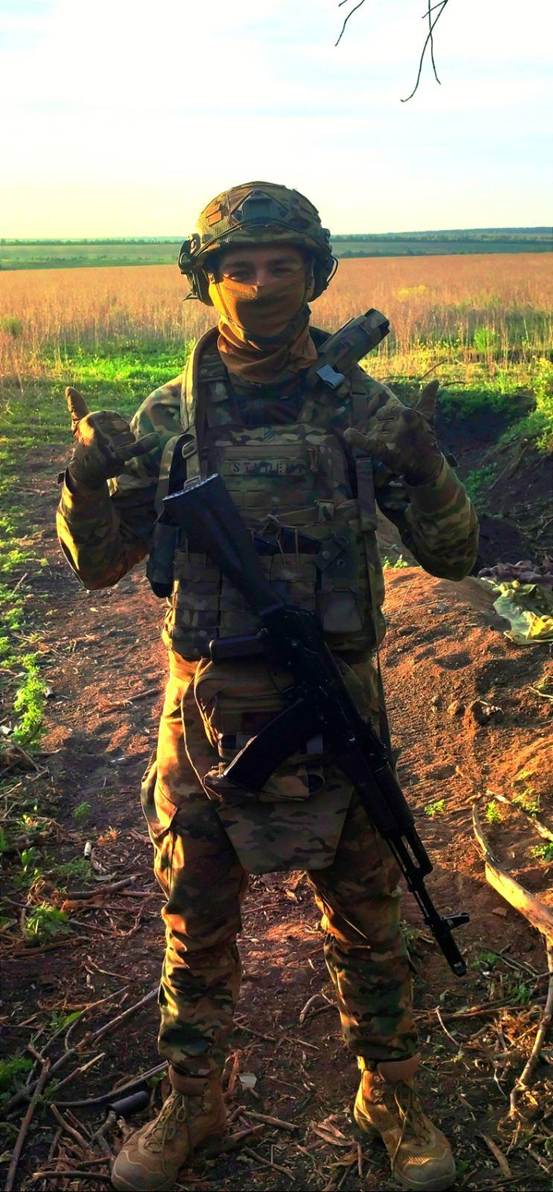
Maksym Nikolaychuk volunteered for the front line at the age of 18. Photo provided by Maksym
Maksym still remembers the day he lost his leg almost minute by minute.
"I was wounded on July 2 at 3:30 a.m. in the Luhansk region. The radio reported that there was a 300th and we needed to help pull him out. I went out into the field and stepped on a mine. My left leg. Mechanically, because we had practiced this a lot, I applied a tourniquet and hopped on one leg to my comrades, who were about 100 meters away. My comrades met me, evacuated me, and by 6 a.m. I had undergone surgery. I lost my foot and part of my lower leg," recalls the veteran.
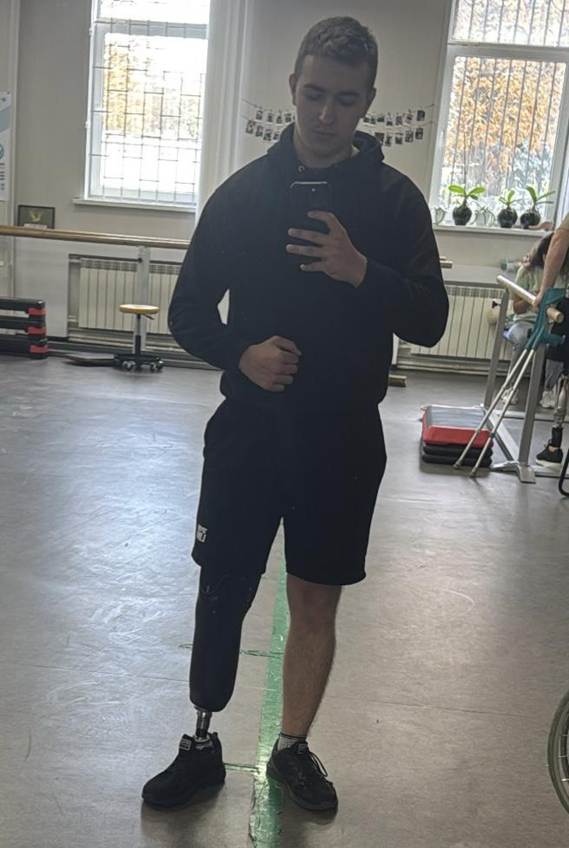
War veteran Maksym Nikolaychuk during rehabilitation. Photo provided by Maksym.
After returning to his native village following treatment and rehabilitation, Maksym set about resolving bureaucratic issues related to his new status. He did not plan to seek individual support for veterans, even though he knew about this possibility, but was used to relying only on himself.
The veteran came to the social protection office in the village of Baryshivka to apply for a disability ID card. And accidentally ended up in the wrong office. That is how fate brought him together with Yulia Ilyash, a person who has made it her mission to support veterans.
She decided to use her skills to support veterans
Yulia is a specialist in supporting veterans in the Baryshivka community in the Kyiv region. She worked in the child and family services department for 12 years, and when she found out that the community was recruiting people to provide professional support to war veterans and their families, she immediately applied.
"If there are people whose courage has allowed me and my children to live and have a roof over our heads, then I must use my potential to help them," she says.
Yulia Illiash is currently helping 87 community residents overcome bureaucratic obstacles and receive the support they need from the state more quickly. She works not only with veterans, but also with the families of fallen defenders.
Came for a certificate – got lawyers and grant options
When Yulia first saw Maksym at the War Veterans Support Center, she burst into tears: he was the same age as her child. The young veteran was simply looking for a place to apply for a certificate of disability as a result of the war, but after talking to Yulia, he realized that he could get support here for other issues as well.
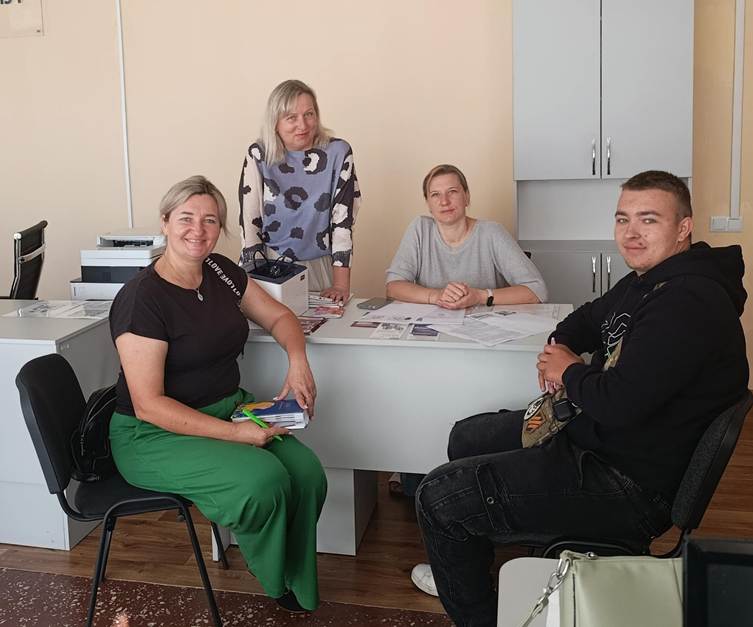
Veteran Maksym Nikolaychuk with war veteran support specialist Yulia Ilyash (to the left of Maksym) at the Employment Center. Photo: War Veteran Support Center of the Baryshiv Community, Kyiv Region
Together, they developed an initial action plan: they decided to first register Maksym for housing or compensation and to explore current grant support programs for veterans, as the young man dreams of starting his own business.
"Our biggest challenge in Maksym's story is to ensure that he receives his 1 million hryvnias from the state. This is a payment provided for by the "Contract 18-24" program for volunteers who entered military service before the age of 25," explains Yulia Ilyash. "There are certain nuances with the procedure for his discharge from the military unit, and two lawyers are currently working on the case."
Maksym dreams of a car repair shop, Yulia wants him to go to college.
The Kyiv-Kharkiv highway runs past the village where Maksym Nikolaychuk lives. He is a trained auto mechanic, so he has an idea for his own business: to open his own auto repair shop.
"He has already thought everything through. This guy has so much energy and strength—he's burning with the dream of his own service station," Yulia shares. "We just need to support him in every way so that this enthusiasm doesn't fade."
The payment under the Contract 18-24 program will allow the veteran to open a car repair shop faster, but while lawyers are working on this issue, Maxim and Yulia are exploring grant opportunities for veterans and options for higher education.
"Maxim wants to start working right away. But I dream that he will also get a higher education," smiles the civil servant. "I root for him like he's my own child. We are still in the process of negotiating with the university, but we are about to go to the Employment Center to find out what options Maxim has for receiving financial aid for his education. This is provided for by law: military personnel and demobilized persons can receive vouchers for training to increase their competitiveness in the labor market."
"I'm not Batman, I can't do fantastic things, but I know where to look for help."
Veteran Maksym and support specialist Yulia have only known each other for a couple of months, but during this time, their professional relationship has grown into a sincere friendship.
"Maksym even introduced us (the employees of the War Veterans Support Center – ed.) to his girlfriend. And once I even helped him choose a gift for her," says Yulia Ilyash, delighted with the veteran's trust.
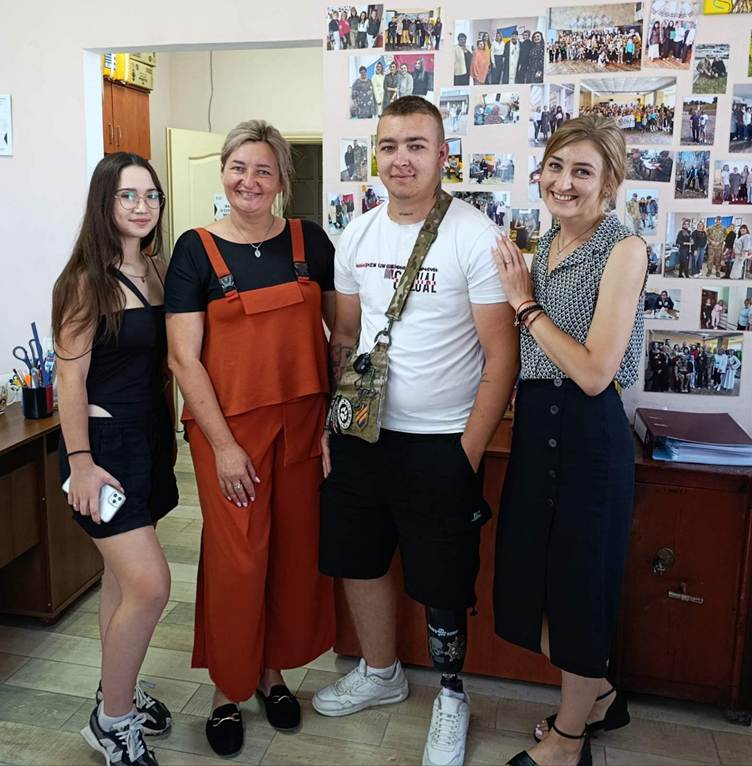
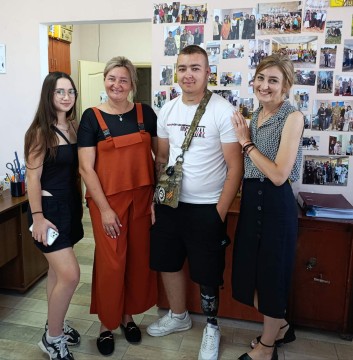
From left to right: Nadiya, Maksym's girlfriend, Yuliya Ilyash, a specialist in supporting war veterans and demobilized persons, Maksym Nikolaychuk, a veteran, and Alina Basenko, head of the Baryshiv War Veterans Support Center. Photo provided by the Center
The official admits that it is not always possible to establish such a trusting and friendly relationship with every veteran as with Maksym.
"There was a case when one veteran said that we were a 'useless organization' because we were unable to help him obtain land. But how could we? It's martial law, it's beyond our power," says Yulia.
The task of the support specialist is not only to resolve the individual requests of the veterans who come to her, but also to find an approach to each of them so that further communication is open and trusting. Her first degree as a certified psychologist is very helpful in this regard.
"When I first started working with veterans, it was difficult for me to hold back my tears at first," recalls the specialist. "I've been doing this job for four months now. I already know how to respond to the most painful issues and how to listen. I understand that I am not Batman and cannot do fantastic things, but I know where to look for the necessary help, where to call or go with specific questions. And I go there together with the veteran."
How can support specialists help?
According to the results of a large-scale survey in the Diya app, defenders most often face the following obstacles in receiving the state assistance they are entitled to:
- queues and excessive bureaucracy – 29.8% of respondents;
- the need to collect certificates from various institutions – 16.1%;
- lack of clear and accessible information about services – 15.1%;
- lack of a unified algorithm for applying for benefits – 13.1%.
Specialists who support veterans take on the task of overcoming these obstacles: they help gather all the necessary information, fill out documents, and accompany veterans on visits to government agencies or trips to the hospital.
"Sometimes support is needed even for a trip to the Administrative Services Center. When veterans suffer from concussions, it can be difficult for them to quickly process information, let alone understand paperwork," says Yulia Ilyash. "That's where we, the veterans' support specialists, come in. We speak for them when necessary."
Currently, not all communities have veteran support specialists, and the process of selecting and training such specialists is ongoing. By the way, until the end of September 2025, you can still apply to participate in the next stage of selection for the position of support specialist through the e-Veteran web platform.
In total, the state plans to train and employ up to 11,300 support specialists in various cities and villages. It is expected that one specialist can handle up to 35 requests at a time. One request is considered to be the processing of requests from veterans and their family members.
In order to ensure that all veterans have access to professional support services, regardless of their place of residence, the Cabinet of Ministers introduced the principle of "extraterritoriality" in the work of specialists supporting war veterans, demobilized persons, and their families in June 2025.
This means that now such specialists can work with veterans remotely, regardless of their place of residence or location. This allows for prompt support to be provided to veterans who, for example, are in a hospital or rehabilitation center.
How can a veteran find a support specialist?
You can find available specialists to support veterans and demobilized persons in a specific region through the Veteran Pro digital space in the Diya app.
Step-by-step instructions on how to do this:
- Open the "Dіа" app.
- Go to "Services" → "Veteran Pro."
- Select the "Find a specialist" option.
- Enter: Full name if you are looking for a specific specialist, or the region and community where you want to find a specialist and use their services.
- Click "Apply."
Check out the list of available specialists: full name, contact number, email, and the institution where the specialist works.
The state program for professional support of war veterans lays the foundation for comprehensive support for defenders and their families, but it is society's task to make it tangible everywhere: from the organization of quality services to respect in everyday communication from employers, colleagues, and neighbors.
The "Opportunities for Veterans" information campaign is being implemented as part of a partnership between the Ministry of Veterans Affairs and the Veterans Reintegration Program, which is being implemented by IREX with the support of the US State Department.