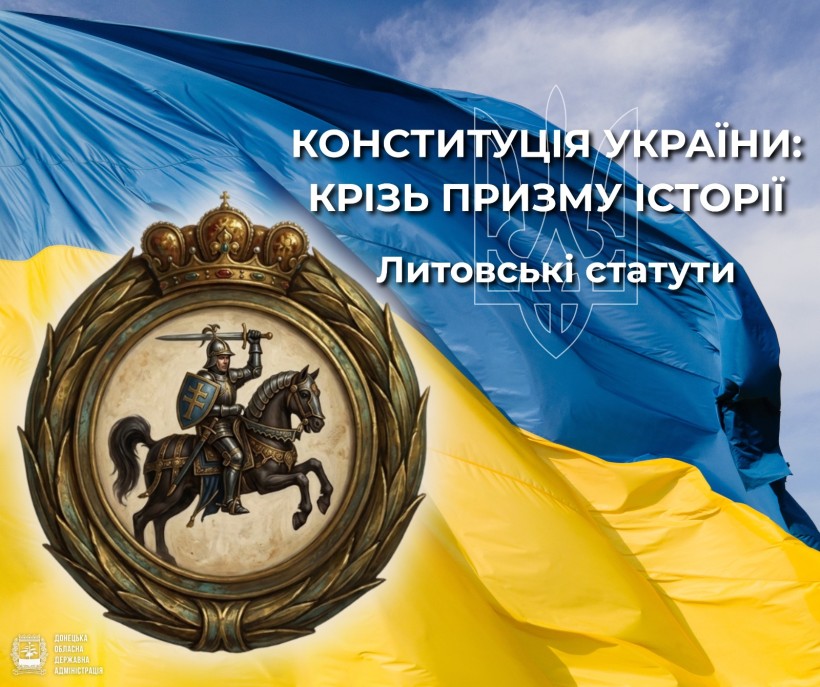
On June 28 of this year, Ukraine will celebrate the 30th anniversary of its Constitution, the country’s primary legal document. Ukrainian constitutionalism has deep historical roots and continuity, as well as its own distinctive features. It has evolved over the centuries in accordance with the national character of Ukrainians, their way of life, values, and social relations. On the occasion of Ukraine’s Constitution Day, we invite you to reflect on the major milestones in Ukrainian constitutional thought.
The Statutes of the Grand Duchy of Lithuania of 1529, 1566, and 1588 occupy an important place in the history of Ukrainian law and constitutionalism. These codes of law were based on Lithuanian, Belarusian, and Ukrainian (Rus’) law, as well as the judicial practices of the time. Their sources included the provisions of the “Rus’ Pravda,” as well as German, Polish, and Roman law.
The first Statute was adopted in 1529. Its official title was “Written Laws Granted to the State of the Grand Duchy of Lithuania, Rus’, Žemaitija, and Others…”. The document consisted of 13 chapters and 244 articles, and their number later increased to 283. Seven copies of this Statute in various languages have survived to this day. Of particular significance for Ukraine is the so-called Firlej copy, created in the 1530s, likely in Volodymyr in Volhynia. This is why historians often refer to the Statute of 1529 as a kind of constitution of the feudal state.
The Second Statute was adopted in 1566. It already contained 14 chapters and 367 articles. Due to the significant influence of the Volhynian nobility on its drafting, the document is often referred to as the “Volhynian Statute.” This code of laws significantly improved the system of state administration. It clearly defined the powers of the Grand Duke, laid the foundations for administrative reform, and provided for the functioning of a separate judicial system through the activity of zemsky, town, and sub-chamber courts. The Statute also granted equal rights to the nobility and magnates, standardized legal terminology, and enshrined the principle of the primacy of written law.
Work on the third edition of the Statute was completed in 1584. Leading jurists of the time, under the direction of Chancellor Ostafi Volovich and Vice-Chancellor Lev Sapieha, were involved in its preparation. The document was finally approved on January 28, 1588, by Sigismund III Vasa, King of Poland and Grand Duke of Lithuania.
The Third Statute consisted of 14 chapters and 488 articles and became the most comprehensive legal code of its time. It was imbued with the ideas of humanism and religious tolerance, defined the powers of state authorities, and regulated matters of criminal, civil, land, and family law. At the same time, the document definitively enshrined the privileges of the nobility and legally formalized the serfdom of peasants.
The Statutes of the Grand Duchy of Lithuania remained in force in Ukrainian lands for several centuries and had a significant impact on the development of Ukraine’s legal system. They marked an important stage in the codification of legislation, laid the foundations for the social and political order, and contributed to the spread of the principle of the supremacy of written law.
That is why the Statutes of the Grand Duchy of Lithuania are considered an important component of Ukraine’s legal heritage and one of the historical stages in the formation of traditions that were later reflected in Ukrainian constitutionalism and the modern Constitution of Ukraine.