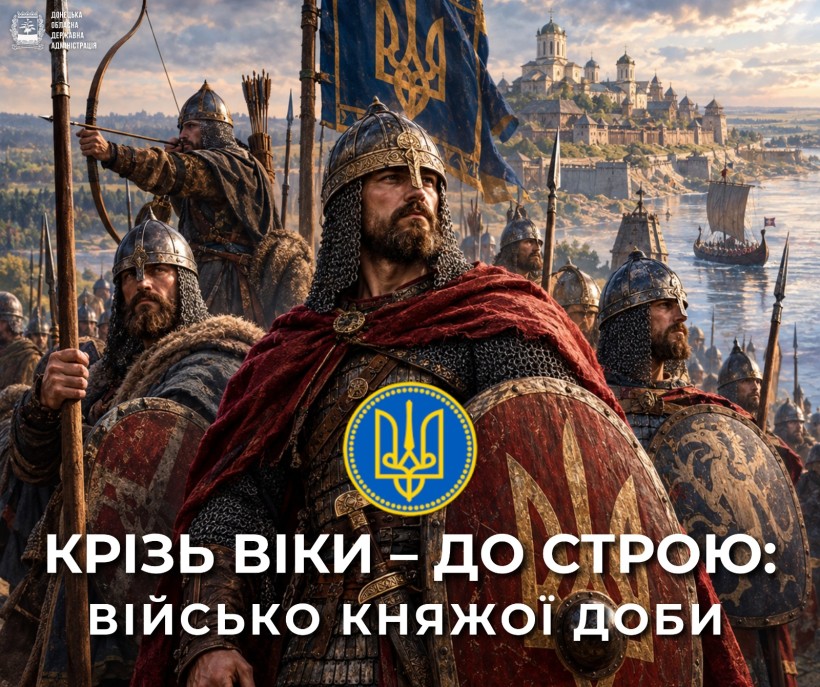
The Ukrainian military has a long history. It is a thousand-year journey of evolution, from the princes’ retinues and Cossack regiments to the state-of-the-art Defense Forces of Ukraine, where the uncompromising struggle for freedom has remained the central, unifying theme throughout the centuries. Today’s defenders of Ukraine have inherited the finest military traditions of their ancestors: from the Rus’ warriors—the double-pronged and trident symbols; from the Zaporozhian Cossacks—the Cossack crimson cross and the culture of military democracy; and from the armies of the Ukrainian People’s Republic (UNR) and the Ukrainian Insurgent Army (UPA)—tactical flexibility, self-sacrifice, and an unbreakable bond with the volunteer movement. Today, the Ukrainian army is a unique digital defense force that is constantly evolving thanks to the initiative of junior commanders and the successful implementation of advanced technologies. On Defenders of Ukraine Day, we not only pay tribute to the modern military but also speak of the continuity across generations, for today our military is the direct successor and guardian of centuries-old military traditions. A shield that today protects not only Ukrainian soil but also the security architecture of the entire free world.
The foundation of the military structure of Kievan Rus’ and the Galicia-Volhynia state was princely authority, which relied on professional warriors. The army consisted of the prince’s druzhina and a popular militia. The druzhina included local men from the upper classes of society. Members of the druzhina were required to serve the prince loyally and be ready to go to war with him. The princes maintained the druzhina, paid them in money, allowed them to appropriate a portion of the spoils of war, and granted them land. The second part of the army was the people’s militia—the voiv. At first, the warriors had no permanent military organization and gathered only for self-defense when the enemy attacked. Later, Princes Oleg and Igor began taking the warriors on campaigns. Townspeople and peasant farmers were recruited into the militia. Everyone was enlisted to fight the enemy, regardless of age, armament, or experience. In cases of extreme danger, the princes issued weapons to the militia from their own stockpiles. The people’s militia was organized and divided into thousands based on territory and named after their place of formation—the Volodymyr, Kyiv, Chernihiv, and so on. The prince’s druzhina consisted of regiments (100–200 men each), which were named after the prince. A regiment could be subdivided into smaller units.
During the princely era, the army was divided into two main types of troops: armored warriors and archers. The armored warriors wore armor. The archers were armed only with bows and arrows. Until the end of the 11th century, the Ukrainian army consisted of infantry. The main striking force was the heavily armed infantry (wearing armor, carrying shields and spears). Oleg and Igor first used cavalry in the 10th century during their campaigns against Byzantium and the Greeks. The cavalry was divided into heavy cavalry (warriors in armor and helmets, armed with lances and shields) and light cavalry (archers). The prince initiated the battle by being the first to throw a lance. When the lances broke, the battle continued with swords. Archers fired at the enemy from behind the city walls. Over time, the infantry gave way to the cavalry. After the cavalry secured victory, the infantry finished the battle: routing the remnants of the enemy, taking prisoners, and seizing spoils and weapons.
During the princely era, the Ukrainian navy also began to develop. The river fleet defended Kyiv on the Dnipro and Chernihiv on the Desna.
The army was assembled on the prince’s orders, as there was no standing army at that time. There were no special military drills, maneuvers, or training exercises in the army. Adults honed their military skills in battle. Children, on the other hand, were introduced to the customs of the people from an early age within their families; they were raised to feel loyalty to the prince and the community, to respect those who had fallen in battle, and were taught to ride horses. Boys were expected to be familiar with all types of weapons, to know how to wrestle, throw a spear, shoot a bow, wield a sword and a saber, ride a horse, and fight hand-to-hand. “Wrestling” and “strength contests” were the boys’ favorite pastimes. After such training, teenagers were taken on military campaigns. The army upheld the strength and power of the state and defended its borders.
Warriors who participated in battles were awarded medals. These were special necklaces—grivnas—made of precious metals and bronze. Voivodes were awarded a gold grivna necklace as well as a gold chain. Rank-and-file warriors were awarded less valuable grivnas made of silver or bronze.
The modern Ukrainian Armed Forces have inherited symbols from the princely army: the two-pronged and three-pronged tridents, which are widely used in their insignia. Thus, Vladimir the Great’s trident became the logo of the Armed Forces of Ukraine, becoming part of the national identity and underscoring the antiquity of our history dating back to the princely era, even before the Christian era. Sviatoslav’s double-pronged spear has become the symbol of the Ukrainian Special Operations Forces, and the prince’s military slogan, “I’m coming for you!” is the official motto of this branch of the military. Individual brigades also use the double-pronged spear in their symbols, such as the 53rd Separate Mechanized Brigade named after Prince Volodymyr Monomakh and the 3rd Separate Special Purpose Regiment named after Prince Sviatoslav the Brave.
At the same time, emphasizing the continuity of military glory, modern combat brigades bear the names of outstanding commanders and rulers from the princely era. Among them are the 24th Separate Mechanized Brigade named after King Danylo (in honor of Danylo of Halych), the 30th Separate Mechanized Brigade named after Prince Kostyantyn Ostrozky, the 14th Separate Mechanized Brigade named after Prince Roman the Great, and others.