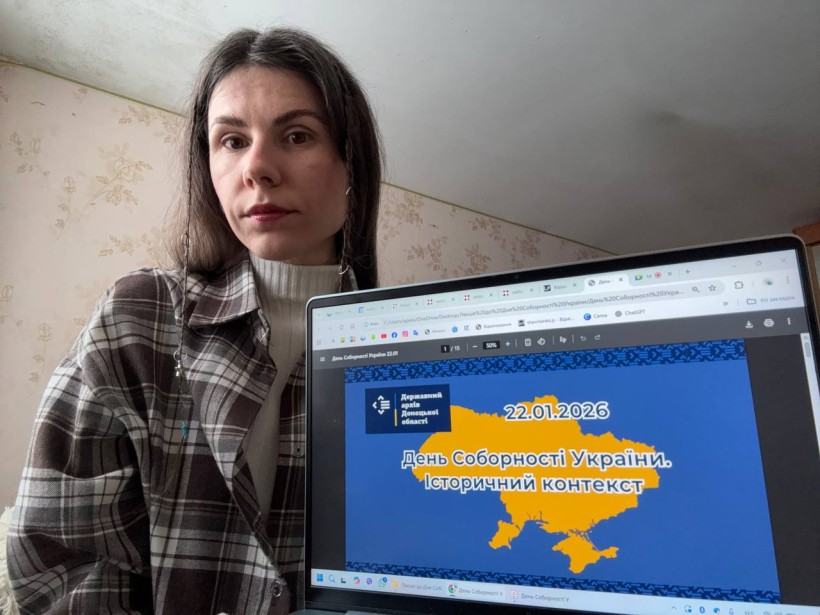
On the occasion of Ukrainian Unity Day, the Department of Family, Youth, and Mass Events of National Patriotic Education of the Regional State Administration, together with the State Archives of Donetsk Region and the Center for Unity and National Resistance platform, held an online dialogue for young people in the region. The purpose of the event was not simply to remember dates, but to understand why "unity" is a matter of our survival today.
During the meeting, participants discussed the very concept of "unity." It is not just about borders on a map. Unity is about "sobor," or gathering of the community. It is spiritual, linguistic, and cultural integrity.
History proves that Ukrainians have sought unity for centuries. From Kievan Rus, through the Cossack state of Bohdan Khmelnytsky and Pavlo Doroshenko, to the intellectual appeals of Taras Shevchenko and Ivan Franko, the idea of a "united, indivisible Ukraine" has always been our guiding principle.
The Act of Unification became a key topic of dialogue. Young people learned about the complex geopolitical conditions of the early 20th century. Despite the fact that Ukrainians found themselves on different sides of the imperial barricades (Austria-Hungary and Muscovy), the will to unite proved stronger than borders.
The Ukrainian People's Republic (Naddniprianshchyna) and the West Ukrainian People's Republic (Galicia, Bukovina, Transcarpathia) united into a single sovereign state.
During the online discussion, special attention was paid to the events of January 21, 1990. At that time, more than a million people joined hands, forming a "living chain" from Lviv to Kyiv.
Yana Vlasova, chief specialist of the document information use department of the State Archives of the region, emphasized an important fact: representatives of Donetsk region also took part in this action. Even then, residents of the east of the country clearly articulated their belonging to a single Ukrainian space. This debunks modern Russian myths about the "artificial division" of Ukraine — our region has always been and remains part of the unified body of the state.
Today, in the context of full-scale war, unity is no longer just a term from a textbook. Now it is a daily action. Maintaining unity today means supporting the Armed Forces of Ukraine and preserving the Ukrainian language and culture.
"Unity is not a legacy that we simply inherited. It is a value that we defend every day. Only in unity can we win and preserve independence for those who come after us," concluded the event organizers.