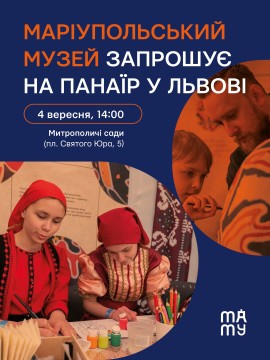
On September 4, in the Metropolitan Gardens, Lviv will host its first Panayir—a traditional religious, community, and family festival of the Greek community in Ukraine. The word *panigyri* itself means “general gathering”—a festival that brings people together around culture, traditions, music, shared meals, and remembrance.
At the Panayir, the Mariupol Local History Museum will set up its own themed exhibit, “Mariupol: Where the Steppe, the Sea, and Traditions Meet”—a space where the cultural heritage of the Greeks of Nadazovia comes to life.
What will you see at the Mariupol Local History Museum’s exhibit?
🔹Unique Nadazovia carpets—patterns that encode the history, worldview, and traditions of our ancestors.
🔹Ikanichi—traditional Easter eggs of the Greeks of Nadazovia, their symbolism, and distinctive patterns.
🔹An exhibition about Arkhip Kuindzhi—an outstanding artist born in Mariupol, known as the “artist of light.”
🔹“The Thread of Unity”—a symbolic image that unites culture, memory, and people, reminding us that tradition lives on as long as we carry it forward.
Adults and children are invited to workshops where they can:
🔹 paint a wooden egg in the Ikanich tradition;
🔹 create their own shopping bag with a unique Nadazovya ornament.
Registration for the workshops takes place directly at the museum. Participation is free.
Before the full-scale war, Panayir was traditionally celebrated in Mariupol, Volnovakha, and other cities in the Nadazovya region. Today, this festival takes on special significance in Lviv. It serves as a reminder that even when one’s homeland is occupied, culture continues to thrive, and the community remains united.
The organizers of the Panayir in Lviv are the Federation of Greek Societies of Ukraine and Khrystyna Kavetska, founder of the “KAVA” Charitable Foundation, the ENOSIS Greek Society, and the Kornaktos Western Ukrainian Greek Society. With the support of the Ukrainian Parliament Commissioner for Human Rights and the Embassy of Greece in Ukraine.
Based on materials from the Mariupol Local History Museum