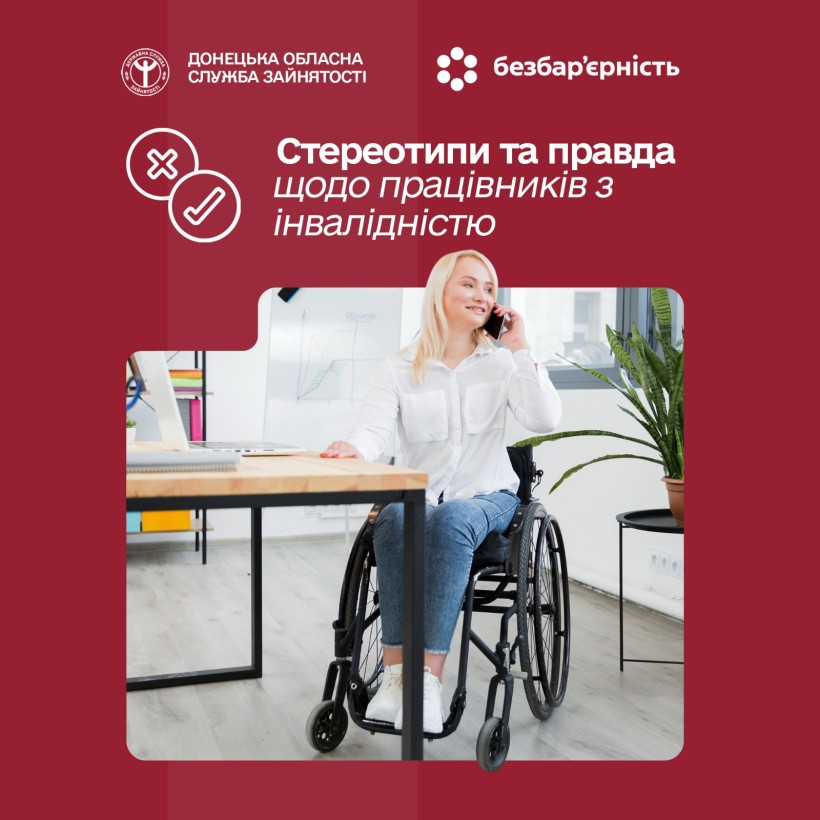
Stereotypes are generalized perceptions through which we often view the world. They help us navigate information more quickly, but sometimes they limit our thinking and prevent us from seeing the full picture. People with disabilities frequently encounter such biases, particularly in employment. Let’s look at some common stereotypes and try to debunk them.
1. People with disabilities (especially Group I) cannot work.
Disability means having certain physical, sensory, intellectual, or psychosocial characteristics, but it does not define a person’s professional abilities. First and foremost, it is an individual with experience, knowledge, and the right to equal opportunities in the labor market.
2. People with disabilities can only perform low-skilled jobs.
In reality, many people with disabilities successfully work in various fields—as programmers, teachers, entrepreneurs, doctors, or scientists. Well-known examples include physicist Stephen Hawking, motivational speaker Nick Vujicic, and U.S. President Franklin Delano Roosevelt.
3. Such employees are often absent from work.
Research shows that employees with disabilities are often highly responsible and value their jobs. In many cases, they change jobs less frequently and have lower absenteeism rates.
4. A person with a disability requires constant assistance.
Most people with disabilities lead independent lives, work, study, and actively participate in society. Sometimes they may need an accessible environment or assistive technologies, but this does not mean constant dependence on others.
5. Workplace adaptation is very expensive.
In many cases, adaptation does not require significant costs. Flexible schedules, part-time work, or remote work can be simple solutions. Moreover, part of the costs for workplace adaptation can be compensated by the state.
What does the employer gain?
Hiring people with disabilities allows employers to benefit from reduced social contributions, receive compensation for workplace adaptations, enhance corporate social responsibility, and engage motivated employees.
People with disabilities can and want to work. It is important to create equal opportunities and remove barriers, evaluating individuals primarily by their professional qualities.
If you need assistance in finding a job or recruiting qualified employees, contact our specialists here: https://t1p.de/rzryk.
Call center of the Donetsk Regional Employment Center: 0-800-219-713.