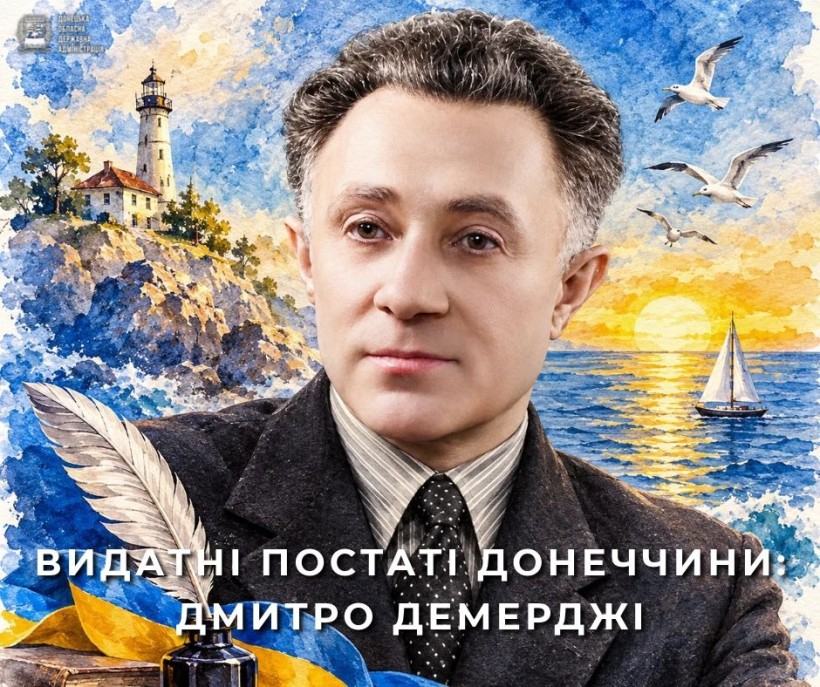
The Donetsk region is much more than just an industrial center or an endless, warm steppe. It is a land with deep cultural roots that has given Ukraine and the world people of incredible strength of spirit, a refined sensibility, and an uncompromising love for their native language. These people have shaped and continue to shape the course of history, enriching world culture, and today they stand as symbols of the indomitable Ukrainian spirit. Today, we introduce our readers to one such figure.
November 4, 2026, marks the 125th anniversary of the birth of Dmytro Lazarovych Demerdzhi—a Ukrainian poet, prose writer, translator, and member of the Writers’ Union of Ukraine.
Dmytro Lazarovych was born on November 4, 1901, in the Azov village of Urzuf to a humble peasant family—Lazar Stavrovych and Yelyzaveta Iordanivna Demerdzhi—a family where respect for knowledge, reading, and books reigned supreme. The poet’s father died young, and his mother raised seven children on her own, so Dmytro experienced hard labor from childhood and worked as a day laborer.
After graduating from the village school at age 15, he enrolled in the four-year Preslav Teachers’ Seminary (now the village of Preslav in the Primorska community of Zaporizhzhia Oblast), then studied at the Berdiansk Pedagogical Technical School, and later at the History Department of the Institute of Public Education in Dnipro (Dnipro National University). While studying at the institute, the poet also took vocal lessons at the Dnipropetrovsk Conservatory. He had a beautiful baritone-tenor voice, so he performed on the stages of the opera house as well as the T.G. Shevchenko Music and Drama Theater in Dnipro. Dmytro Demerdzhi appeared in the productions “Natalka Poltavka” and “Early on Sunday Morning She Dug Up Her Potion.” Fate gave him the opportunity to work alongside the brilliant Ukrainian actress Natalya Uzhviy, who was also performing on theater stages at that time.
During those same years, Dmytro Lazarovych served as the head of a history club led by the distinguished Ukrainian historian and researcher of the history of the Zaporizhian Cossacks, Dmytro Yavornytsky. The poet became one of the distinguished scholar’s favorite students, and upon graduating from the institute in 1929, Yavornytsky helped Demerdzhi enroll in the graduate program at Leningrad University to study “archaeology.” After two years of graduate study, Dmytro Lazarovych returned to Dnipro. However, instead of pursuing a career in teaching or research, Dmytro Demerdzhi chose journalism.
He worked at the editorial offices of Dnipro newspapers, at the magazine *Shturm*, and as a correspondent for RATAU-TASS in the Dnipropetrovsk and Ivano-Frankivsk regions.
During World War II, Dmytro Lazarovych fought on the Caucasus Front. In 1944, he returned to Dnipro to work in editorial and publishing. For a long time, he held a leadership position at the regional book publishing house, which was later transformed into the zonal republican book publishing house “Promin” (later “Sich”).
Dmytro Demerdzhi had been engaged in literary work since his youth. In 1933, his first collection of poems, *Radist* (*Joy*), was published. The poet also became one of the organizers and long-time leaders of “Plavka,” the oldest factory literary group in Ukraine. In 1935, his poems were included in the anthology *Plavka*. And in 1958, the poetry collection *My Sea* was published, receiving numerous favorable reviews and captivating readers with its subtle lyricism and the depth of its poetic imagery.
In 1962, the poet was admitted to the Writers’ Union. By that time, he had already published several works, including poetry collections, essays, children’s books, and contributions to anthologies. Dmytro Demerdzhi wrote primarily in Ukrainian, the language of his homeland, where he was born and lived; he wrote poems and song lyrics (for which well-known composers wrote the music) and translated from Greek and Russian. The sea was the central theme of his poetic work, and the nature of the Azov region was his source of inspiration.
Dmytro Lazarovych’s body of work includes a number of books: *Joy* (1933), *My Sea: Poems* (1958), *As My Heart Dictated: An Essay* (1958), *The Sun on the Wings of a Seagull: Poems” (1967), “Play, Sea, Good Sea: Poems” (1985); the rhyming fairy tale “Friends: The Merry Adventures of Three Animals” (1961); and the memoir “About Myself and My Friends” (1960). In 1961, Demerdzhi’s vividly illustrated children’s fairy tale *Friends* was published in Ukraine. Such books were rare at the time, so it caused a real sensation in the publishing world.
A separate milestone in the poet’s career was his work to preserve the literary legacy of Greek poets from the Azov region. Thus, in 1979, the poetry anthology *From the Shores of the Azov*, edited by Demerdzhi, was published. The anthology included his Ukrainian translations of poems by G. Kostoprav, A. Shapurma, L. Kiryakov, A. Dimitriou, V. Galli, D. Telenchi, S. Kosse, P. Saravas, D. Papush, V. Bakhtarov, and G. Danchenko (Meotisa). The writer’s work as a translator played an important role in popularizing the literature of the Greeks of the Azov region.
The poet died on December 22, 1991.