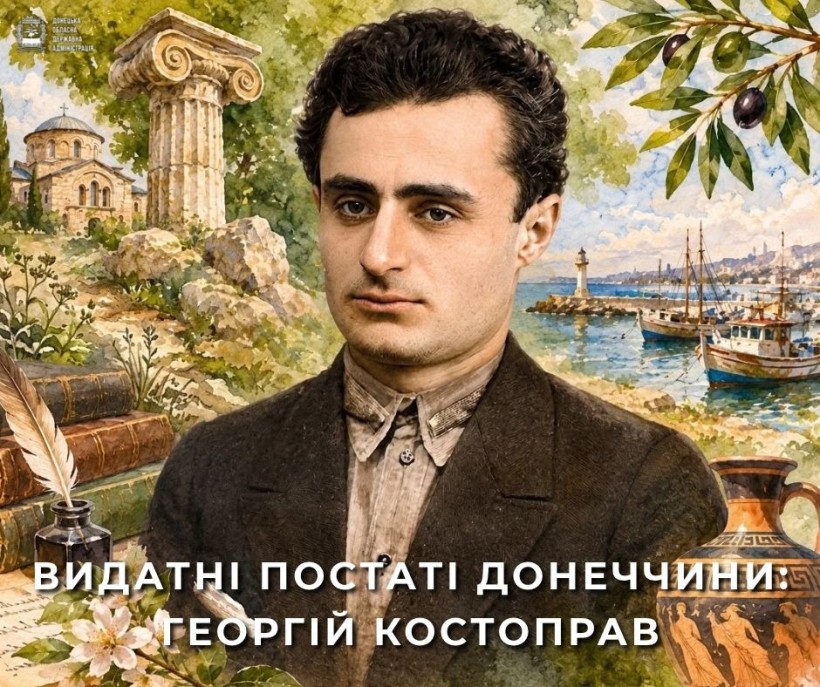
The Donetsk region is much more than just an industrial center or an endless, warm steppe. It is a land with deep cultural roots that has given Ukraine and the world people of incredible strength of spirit, a refined worldview, and an uncompromising love for their native language. These people have shaped and continue to shape the course of history, enriching world culture, and today they stand as symbols of the indomitable Ukrainian spirit. Today, we introduce our readers to one such figure.
November 9, 2026, marks the 123rd anniversary of the birth of Georgy Antonovich Kostoprav—a Rumelian, poet, and writer; the founder of the national literature of the Greeks of Ukraine; and editor of the Mariupol Greek newspaper *Kolehtivistis*.
Georgy Kostoprav was born on November 9, 1903, in the village of Maloyanisol near Mariupol into the family of a volost clerk. The future poet’s father, Anton Ivanovich, loved reading fiction and had assembled a home library. From early childhood, Georgy developed a passion for reading and creativity. Even before he could write, he began composing poems. His love for his native land and nature—the pure, living source of Kostoprav’s poetry—has its roots in the poet’s childhood impressions.
After graduating from school, Georgy moved to the city to study at the Mariupol Real School. After receiving his diploma, he served in the army and later worked at the Ilyich Plant as a secretary in the personnel department, where he also headed the plant’s literary studio. His work was published in the newspapers *Golos Truda* and *Ilyichivets*.
In 1931, Heorhii Kostoprav began writing in Greek. On November 7, 1931, the poet published his first literary work in the Greek language of the Nadazov region in the newspaper “Kolekhtivistis.” It was the poem “Lambos.” This date and this work are considered the beginning of the history of modern Greek literature in Ukraine.
Starting in 1932, Kostoprav worked on the editorial staff of the Greek-language newspaper “Kolekhtivistis.” During this period, his talent as an organizer came to the fore. He gathered writers around him, inspiring them with the idea of creating a unified literary language for the Greeks of the Azov region. While working at the newspaper and at the “Azovstal” plant, he founded and led two literary groups for aspiring poets who wrote in the Rumai language. In addition, the poet collected oral folk art and folklore of the Azov Greeks, involving young people in this effort.
During this time, the poet’s books *Ta protavymata* (“First Steps”), *Leontiy Honagbey*, and *Kalimera, zisimo!* (“Hello, Life!”) were published. In addition to his own works, Kostoprav was active as a translator. He translated Ukrainian folk and Soviet songs, as well as the poetry of Taras Shevchenko, Stepan Rudansky, Maksym Rylsky, Pavlo Tychyna, Volodymyr Sosyura, and poets from the Donetsk region, into Greek. The author wrote critical articles and detailed reviews of Greek literature from the Donetsk region and Ukraine, and he led the Mariupol Greek Literary Group, which included the well-known writers Vasyl Galla and Amphiktion Dimitriou.
However, the poet’s life was destined to be short. In December 1937, as part of the “Greek Operation”—a national “purge” of the Soviet era—Kostoprav was arrested. Investigators accused the poet of espionage, ties to Greek intelligence, and active participation in a counterrevolutionary nationalist organization. On February 14, 1938, Georgy Kostoprav was executed by firing squad.
Greeks in the Nadazov region honor Kostoprav’s memory. For a long time, Olympiads on Greek language and culture were held in Mariupol, where participants often recited the poet’s verses. Several books have been written about him. Among them are *The Case of Georgy Kostoprav* by Galina Zakharova and *Georgy Kostoprav: Poet and Citizen* by Pavel Mazur. And Gennady Animitsa published a complete collection of poems by the author from the Azov region.