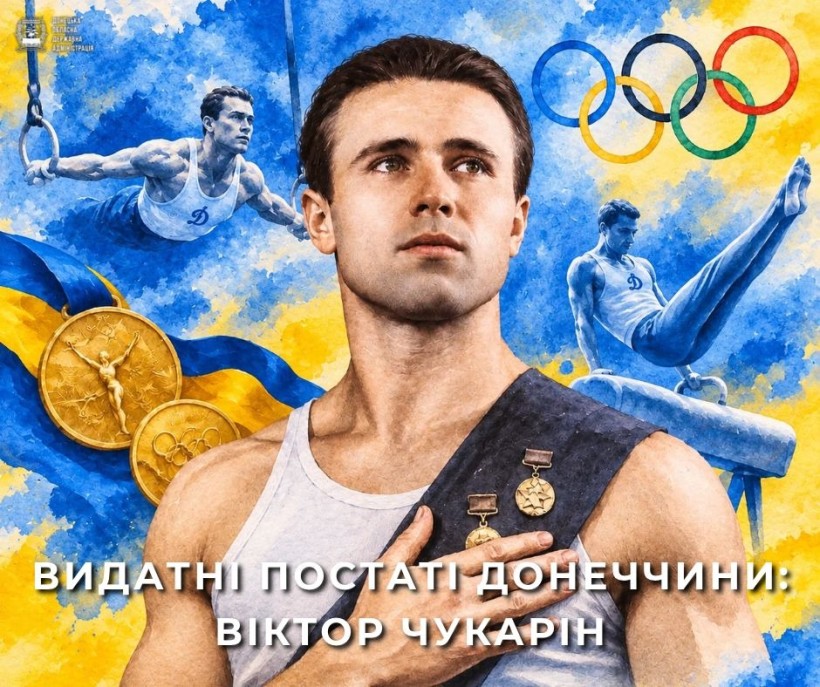
The Donetsk region is much more than just an industrial center or an endless, warm steppe. It is a land with deep cultural roots that has given Ukraine and the world people of incredible strength of spirit, a refined sensibility, and an uncompromising love for their native language. These people have shaped and continue to shape the course of history, enriching world culture, and today they stand as symbols of the indomitable Ukrainian spirit. Today, we introduce our readers to one such figure.
November 9 marks the 105th anniversary of the birth of Viktor Ivanovich Chukarin—an outstanding Ukrainian gymnast, two-time undisputed Olympic champion, and a man whose life has become a symbol of incredible resilience. His athletic achievements continue to amaze the world today, but his greatest victory took place not on the gymnastics floor, but in his struggle against the harsh circumstances of the 20th century.
Viktor Chukarin was born in 1921 in the Donetsk region, in the village of Khreshchatytske on the Azov Sea coast; his family later moved to Mariupol. It was there that the teenager became fascinated with gymnastics, which became his life’s work. His first major successes came while studying in Mariupol and Kyiv, but the young athlete’s rise was brutally cut short by World War II. Chukarin volunteered for the front, was wounded, and taken prisoner. During the war, he went through a living hell, surviving 17 Nazi concentration camps, including the horrific Buchenwald.
When he returned home in the fall of 1945, his own mother recognized him only by the scar on his head—the former athlete weighed just over 40 kilograms and was utterly exhausted. Doctors unanimously declared that sports were out of the question, and that his professional career was a thing of the past. However, his iron will and Ukrainian spirit dictated their own rules. After enrolling at the Lviv Institute of Physical Culture, Chukarin began grueling training, regaining his lost strength muscle by muscle. His return to the high bar became a global sensation. Within just a few years, he proved that nothing is impossible for a person with a dream.
Viktor Chukarin’s athletic career is marked by fantastic achievements: he won 11 Olympic medals—including 7 gold, 3 silver, and 1 bronze—became a two-time overall champion at the Olympic Games in Helsinki (1952) and Melbourne (1956), as well as an undisputed world champion (1954) and a multiple champion of the USSR. His performance at the Melbourne Olympics at the age of 35 became legendary. At that time, the Ukrainian gymnast outperformed a much younger Japanese rival, demonstrating flawless technique and mental resilience. The Western press enthusiastically called him “the man who cannot be beaten.”
After retiring from competition, Viktor Ivanovych did not leave the sport. He made Lviv his home, where he headed the Department of Gymnastics at Lviv State University of Physical Culture. As an outstanding educator, he trained more than three dozen Masters of Sport and nurtured new generations of Ukrainian champions.
The great athlete passed away on August 25, 1984. He was buried on the main avenue of Lychakiv Cemetery in Lviv. A bronze monument stands on his grave, depicting the gymnast on his favorite parallel bars.
Streets in Lviv and Mariupol have been named after him. In the German city of Domboston, his admirers established a museum while the greatest gymnast was still alive.
Viktor Chukarin’s life was difficult, yet full of achievements. He never gave up when others lost heart, and he emerged victorious through incredible effort, perseverance, and self-discipline. Viktor Chukarin is not only one of the legendary figures of Ukrainian world-class sports but also a unique role model for many Ukrainians. His story is inspiring because it powerfully demonstrates how human dignity, resilience, and a zest for life can overcome death, concentration camps, and the harshest trials of fate.