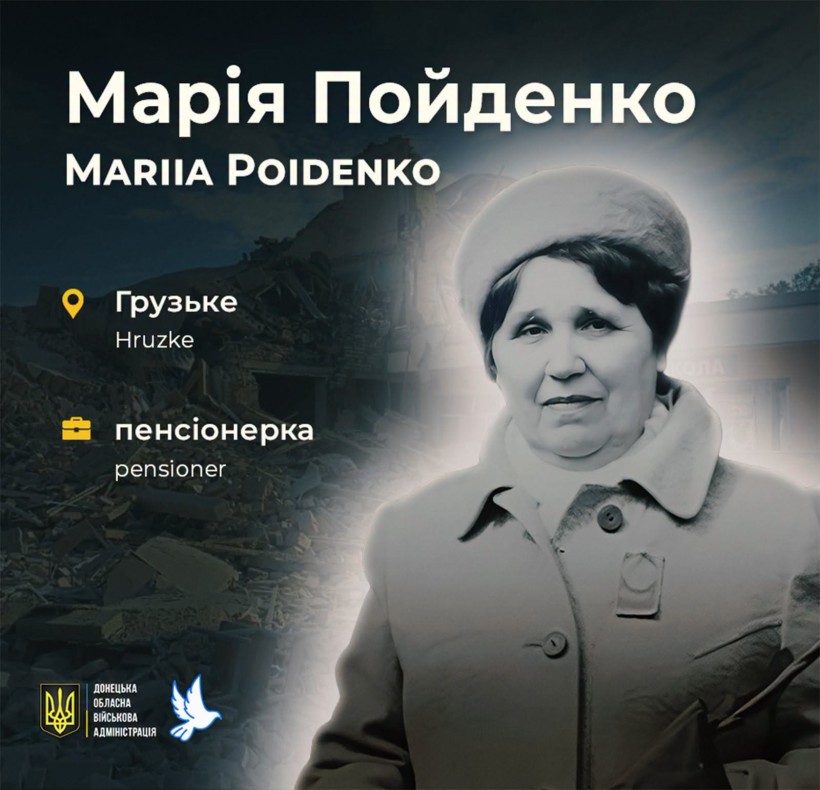
Maria Poidenko was 95 years old. She died during the full-scale war in Mariupol.
After heavy shelling of the city, Maria’s health deteriorated sharply. She died of a stroke on March 23, 2022.
“Despite her age, Mom was still in good health. She walked around the apartment with a cane and did crossword puzzles. But during another round of shelling, when all the windows and the front door were blown out, she took to her bed. They had to carry Mom down to the basement on a blanket,” recalled her daughter, Iryna.
Maria Poidenko was buried behind the five-story building on Kuprin Street, where she lived. There were already several graves there.
“Our apartment was destroyed. And on March 27, we left the city. I suppose Mom simply let us go so that we could stay alive,” said Irina.
Maria Poidenko was born in the village of Hruzke in the Donetsk region. She was still very young when World War II began. Her family was evacuated to Russia. Later, they returned to Ukraine—to the Luhansk region. Maria earned her higher education at the National Metallurgical Academy in Dnipro. She worked as an economist at Azovmash. She retired in 1984. She helped her daughter with her grandchildren and cared for her own mother.
“I remember her as strict. My mother raised me and my children to be disciplined. Thanks to her, we grew up to be decent and serious people,” said Iryna.
The family does not know where Maria Poidenko was reburied.
“Mariupol was hell. Now it has become a graveyard… As long as I live, I will remember all of this. I want to write a book about what I went through—I kept a diary during the active fighting,” added Iryna.
Maria Poidenko is survived by her daughter and grandchildren.
At 9:00 a.m.—a nationwide minute of silence. The Donetsk Regional Military Administration and the Memorial platform: those killed by Russia remember the residents of Donetsk Oblast killed by Russians. Vadym Filashkin’s greeting on Railway Workers’ Day.