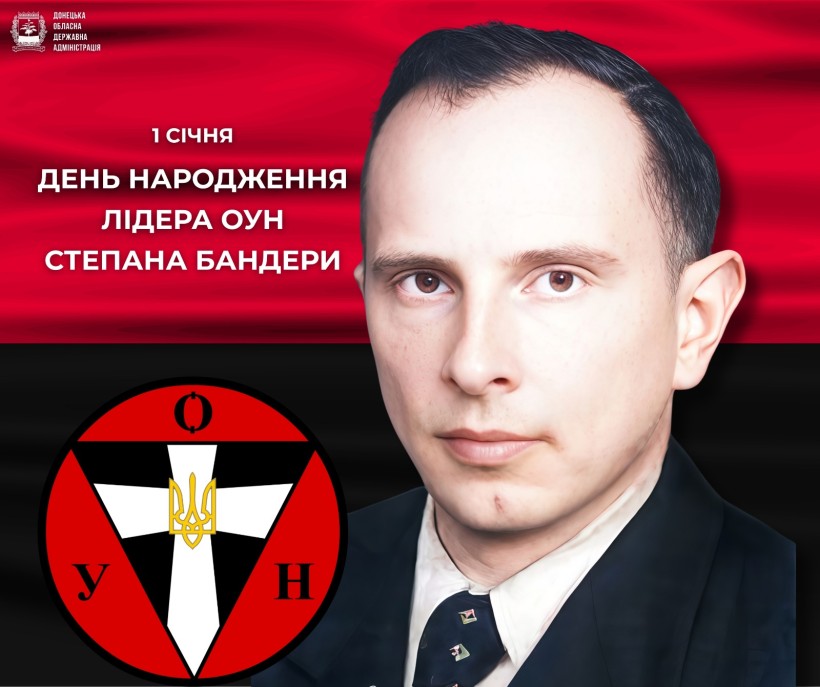
On January 1, 2026, Ukraine will celebrate the 117th anniversary of Stepan Bandera's birth. For most Ukrainians today, the name Stepan Bandera is a symbol of the uncompromising and undying struggle for the Ukrainian nation's right to be the master of its own destiny on its own land.
Stepan Bandera was born on January 1, 1909, into the family of Greek Catholic priest Father Andriy Bandera and Myroslava from the Hlodzinsky family in Uhryniv, Staryi Kalush County, in what is now Ivano-Frankivsk Oblast.
Stepan received an excellent home education, which enabled him to enter high school and later university. He was unable to defend his diploma due to his imprisonment. Thanks to his family and surroundings, he prepared himself for political activity from the age of 14. He imagined and rehearsed interrogation scenes, trying to strengthen his will and body so as not to betray his comrades who had to continue fighting for Ukrainian independence.
At the age of 18, Stepan Bandera became a member of the Ukrainian Military Organization (UVO), where he was initially assigned to the intelligence department. But later, due to his health (severe rheumatism of the knees) and thanks to his oratory skills, he was transferred to the propaganda department.
From 1928 to 1934, he studied at the agronomy department of Lviv Polytechnic. At the same time, he participated in the activities of Plast, Prosvita, and many other patriotic organizations. After the Polish authorities banned Plast, he actively joined the Organization of Ukrainian Nationalists (OUN) and later became its regional leader.
In just a few years, he managed to build a brilliant political career, becoming the regional leader of the OUN in western Ukraine in 1934. The organization combined extensive propaganda campaigns with guerrilla warfare against the Polish occupiers.
After the Act of Restoration of the Ukrainian State was proclaimed in Lviv on June 30, 1941, the German authorities arrested Stepan Bandera, demanding that he revoke the Act. Many other OUN leaders were soon arrested, but Bandera refused to revoke the Act. Until 1944, he was held behind barbed wire in the Nazi camp at Sachsenhausen. His brothers Vasyl and Oleksa were murdered in the Auschwitz concentration camp.
In mid-December 1944, when the Wehrmacht no longer controlled any part of Ukrainian territory, the isolation of the OUN leader lost its relevance for the Nazis, and Bandera was released from the concentration camp under police supervision. The Nazis offered him negotiations on establishing allied relations between the Ukrainian nationalist movement and Germany. But the former concentration camp prisoner rejected this proposal.
From 1945, Bandera was super involved in the OUN as its leader, but he had to keep hiding from the Soviet secret service. On October 15, 1959, he was assassinated by KGB agent Bohdan Stashynsky.
In the history of the Ukrainian people, this figure remains politically alive to this day and causes much debate. Today, Stepan Bandera is perhaps the most vivid symbol of the desire for Ukrainian independence in its most uncompromising form.
In 1959, the American magazine Time, with a circulation of two million copies in Chicago (USA) and Paris (France), published an article entitled "The Partisan," illustrating it with a photo captioned: "Stepan Bandera, profession: patriot." The article went on to say: "For most of his life, Stepan Bandera was a passionate, fanatical exile, devoted to a hopeless cause. That cause was the independence of Ukraine, for which he fought so stubbornly that Soviet propaganda dubbed all members of the Ukrainian underground "Banderites."
However, today we know that Ukraine's independence is not a hopeless cause, but a completed historical fact. And Stepan Andriyovych did not sacrifice his life in vain. Today, Ukraine is at war with Russia, which has encroached on its state independence and occupied part of its territory. The name of Stepan Bandera continues to resonate in this struggle: it frightens enemies and inspires Ukrainians.