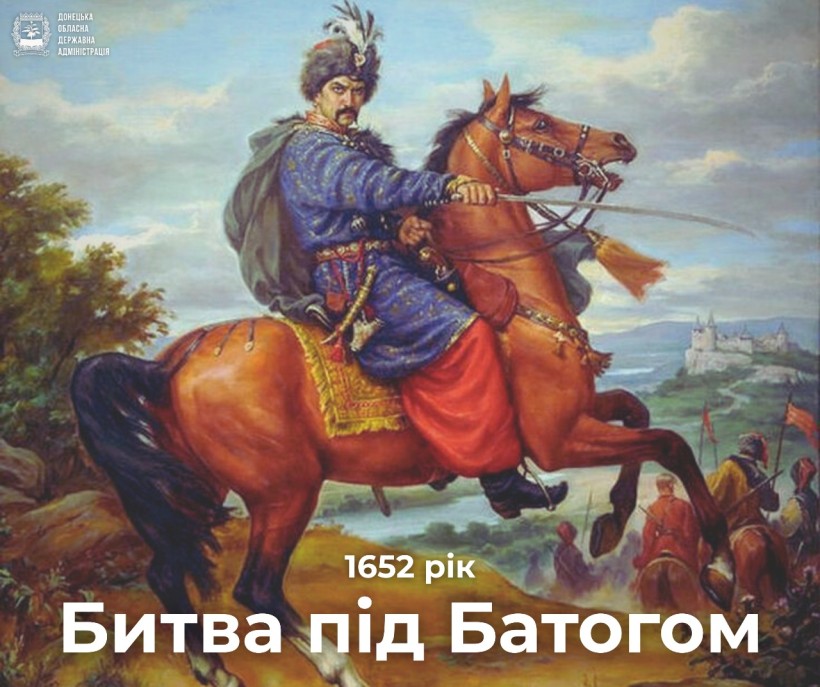
In the history of the Ukrainian army, there are many glorious victories, but perhaps the most famous of them is the battle near Batih in 1652 during the Khmelnytsky Uprising.
After the tragic defeat at Berestechko and the Treaty of Bila Tserkva in 1651, the Polish-Lithuanian Commonwealth seemed to slowly regain its positions. The nobility returned to their estates, and the royal army occupied Bratslavshchyna and Chernihivshchyna – provinces that the Cossacks were supposed to leave according to the agreement. However, a certain "calm" was an illusion – both sides were preparing for the continuation of the war.
The reason for the new clash between the royal army of the Polish-Lithuanian Commonwealth and the Cossack forces was "marriage diplomacy" - the elder son of Bohdan Khmelnytsky, Tymish, was to marry the daughter of the Moldavian ruler Vasyl Lupu – Rozanda. However, after the defeat of the Cossacks at Berestechko, the future father-in-law lost the desire to connect with the Ukrainian hetman.
That is why in the spring of 1652, the groom with a 15,000-strong army headed to Moldova to convince Vasyl Lupu of the necessity to adhere to the agreement and hold the wedding. The Poles also tried to prevent this marriage, as its conclusion would mean strengthening the alliance of Ukraine's Hetmanate with Moldova on one side and elevating the Khmelnytsky family on the other.
To prevent the alliance of Ukraine with Moldova, the Polish government sent an army to Ukraine, which had 12,000 cavalry, 8,000 soldiers, and 30,000 armed servants.
To assist his son, Bohdan Khmelnytsky approached with a 35,000-strong Cossack army and a 20,000-strong Tatar reinforcement led by Karach-bey.
On June 1, 1652, the Ukrainian army led by Bohdan Khmelnytsky attacked the Polish army under the command of Martyn Kalynovsky near Mount Batih, which is near the banks of the Southern Bug in Bratslavshchyna (not far from the village of Chetvertynivka in Vinnytsia region).
On June 2, decisive battles took place, in which the Cossack cavalry led by Ivan Bohun distinguished itself. In the morning, artillery and rifle fire began on the Polish camp. After that, the Cossacks went on the attack. Panic broke out among the nobility. However, the German mercenaries fighting in the royal army fiercely defended themselves. But their resistance was broken, and the Cossacks burst into the Polish camp.
The army of the Polish-Lithuanian Commonwealth was completely defeated, and Kalynovsky himself was killed. Also killed were the commander of the German infantry Sigismund Pshiyemski and the brother of the future king Jan Sobieski, Marek. Poland lost 8,000 elite soldiers killed.
The victorious battle near Batih sparked a mass uprising of Cossack Ukraine against the nobility. By the beginning of July, the Cossack administrative structure was restored in Ukraine. Bohdan Khmelnytsky once again restored the border along the Dniester and Sluch rivers.
Bohdan Khmelnytsky once again proved his remarkable talent as a commander, and the Cossacks demonstrated their ability to win.