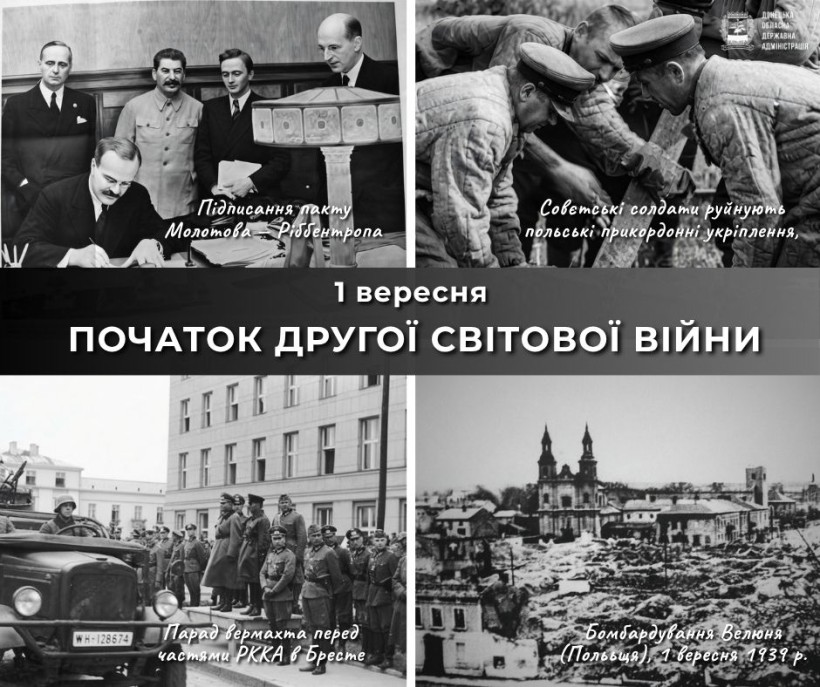
On September 1, 1939, the day Nazi Germany invaded Poland, World War II began. At that time, the first German aerial bombs fell on Lviv, Stryi, Sambir, and other cities in the western Ukrainian territories that were then part of the Republic of Poland. Approximately 120,000 Ukrainians took up arms against the enemy in the ranks of the Polish army from the very first hours of the conflict.
By September 3, Great Britain and France had declared war on Germany, which definitively turned this attack into a global conflict. The Molotov–Ribbentrop Pact of August 23, 1939, laid the groundwork for this tragedy; its secret protocol divided Eastern Europe, resulting in the Soviet Red Army’s occupation of Western Ukrainian territories on September 17. The USSR entered the war on the side of the aggressor, and until Hitler’s attack on the Soviet Union, its propaganda machine had been relentlessly denouncing England and France as the main instigators of the war. For nearly two years, Stalin pursued an aggressive policy of conquest—the war against Finland, the occupation of Lithuania, Latvia, and Estonia, as well as Bessarabia and Northern Bukovina, which belonged to Romania.
Gradually, the conflict engulfed the entire planet, forming several fronts: the European (Western and Eastern), the Pacific, the Mediterranean-North African, as well as the naval Battle of the Atlantic. Against this backdrop, Ukraine’s role became both decisive and tragic: due to their vast resources, Ukrainian lands became the primary target of Hitler’s expansionist plans and a strategic foothold for Stalin.
The Ukrainian people’s contribution to the defeat of Nazism was global: more than 6 million Ukrainians fought in the Red Army (including the legendary pilot Ivan Kozhedub), and tens of thousands fought in the armies of the Western Allies and took part in the Normandy landings (such as Sergeant Michael Strenk). The liberation movement also played a crucial role. The OUN and UPA, led by Roman Shukhevych, fought on two fronts for Ukraine’s independence.
The contribution of Ukrainian women was also a heroic chapter in this history. Hundreds of thousands of Ukrainian women served as liaison officers, doctors, and pilots. Sniper Lyudmila Pavlichenko killed 309 occupiers and became the first Soviet citizen to be received at the White House. In the OUN and UPA underground, women served as scouts and medical personnel for the Ukrainian Red Cross, while the poet Olena Teliga—who, despite all the dangers, returned to Kyiv in 1941 to revive Ukrainian cultural life in the capital—was executed by the Nazis at Babyn Yar.
The immediate consequences of 1939 radically altered the region’s fate. The western regions of Ukraine became part of the Ukrainian SSR. This united most of the Ukrainian lands but brought brutal Sovietization, repression against the intelligentsia, and mass deportations to Siberia. The entire territory of Ukraine was ravaged by fighting twice and completely occupied.
For Ukraine, the end of the war had dual significance. On the one hand, its colossal contribution to the victory and enormous sacrifices (nearly 8 million compatriots killed) received international recognition—Ukraine became one of the founding members of the United Nations. In addition, in June 1945, Transcarpathia was incorporated into the Ukrainian SSR, which practically completed the long process of establishing modern Ukrainian borders. On the other hand, the victory over Nazism did not bring the Ukrainian people the freedom they had longed for, but instead led to the return of communist terror. This was manifested in the deportation of Crimean Tatars and other peoples from Crimea, the mass man-made famine of 1946–1947, the deportations of ethnic Ukrainians from Poland, the resumption of repressions, the re-Sovietization of western Ukraine, and attempts to destroy the Ukrainian Autocephalous Orthodox Church and the Ukrainian Greek Catholic Church, among other things.
Today, Russian propaganda actively cultivates myths about World War II not only within its own country and among states that were once part of the USSR, but also attempts to manipulate public opinion in Europe and around the world. It is precisely the Russian Federation’s appropriation of the status of “chief victor” and its transformation of the victory over Nazism into a cult and war propaganda that has become the ideological foundation of Rashism—the Russian version of Nazism. It poses a threat not only to the independence and sovereignty of our state but also to the international legal order and the security of all humanity, the modern world, and democracy.
Russia, mimicking Nazi rhetoric about “protecting compatriots” and disregarding international law and the Budapest Memorandum, annexed Crimea and launched a war against Ukraine—the largest armed conflict in Europe since World War II, which is likewise accompanied by widespread destruction of cities, war crimes, and acts of genocide.
For over 12 years, Ukrainians have been taking up arms to defend not only themselves but all of Europe from Russian expansion, and they are providing an opportunity to build a more lasting peace and create a new, more just global security system. Today, in the face of this aggression, the only path to restoring peace is to defeat the aggressor.