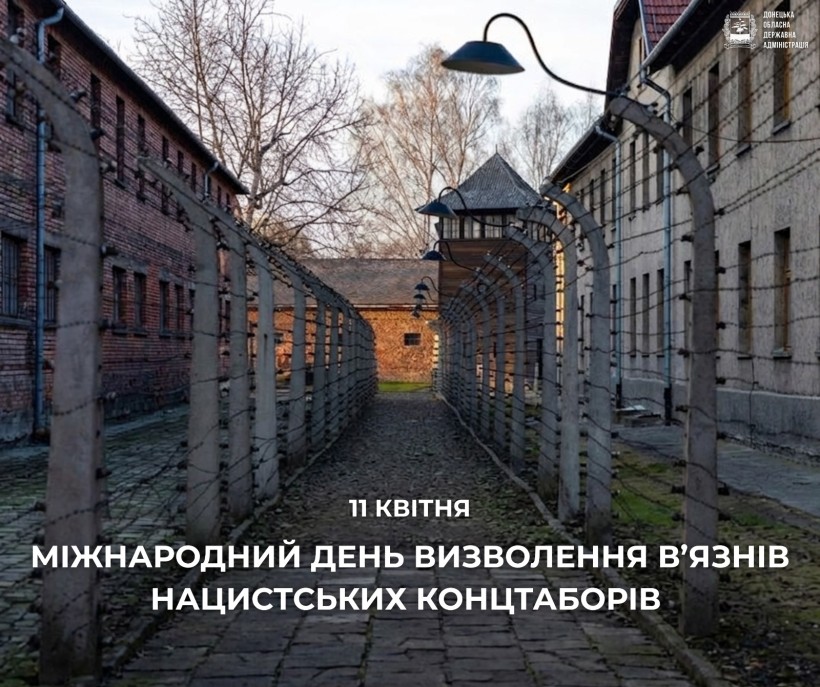
Every year on April 11, the world observes International Day of Liberation of Prisoners of Fascist Concentration Camps. It was on this day in 1945 that prisoners at Buchenwald staged an international uprising against the Nazis and regained their freedom.
Concentration camps became widespread in Nazi Germany. They typically held political prisoners, as well as individuals persecuted on racial, religious, social, and other grounds.
In total, there were more than
14,000 concentration camps. By the Nazis’ own admission, a prisoner whose life expectancy in the camp was less than a year brought the Nazis nearly 1,500 Reichsmarks in net profit.
The Buchenwald concentration camp was built near the city of Weimar and began operations on July 19, 1937. Over the course of 8 years, approximately 239,000 people were imprisoned at Buchenwald. Initially, these were German political prisoners; later, during World War II, they included representatives of many other nationalities. A significant portion of the prisoners died during the construction of the camp, which was carried out without the use of machinery. Prisoners were also exploited by the owners of large industrial firms whose enterprises were located in the Buchenwald area (Siemens, Junkers, and others). During World War II, approximately 10,000 prisoners of war were executed at Buchenwald, 8,500 of whom were Soviet soldiers. In total, over the years of its existence, 56,000 prisoners of 18 nationalities were tortured to death in this concentration camp.
On April 11, 1945, the prisoners of Buchenwald, having learned of the approach of Allied forces, successfully carried out an armed uprising, disarmed and took about 80 guards prisoner, and took control of the camp. Just two days later, American troops stationed nearby reached the camp. By staging the uprising, the Buchenwald prisoners saved themselves from extermination, as the Nazi authorities had issued an order the day before to physically exterminate all prisoners.
At the Nuremberg Trials in 1946, the international court ruled that the imprisonment of civilian citizens of foreign states, as well as the forced use of their labor for the benefit of Germany, was not merely a war crime—it was a crime against humanity.
Russia’s full-scale invasion of Ukraine on February 24, 2022, demonstrated that the world is once again facing a regime that seeks to redraw borders by force and is heading toward a new form of totalitarianism. One example of how the Russians are in many ways emulating the most heinous atrocities of the Nazis—particularly in their treatment of captives in places of detention—is the concentration camp for Ukrainian prisoners of war near Olenivka. On the night of July 28–29, 2022, Russian occupation forces carried out a mass killing of Ukrainian prisoners of war—the defenders of Azovstal in Mariupol. Explosions at Olenivka Colony No. 120, where Ukrainian defenders were being held, killed 53 prisoners and wounded over 130.
Today, Ukraine, together with the entire world, pays tribute to those who endured the hardships of concentration camps. On this day, we pay tribute to the victims of Nazism who perished in concentration camps, including those located on the territory of Ukraine. These are the “Syrets,” “Babyn Yar,” and “Darnitsa” concentration camps, where over 12 million people from 30 countries around the world died during World War II.