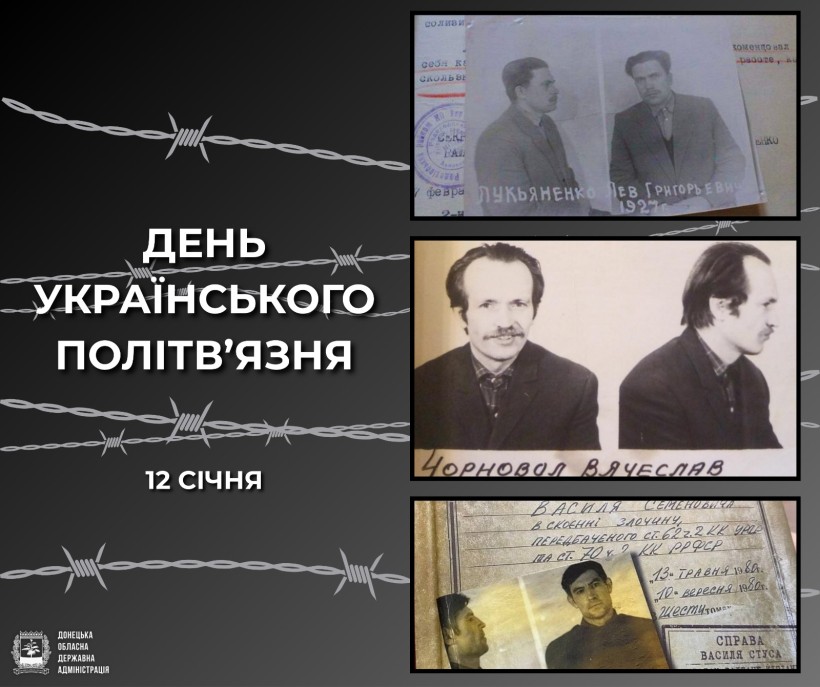
Every year on January 12, Ukraine celebrates Ukrainian Political Prisoners Day, honoring those who have always stood for truth, dignity, and freedom. By defending national interests, their sacrifice and struggle revived the independence of Ukraine, which had been dreamed of by generations of fighters. The tradition of celebrating Political Prisoners' Day was established in 1975 at the suggestion of Vyacheslav Chornovil, who called for resistance to the repression and cruelty of the Soviet regime. The date was not chosen at random. On January 12-14, 1972, the Soviet authorities carried out the largest repressive action against Ukrainian dissidents. Mass detentions and arrests were revenge for their struggle for Ukraine's independence and creativity, which proved the mythical nature of the ideology of the Soviet man.
On this day, we remember Vasyl Stus, Ivan Svitlychny, Igor Kalynets, Yevhen Sverstiuk, Zinoviy Antoniuk, Danylo Shumuk, Vyacheslav Chornovil, Levko Lukyanenko, Mykhailo Osadchy, Petro Hryhorenko, Mykola Rudenko, Ivan Gel, and many others who laid down their lives in the struggle for Ukraine. They were persecuted, thrown into prisons, tortured and subjected to "punitive psychiatry." All of them were true warriors who openly opposed the totalitarian system.
According to the Kharkiv Human Rights Group, between 1972 and 1974, more than a thousand searches were conducted and 193 people were arrested, 100 of them for anti-Soviet propaganda and 27 for religious beliefs.
The Kremlin severely punished those who sought freedom: almost all of them received seven years of imprisonment in strict regime camps and five years of exile — and were deported beyond the borders of their homeland — to Mordovia and the Perm region of Russia, then to Siberia and Kazakhstan. Those whom the regime feared most were sent to mental hospitals.
During the "Khrushchev Thaw" alone, from 1954 to 1964, nearly 800 people were arrested for so-called "anti-Soviet activities."
And in 1965, from August 24 to September 4, in Kyiv, Lviv, Odesa, Ivano-Frankivsk, Ternopil, Lutsk, and Feodosia, KGB agents arrested more than 20 representatives of the Ukrainian intelligentsia.
Historians have calculated that Ukrainian human rights activists and dissidents spent a total of 550 years in Soviet camps, colonies, prisons, and undergoing forced treatment in psychiatric hospitals. Not all of them lived to see their release: Vasyl Stus, Valery Marchenko, Oleksa Tykhyi, and Yurii Lytvyn died in the camps. There were also cases of suicide: on May 25, 1972, in Lviv, on the eve of another interrogation by the KGB, samizdat publisher and engineer Marian Hatala took his own life, and on March 9, 1979, on the eve of his inevitable arrest, Mykhailo Melnyk, a member of the Ukrainian Helsinki Group, did the same. Such was the price for defending human rights and defeating the communist regime.
"What drove me? I was driven by the desire to continue the struggle. I believed it was my duty to raise the blue and yellow flag and carry it forward. To show Muscovy that it had not defeated us, the Ukrainian nation, that the nation was continuing the struggle," recalled Levko Lukyanenko, who spent 25 years in Soviet prisons and torture chambers for "anti-Soviet agitation and propaganda."
Today, the Russian authorities are completely emulating Soviet methods of fighting dissenters. After the temporary occupation of Crimea and the start of armed aggression against Ukraine in the territories occupied by the enemy, a real terror against Ukrainians and Crimean Tatars unfolded. The hostile totalitarian regime is constantly working to create an atmosphere of fear, powerlessness, and hopelessness, throwing activists and human rights defenders behind bars, persecuting people on religious and national grounds, committing mass war crimes, brutal violations of rights and freedoms, and disregarding human dignity. human rights defenders, persecutes people on religious and national grounds, commits mass war crimes, brutally violates rights and freedoms, disregards human dignity, embodies the aggressive doctrine of the "Russian world," and engages in total propaganda that has no connection with the truth...
So today we honor modern heroes who, under various circumstances, have become hostages of the enemy. Behind each of them is a vivid story of struggle, courage, and strength of spirit. Unfortunately, the actual number of current Kremlin captives is not known for certain.
We will never stop fighting for democratic values and rights, truth, and freedom for every citizen of Ukraine!