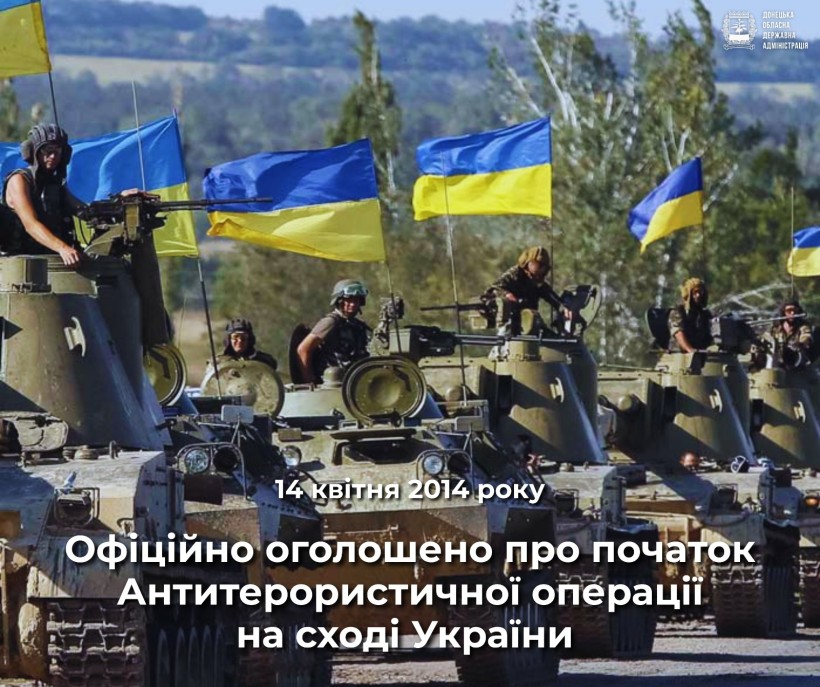
Twelve years ago, on April 14, 2014, the launch of the Anti-Terrorist Operation (ATO) was officially announced in Ukraine. This marked a new turning point in Ukraine’s War of Independence, which had begun several months earlier with the annexation of Crimea.
The announcement of the Anti-Terrorist Operation in eastern Ukraine was preceded by a series of events. In particular, on April 12, 2014, Russian sabotage units under the command of retired FSB Colonel Igor Girkin forcibly took control of the Ministry of Internal Affairs offices in Sloviansk and Kramatorsk. As early as April 13, 2014, special forces of the Security Service of Ukraine engaged in their first battle of the War for Ukraine’s Independence near Sloviansk.
In response to these events, on April 14, 2014, Oleksandr Turchynov announced the start of the ATO. Lieutenant General Oleksandr Lokota commanded the Anti-Terrorist Operation until November 2017. Major General Oleksandr Syrskyi headed the Anti-Terrorist Operation Headquarters. Command of the troops in specific operational areas of the ATO zone was exercised by: Lieutenant General Ruslan Khomchak, Lieutenant General Serhiy Popko, and Major General Ihor Pavlovsky.
As part of the Anti-Terrorist Operation, in June–August 2014, settlements in the east were liberated from Russian occupation. Specifically, on June 4, the city of Lyman was liberated; on June 13, Mariupol; on July 5, the cities of Kramatorsk, Sloviansk, Druzhkivka, and Kostyantynivka; on July 6—Bakhmut; on July 21—Toretsk; on July 30—Avdiivka; on August 1—Krasnohorivka; and on August 5—Maryinka.
With the constant direct involvement of Russian troops, the war in eastern Ukraine turned into a protracted conflict and eventually escalated into a full-scale invasion.
Since the beginning of Ukraine’s War of Independence, the desire to reach the administrative borders of the Donetsk and Luhansk regions has remained a priority and desired goal for Russia. However, as of April 2026, the Russian Federation had not fully occupied either Luhansk Oblast (although it had captured 99% of its territory) or Donetsk Oblast.
Unfortunately, active hostilities continue in Donetsk Oblast to this day. Sloviansk and Kramatorsk remain symbols of resilience and Ukraine’s outposts in the east. They continue to play a key role in containing Russian aggression, serving as vital defensive strongholds, despite the fact that Russian forces regularly launch devastating strikes against them…