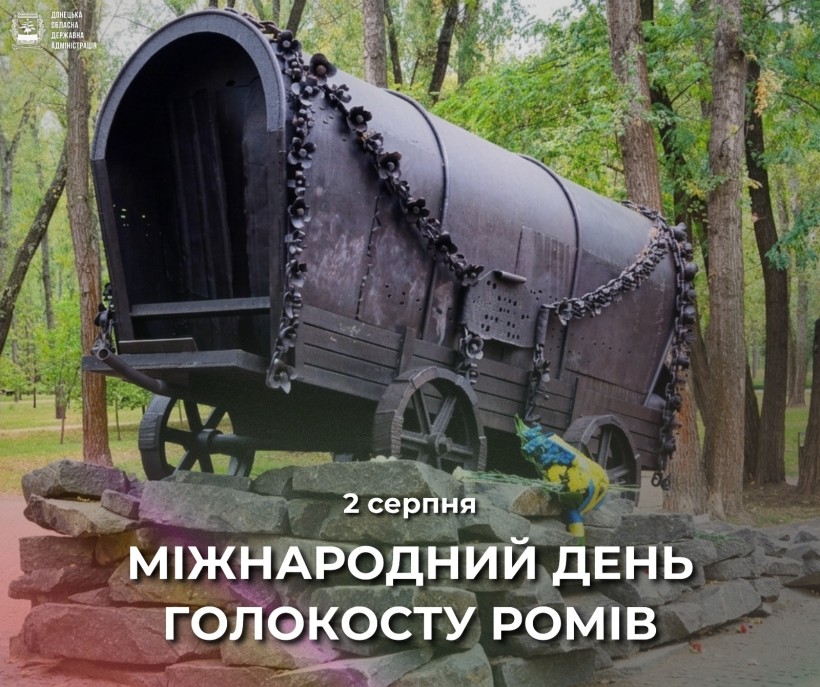
Every year on August 2, the International Day of Remembrance of the Roma Holocaust is observed. It was on the night of August 2–3, 1944, at the Nazi death camp Auschwitz-Birkenau (Oświęcim) that the so-called “Gypsy camp” was completely annihilated. In a single night, approximately 4,300 Romani children, women, and men perished in the gas chambers. According to various estimates, a total of approximately 200,000 members of this ethnic group were exterminated worldwide during the war. In accordance with Resolution No. 2085-IV of the Verkhovna Rada of Ukraine dated October 8, 2004, “On the Commemoration of the International Day of Remembrance of the Genocide of the Roma,” the International Day of Remembrance of the Nazi Genocide of the Roma is observed at the state level in Ukraine.
The Nazis did not initiate and carry out the genocide of the Roma in a vacuum. They ignored anything that contradicted established stereotypes—such as the Roma’s contribution to cultural development or the existence of settled communities. The Nazis exploited and reinforced these prejudices. After coming to power, they gradually isolated the Roma, depriving them of their rights, access to education, and opportunities to earn a living. For example, Roma artists and musicians were expelled from the Imperial Chamber of Musicians and Cultural Figures. Unemployment among the Roma, which was rising due to these restrictions, was presented by the Nazis as proof that the Roma were “asocial.” They could be sent to concentration camps. As a result of the Nuremberg Laws of 1935, marriages between Germans and so-called “foreigners” were prohibited.
That same year, Roma in major cities began to be forcibly relocated to special “camps.” A decree issued by the Criminal Police of the Third Reich on December 8, 1938, referred to the need for a “final solution to the Gypsy question,” which stemmed “from the very nature of this race.”
According to rough estimates, approximately 24,000 Roma perished within the borders of modern-day Ukraine. Calculations of losses in the German-occupied part of Ukraine, based on the 1939 census, suggest that nearly all Roma who lived there before the war—more than 12,000 people—were killed in that territory. Another 12,000 or more of the victims were not locals but had been deported to Ukraine (to Transnistria) from Romania. However, even this estimate is preliminary, as it is based solely on documented cases of murder; there is no data on those who died during forced labor or in ghetto camps.
In 1941, five Romani camps located near Kyiv were shot in Babyn Yar. At the site of the mass shootings of peaceful Romani people on the grounds of the Babyn Yar National Historical and Memorial Complex, a monument titled “Romani Caravan” has been erected.
The catastrophe of the Holocaust did not spare the Donetsk region either. The sites of the largest-scale extermination of Roma in the region are Bakhmut—where, in March–April 1942, Sonderkommando 4b exterminated 200 Roma families (900 people) in a former gypsum mine—and Mariupol, where at least 40 people were killed in 1942.
Local residents saved Roma from the shootings just as they did Jews. But their rescue efforts had their own distinctive features. First and foremost, local residents warned the Roma of impending roundups. Often, representatives of the local administration issued the Roma with false certificates regarding their ethnic origin.
Even after the defeat of Nazism and the international tribunal against Nazi war criminals, discrimination against Roma—including within German society—continued. The victims were blamed for the crime. For example, it was a widespread belief that the reason for the persecution of the Roma lay not in the Nazis’ systematic racial policies, but in the “asocial behavior” of the Roma themselves. It is hard to believe, but as late as the 1970s, the University of Giessen put forward the theory that there was no systematic extermination of the Roma; rather, they were accidental victims of poor sanitary and hygienic conditions. To change the situation, a generational shift was needed, along with an active stance and a civil rights movement among the Roma themselves to defend their rights. The situation in Germany changed significantly only after a week-long hunger strike by Romani men at the memorial site of the former Dachau concentration camp in 1980, which garnered international attention. Two years later, West German Chancellor Helmut Schmidt officially recognized the persecution of the Roma as racism.
It was not until 1996 that leaders of Romani organizations from 10 European countries and the United States, at the “Genocide—Memory—Hope” conference on August 2, designated that date as the International Day of Remembrance for the Victims of the Nazi Genocide of the Roma.
Since gaining independence, Ukraine has implemented policies aimed at the ethnic revival of the Roma, their self-identification, and self-affirmation. The Roma ethno-national community is an integral part of the Ukrainian people, and its history is an integral part of our shared national memory.
Today, on the anniversary of the horrific crime against humanity known as “Porajmos”—which translates from Romani as “Extermination”—we honor the memory of the hundreds of thousands of Roma who were tortured to death during a period of unprecedented immorality and cruelty by the Nazis. This crime reminds us of the importance of combating all forms of genocide. The extermination of nations and the destruction of their identities was the goal of the Nazi and Stalinist regimes back then, and of the Russian regime today.