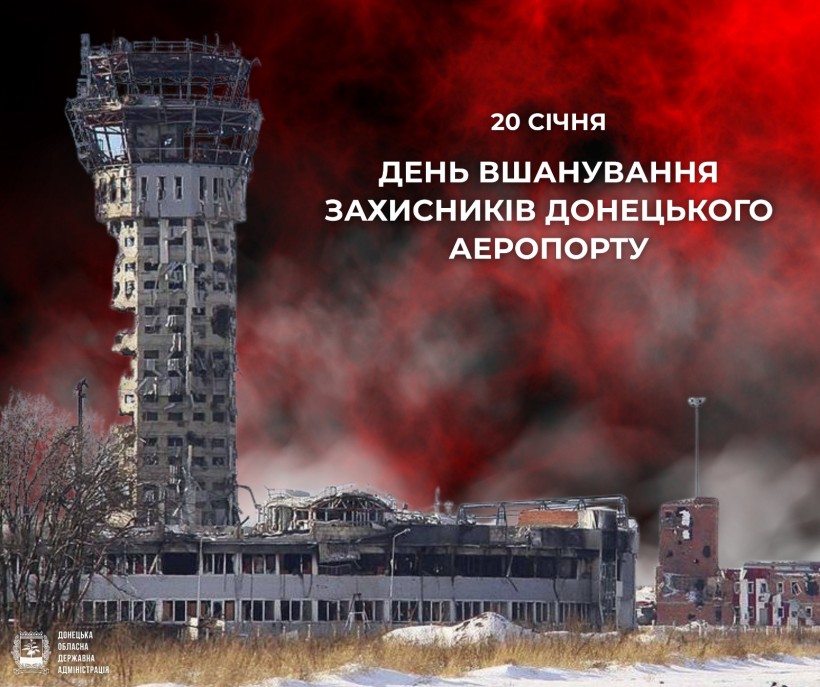
Every year on January 20, Ukraine honors the defenders of Donetsk Airport—the legendary "cyborgs" who held off enemy attacks for a long time. This day has become a symbol of the resilience, self-sacrifice, and strength of spirit of Ukrainian soldiers.
For 242 days, Ukrainian military personnel, volunteers, medics, and volunteers resisted the enemy, fiercely defending a tiny piece of Ukrainian land. The battles for Donetsk Airport began on May 26, 2014, when pro-Russian militants seized the airport buildings in what was then still peaceful Donetsk. On the same day, Ukrainian soldiers, thanks to the coordinated actions of the Ukrainian Air Force and highly mobile airborne troops, struck enemy positions and established control over Donetsk airport.
Later, when Donetsk was occupied, the enemy did not stop trying to take control of the airport, but our soldiers did not give up their positions and, even under heavy fire, held their defenses. Ukrainian military personnel, volunteers, and special forces held the strategic facility under complete siege, under constant artillery fire, air strikes, and assaults from a significantly larger enemy.
At various times, special forces from the 3rd Separate Regiment, fighters from the 79th, 80th, 81st, and 95th Separate Airborne Brigades and the 93rd Separate Mechanized Brigade, the 57th separate motorized infantry brigade, the 90th separate airborne and 74th separate reconnaissance battalions, fighters from the Dnipro-1 regiment, soldiers from the Ukrainian Volunteer Corps (DUK), and others. Many of them were awarded state decorations, some posthumously.
The conditions in which the defenders had to fight are difficult to even imagine. The destroyed terminals turned into ruins, concrete turned to dust, and the winter frosts became a real test. The defenders constantly faced shortages of water, food, and ammunition, which were worth their weight in gold. They had to sleep in fits and starts, often right on the cold floor or among the rubble, but despite everything, the soldiers returned to their positions every time, ready to continue the fight. Their resilience was not based solely on weapons. Their endurance, mutual support, and unshakable belief that Ukraine would be able to stand with them were decisive factors. The defense of Donetsk Airport was based not on weapons, but on the character and strength of spirit of the fighters.
On January 21, 2015, a decision was made to withdraw Ukrainian troops, as the facility had been completely destroyed as a result of numerous battles and had become unsuitable for defense. On January 22, 2015, 20 fighters left the terminal area under fire.
Russian propagandists called the Ukrainian defenders "cyborgs," unable to believe that ordinary people were not only capable of enduring such harsh conditions, but also willing to continue fighting in the hell of the destroyed airport. For Ukrainians, however, this word took on a different meaning — it became a symbol of superhuman resilience, courage, and unyielding spirit, the embodiment of the image of a modern warrior for whom honor, brotherhood, and freedom are more valuable than fear or exhaustion.
Since the beginning of Russia's full-scale invasion of Ukraine in 2022, the feat of the "cyborgs" has taken on new meaning. For thousands of Ukrainian soldiers, it has become an internal benchmark of resilience — to hold on, not to give up, to support their comrades even in the most difficult moments. The "cyborgs" proved that resilience is not just a beautiful word, but a daily choice that allows one to remain a dignified person even in the most brutal circumstances of war.
The memory of the defense of Donetsk Airport is not just about the past. It is also the embodiment of the values on which modern Ukraine is based. The phrase "The cyborgs held out — the concrete did not" has become more than just a phrase. It is confirmation that heroism does not disappear with the ruins. It becomes part of the national character, inspiring and giving strength to continue the struggle for the future.