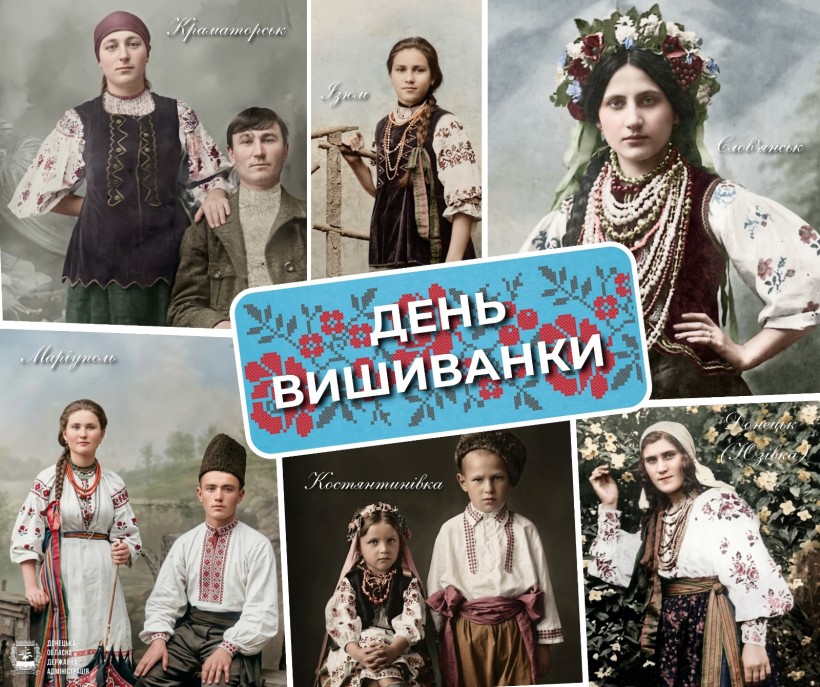
Vyshyvanka Day is a relatively new but already deeply symbolic holiday celebrated annually in Ukraine on the third Thursday of May. It was launched in 2006 on the initiative of the student community at Yuriy Fedkovych Chernivtsi National University, and since then it has grown into a nationwide and international event that unites millions of Ukrainians in various corners of the world.
The vyshyvanka is not merely an element of traditional clothing, but a bearer of the nation’s deep cultural code. Its ornaments, colors, and techniques have evolved over centuries and reflect Ukraine’s history, worldview, and regional characteristics. Geometric patterns are traditionally associated with ideas of harmony and order in the world; plant motifs symbolize life, rebirth, and prosperity, while zoomorphic motifs represent strength and protection.
The regional diversity of Ukrainian embroidery is exceptionally rich. The Poltava region is characterized by restrained, delicate ornaments, often executed using the “white-on-white” technique. Podillia is distinguished by a combination of rich colors—primarily red and black—with clear geometric elements. In the Hutsul region, bright, multicolored compositions with fine detail are common, while the Chernihiv region is characterized by restrained geometric patterns dominated by red and black.
The Donetsk region holds a special place in the contemporary interpretation of traditions. The embroidery of this region developed amid the historical intersection of various cultures and traditions, which has influenced its artistic characteristics. Researchers note that the region as a whole is characterized by a combination of traditional Ukrainian motifs with elements typical of southern and eastern ornamental influences.
Embroidery from the Donetsk region often uses contrasting color combinations—primarily red and black, sometimes with the addition of blue or green shades. Both geometric patterns and stylized plant motifs—branches, flowers, and grapevine elements—are common, symbolizing vitality and the continuity of tradition.
At the same time, it is important to note that the Donetsk region does not have a clearly unified embroidery school, and ornamental features may vary depending on the specific locality. Different communities exhibit their own variations in composition, stitch density, and color palette. In particular, more restrained ornaments, similar to the traditions of central Ukraine, are more common in the northern regions, while the southern regions feature brighter and more decorative designs. These differences reflect the living nature of the folk tradition, which has evolved under the influence of historical, social, and cultural factors. In the western regions of the oblast, patterns closer to general Ukrainian traditions are more common—with a predominance of geometric motifs (diamonds, crosses, broken lines) and a more subdued color palette. In contrast, in the eastern regions, stylized plant elements are more widely represented alongside geometric ones, and the ornaments themselves can be more decorative and rich in color.
Such differences are relative and depend on historical, social, and family traditions, yet it is precisely these differences that highlight the multifaceted nature of the region’s cultural heritage and the vibrant character of folk art.
Today, Vyshyvanka Day is not only a celebration of traditions but also a symbol of the unity of the Ukrainian people. In the face of modern challenges, it takes on special significance as an expression of national identity, cultural memory, and inner resilience. By wearing a vyshyvanka, Ukrainians affirm their connection to a shared history and preserve the bond between generations, reaffirming their faith in a future where traditions remain alive and relevant.