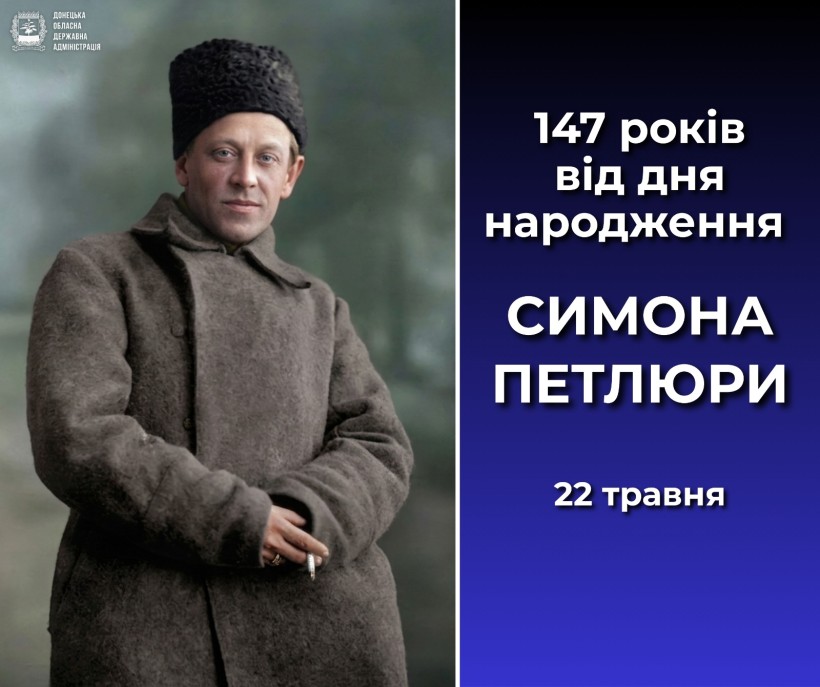
I believe and am certain that Ukraine will exist as a state. Perhaps not as large as we would like right away, but it will exist. I believe that the path to Ukrainian statehood lies through Kyiv, not through Lviv. Only when Ukrainian statehood is firmly established on the banks of the Dnipro and near the Black Sea can we realistically consider the reunification of Ukrainian lands seized by our neighbors.
Symon Petliura
At the end of May, Ukraine honors the memory of Symon Petliura. May 22 marks the 147th anniversary of his birth, and May 25 marks 100 years since his death at the hands of a Moscow agent.
Throughout his life, Symon Petliura fought for Ukrainian independence through the written word: as a journalist, art critic, and editor of leading Ukrainian magazines. During the harshest times of Russian censorship, he organized underground printing presses. And he embarked on the path of revolutionary journalism thanks to a song. When Mykola Lysenko arrived in Poltava for the Shevchenko celebrations in 1901—where Petliura was studying at the seminary—the music-loving seminarian invited the composer to listen to the seminary choir, under his direction, perform Lysenko’s cantata “The Rapids Roar” to lyrics by Taras Shevchenko. The seminary rector burst into the unauthorized concert, accused Lysenko of a “Mazepa-style conspiracy,” and Petliura was expelled from his final year at the seminary.
In 1902, Symon Petliura moved to the Kuban, where he founded an underground printing press with like-minded individuals to distribute revolutionary proclamations to the population. There he began his career as a journalist. He sent his first publications to the Lviv-based “Literary and Scientific Herald.” He wrote mainly about culture: education and theater, archaeological finds, and Oleksandr Koshyts’s Kuban expeditions. He criticized the Russian Orthodox Church as an instrument of the tsarist regime’s Russification policy.
In 1905, Symon Petliura moved to Lviv, where he worked as co-editor of the Revolutionary Ukrainian Party’s magazines *Selianin* and *Pracia*. In 1906, he edited the magazine *Vilna Ukraina* in St. Petersburg. In 1907, he became secretary of the newspaper “Rada” in Kyiv. In addition to social and political journalism, Petliura wrote reviews of Ukrainian and foreign books, published music and theater reviews, and printed anniversary dedications to cultural figures.
In 1910, the already well-known journalist moved to Moscow, where he headed the Ukrainian press in the heart of the hostile empire—the magazine “Ukrainian Life.” From 1912 to 1916, as the publication’s editor, he worked with the finest Ukrainian authors. He wrote extensively himself, once again focusing on culture. In 1914, he prepared an entire issue dedicated to the 100th anniversary of Taras Shevchenko. When Petliura returned to Kyiv in 1917 and headed the Ministry of War of the Ukrainian People’s Republic, he did not forget about culture there either. In one of his appeals to the public, he asked citizens to donate money to purchase Ukrainian literature for the front.
At the same time, Petliura was one of the founders of the Ukrainian armed forces. His experience in the Ukrainization of the army and his conviction that statehood is impossible without a strong military are fundamental to modern Ukraine. Unlike some of his contemporaries, who believed in militia units, Petliura insisted on a regular army to repel the Bolshevik threat.
In December 1917, Bolshevik Russia launched a war of aggression against the Ukrainian People’s Republic (UNR). On the last day of 1917, in protest against the pro-Bolshevik stance of Vynnychenko, the head of the General Secretariat, Petliura resigned from the government, and by early January 1918, he had taken command of the Haidamaka Kish of Sloboda Ukraine. In Kyiv, he formed a company of Black Haidamaks (up to 150 soldiers) from volunteers of the Second Infantry Youth School, which became part of the Kish.
He led the Haidamaks in battle against the Bolshevik forces. He saw his first combat in the Poltava region during the battles for Hrebinka. Later, Kish joined the suppression of the January Bolshevik uprising in the capital. Petliura took part in defensive battles in Kyiv against the invasion of Mikhail Muravyov’s Bolshevik troops.
On December 19, 1918, the Ukrainian army entered Kyiv. The restoration of the republican system and the UNR began. On January 22, 1919, the UNR Directory solemnly proclaimed a universal declaring the unification of the UNR and the ZUNR into a single state. At this time, Bolshevik Russia launched its second armed aggression against Ukraine. On February 11, Symon Petliura took the helm of the Directory. Under difficult internal and external conditions, for 10 months he led the armed struggle of the UNR Army against the Red and White Armies. Under these circumstances, he devoted considerable attention to negotiations with representatives of the Entente, Romania, and Poland. After the conclusion of the Warsaw Treaty with Poland, Ukrainian troops, together with the Polish army, launched an offensive against the Bolsheviks and captured Kyiv on May 7, 1920. In October 1920, Poland concluded an armistice with Soviet Russia. The UNR troops, which crossed the Zbruch River in November 1920, were interned.
In 1921, Symon Petliura was forced to leave Ukrainian territory. However, he did not abandon the political struggle for the independence of the UNR.
Wherever he was, the Chief Ataman engaged in journalism and, most importantly, led the government-in-exile. The government-in-exile of the Ukrainian People’s Republic was established in Poland in 1921, then underwent various transformations until, in 1924, it was renamed the State Center of the UNR in Paris. The Center focused its efforts on securing recognition from the nations of the world and obtaining material, moral, and military support, primarily for intelligence, military, and informational operations against the communist regime. Thanks to Petliura’s organizational talents, the State Center of the UNR became the hub of the Ukrainian people’s long struggle for a national state.
On May 25, 1926, in Paris, Symon Petliura was assassinated by the Bolshevik agent Samuel Schwarzbart. The Chief Ataman was buried on May 30 at the Montparnasse Cemetery in Paris.
Historians draw direct parallels between the events of 1917–1921 and the current War for Ukraine’s Independence. Petliura became a symbol of resistance to Moscow’s expansionism—and it is precisely for this reason that Soviet propaganda spent decades trying to discredit his name, turning the term “Petliurism” into a stigma.
Petliura worked to develop national self-identity through literature, theater, and journalism. He understood the importance of the cultural front and of promoting the Ukrainian cause in Europe, which remains critically important in today’s reality of information warfare.
The figure of Symon Petliura today is not just about the past, but about the lessons of preserving statehood, the necessity of unity, and the role of the army as a guarantor of freedom.