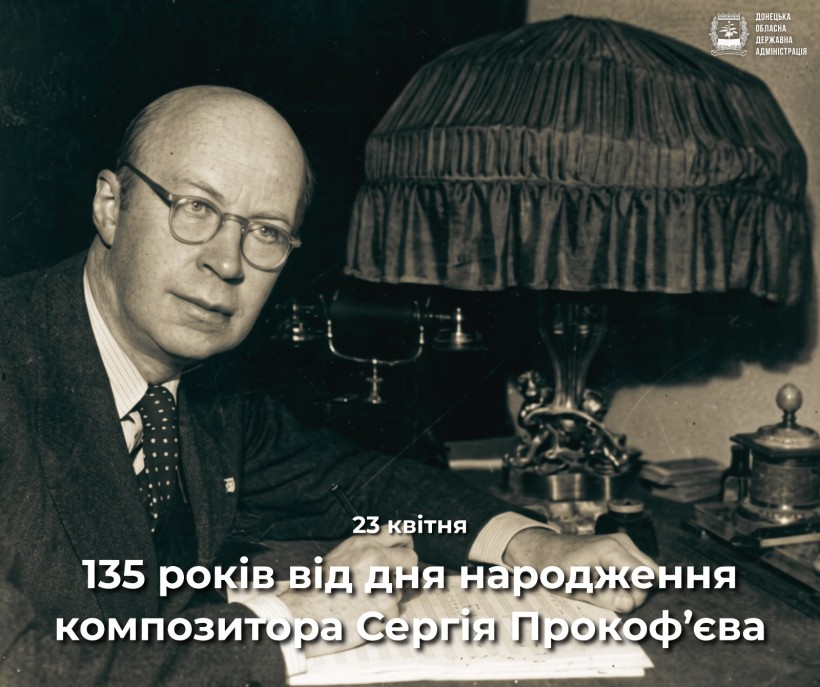
On April 23, 1891, at the Sontsivka estate in the Bakhmutsky District of the Yekaterinoslav Governorate (now the village of Sontsivka in the Pokrovsky District of the Donetsk Oblast), the future world-renowned composer and pianist Sergei Prokofiev was born.
The future composer’s mother was considered a decent pianist and instilled an interest in music in her son. Later, Prokofiev recalled how, in his early childhood, as he was falling asleep, he would hear “somewhere far away, several rooms away, Beethoven’s sonatas, Chopin’s preludes, mazurkas, and waltzes, and sometimes something by Liszt.”
At the age of five, Sergei sat down at the piano himself and almost immediately began composing music. By the age of nine, he had already written his first opera. Noticing their son’s talents, his parents invited the distinguished musician and teacher Reinhold Glière to teach him.
At the age of 13, Sergei Prokofiev enrolled at the St. Petersburg Conservatory. By that time, the young composer from Ukraine had already composed four operas, a symphony, two sonatas, and several piano pieces. In 1909, he graduated from the conservatory as a composer; in 1914, as a pianist; and in 1917, as an organist. At his final exam, he brilliantly performed his First Concerto.
Even while still a student, he became a renowned European performer. He gave his first concert in 1908, when he was only 17, and in 1913 he successfully completed his first concert tour of Europe. Music critics noted a certain flamboyance in Prokofiev’s music and his performance style, yet everyone understood that he was a phenomenon. Newspaper headlines of the time were filled with emotional expressions: “A titan of the piano,” “A volcanic eruption at the keyboard,” “A carnival of cacophony,” “An attack of mammoths on the Asian plateau,” “The Paganini of the piano.”
After the October Revolution of 1917, Prokofiev chose to emigrate and traveled via Japan to the United States; later, he lived for some time in Germany and France, and also toured in England, Italy, Spain, and other countries. Abroad, he associated with Sergei Rachmaninoff, Pablo Picasso, and Henri Matisse.
Prokofiev became very famous in the West; his name joined the pantheon of brilliant figures in the artistic world. At the same time, he never gave up hope of returning to his homeland. While in exile, he returned three times to Soviet Russia for concert tours, and in 1936 he decided to return to Moscow permanently. He was accompanied by his wife—Karolina Kodina, the daughter of Russian émigrés whom he had met in Spain—and his two sons, Svyatoslav and Oleg.
Prokofiev’s return was both a triumph and a tragedy. On the one hand, the USSR and Stalin personally immediately elevated him to a propaganda icon. He won the Stalin Prize six times (three of those in 1946 alone). He composed the music for Sergei Eisenstein’s historical films *Alexander Nevsky* and *Ivan the Terrible*, which enjoyed immense popularity.
But as early as 1948, Sergei Prokofiev, along with a number of other leading Soviet composers (Shostakovich, Myaskovsky, Popov, Shebalin, Khachaturian), accused of so-called “formalism in art,” became the target of political persecution. At the First Congress of Composers of the USSR in 1948, Sergei Prokofiev was subjected to harsh criticism.
This persecution undermined the composer’s health, as he suffered from hypertension. In the years that followed, he was frequently and seriously ill, rarely leaving his apartment or his dacha. Yet, even until his death, he continued to compose music.
Sergei Prokofiev passed away on March 5, 1953, the day of Stalin’s death. Due to this coincidence, the great composer’s death went completely unnoticed, and his friends had to make considerable efforts to organize his funeral.
The composer’s creative legacy consists of 130 musical works, including 8 operas, 8 ballets, 7 symphonies, and 9 concertos for orchestra, all of which have become part of the world’s musical heritage.
Based on materials from the Ukrainian Institute of National Memory