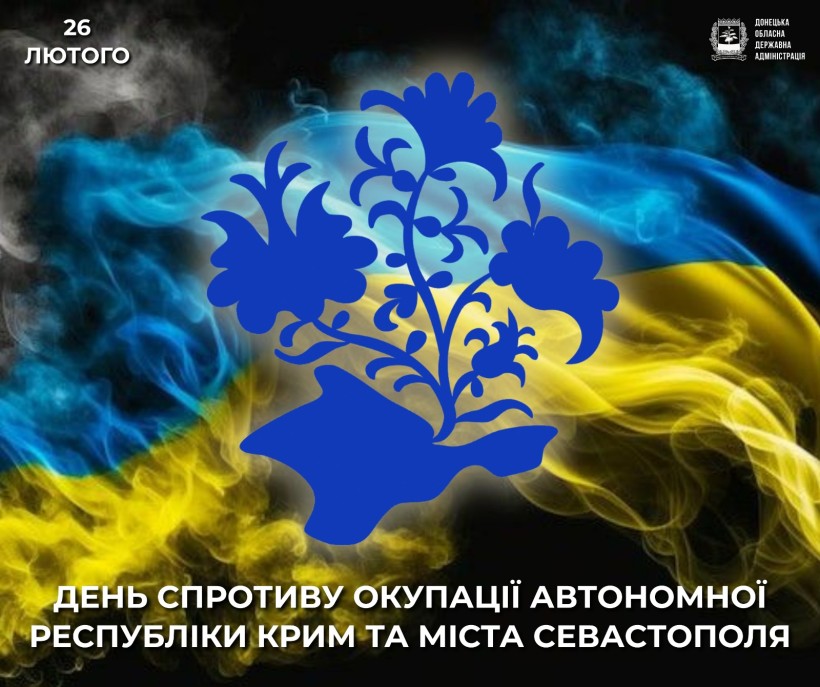
This memorable date was established in 2020 by Decree of the President of Ukraine No. 58 to honor the courage and heroism of Ukrainian citizens living in the temporarily occupied territory – the Autonomous Republic of Crimea and the city of Sevastopol.
In February 2014, Russia launched a military operation to seize Crimea, using regular units of the Russian Federation's armed forces. The residents of the Crimean peninsula did not submit and did not accept the occupiers.
On February 26, 2014, thousands of people gathered near the building of the Verkhovna Rada of the Autonomous Republic of Crimea – Crimean Tatars, Ukrainians, and representatives of other nationalities. They spoke out in favor of preserving the territorial integrity of Ukraine and against the organization of an extraordinary session of the Crimean parliament, which pro-Russian activists had called for on February 25, 2014. The latter demanded that the session consider the issue of holding a so-called "referendum on Crimean independence," but thanks to a rally of thousands of citizens, the extraordinary session of parliament was prevented.
However, a day after this rally, Russia moved to an open phase of force: armed soldiers without identification marks seized the buildings of the parliament and government of the Autonomous Republic of Crimea and the city of Sevastopol, and began to block Ukrainian military units, airports, and land routes to mainland Ukraine.
Ukrainian law defines February 20, 2014, as the date of the start of the Russian Federation's armed aggression against Ukraine. International organizations recognize the fact of this aggression and the illegality of the occupation of the Crimean peninsula.
February 26 has become a day of special significance as a day of open resistance to the Russian occupation of Crimea, which continues to this day, becoming a starting point for civil resistance on the peninsula. Crimean residents are resisting in various ways: from peaceful civic activism to participating in the defense of Ukraine on the front lines or behind enemy lines. This day serves as a reminder of the ongoing struggle to liberate Crimea from Russian invaders.
Crimea under occupation is a territory of systematic human rights violations. Torture, enforced disappearances, political persecution, and oppression of journalists, activists, ethnic Ukrainians, and Crimean Tatars have been documented in Crimea. Crimean Tatars are an indigenous people who are subjected to targeted repression. Russia is pursuing a policy of Russification, banning the Mejlis, and suppressing the Crimean Tatar language and culture, which is a form of systematic discrimination.
As of early February 2026, 284 people on the Crimean peninsula are subject to a policy of judicial persecution, 159 of whom are Crimean Tatars. Russia fabricates criminal cases and passes sentences without any evidence, as human rights activists and defenders of political prisoners constantly emphasize. In addition, the occupation authorities put pressure on political prisoners, keep them in poor conditions, conceal their real condition, and do not provide them with medical care. As a result, the health of political prisoners is systematically deteriorating. For example, Tofik Abdulgaziev, sentenced to 12 years, was diagnosed with a brain tumor and tuberculosis of the lungs while in prison, which directly threatens his life. Another political prisoner, Amet Suleimanov, has been denied necessary heart surgery by the occupiers for years.
After 2022, the occupiers intensified their persecution of those who resisted the occupation. Any manifestation of a pro-Ukrainian position can be grounds for searches, detentions, and subsequent imprisonment. Security forces come to people because of comments in support of Ukraine on social networks or even because of the use of blue and yellow emojis. The occupying authorities interpret such actions as "extremism" or "discrediting the Russian army" and "treason." For example, Galina Dovgopol, one of the oldest Crimean political prisoners, was sentenced to 12 years in a general regime colony for alleged "treason" and "cooperation with Ukrainian intelligence." Human rights activist and journalist Irina Danilovich was illegally convicted for allegedly storing an explosive device. There are hundreds of similar stories. The practice of holding people incommunicado without formal charges remains common.
Occupied Crimea has been turned into a military base for aggression against Ukraine. From the territory of the peninsula, the Russian army is carrying out systematic missile strikes on peaceful cities in Ukraine, and the peninsula has become a logistics hub used by the Russian armed forces to conduct military operations in southern Ukraine. The de-occupation of Crimea is not only a matter of territorial integrity, but also of the security of Ukraine and the Black Sea region as a whole.
According to information from the Office of the President of Ukraine in the Autonomous Republic of Crimea