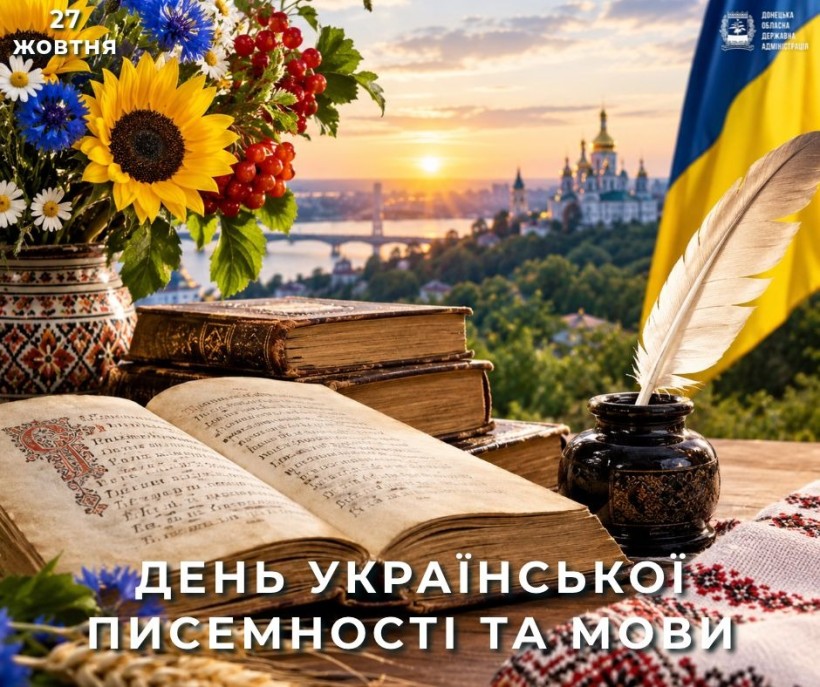
On October 27, the day commemorating the Venerable Nestor the Chronicler, Ukraine celebrates Ukrainian Literacy and Language Day.
The monk Nestor, author of the magnificent “The Tale of Igor’s Campaign,” and the unknown artisans who left graffiti-like inscriptions scratched onto the walls of St. Sophia Cathedral in Kyiv unwittingly documented the birth of a unique linguistic system. On these millennia-old walls, researchers find distinctly Ukrainian inflections, the dative case ending in “-ovi” and “-evi,” as well as words that every child can still understand today: prince, blacksmith, husband and wife, bread. The Ukrainian language grew out of dialects of Proto-Slavic origin, developing as an independent, rich, and melodious language.
The Ukrainian language has endured perhaps the greatest number of official bans and acts of linguicide in human history. Invaders and colonizers of all eras were acutely aware of a fundamental truth: language is the genetic code of a nation. Russian imperialism began the systematic elimination of Ukrainian autonomy as early as the eighteenth century, when Peter I issued a decree in 1720 imposing a strict ban on the printing of new books in the Ukrainian language at the Kyiv and Chernihiv printing houses.
Later, in 1863, Minister of the Interior Pyotr Valuyev signed a secret circular that cynically asserted that “there was no such thing as a distinct Little Russian language, there is none now, and there cannot be one,” thereby completely blocking the publication of educational, scientific, and religious literature. Then, in 1876, Emperor Alexander II, while vacationing at a German resort, signed the Ems Decree. This document effectively outlawed the Ukrainian language: it was forbidden to import any Ukrainian publications from abroad, to print original works of fiction, to stage theatrical performances, to recite texts at concerts, and to teach children in Ukrainian in elementary school. Even sheet music with Ukrainian lyrics was banned.
In the twentieth century, the Soviet totalitarian machine continued the imperial language policy. After a brief and deceptive thaw in the 1920s, the period of the bloody “Executed Renaissance” began. In the 1930s, in the NKVD dungeons, at Sandarmokh, and on the Solovki Islands, an entire generation of brilliant Ukrainian poets, writers, translators, and scholars was physically annihilated, including Les Kurbas, Mykola Khvylovy, Valerian Pidmohylny, and Mykola Zerov. At the same time, Soviet officials artificially altered the very structure of the language. In 1933, a forced spelling reform was carried out. A striking example was the removal of the letter “Ґ” from the alphabet, which was declared bourgeois. Thousands of native Ukrainian terms and synonyms were removed from dictionaries and replaced with calques from Russian to create the illusion of a “merging of nations.”
The subsequent decades of postwar Russification methodically pushed the Ukrainian language out of higher education, science, public administration, and television, creating an artificial, demeaning myth that Ukrainian was exclusively a rural, outdated, and backward language, while Russian was promoted as a mark of civilization and career success.
Despite these trials, the Ukrainian language has endured, retaining its incredible inner strength and astonishing richness. Our language possesses tremendous lexical potential—the synonymic range for the word “horizon” alone includes more than ten poetic equivalents, among them obriy, neboskhil, kraynobo, vidnokolo, and zorinnya. It has a unique vocative case, preserved as an ancient treasure, which lends every address a unique melodiousness and emotional depth. This flexibility and euphony allowed Ukrainian literature to produce world-class masterpieces even during the darkest days of the underground.
Today, Russian invaders continue their policy of linguicide in the occupied territories. They are destroying Ukrainian books, including textbooks, and forcibly implementing education based on Russian standards.
Ukrainian Writing and Language Day is a symbol of Ukraine’s statehood and independence, the foundation of unity, and the preservation of cultural heritage. During Ukraine’s War of Independence, the role of the Ukrainian language grew immensely and gained new leverage in consolidating society. It is the language that ensures the unity of Ukrainians, safeguards the preservation of national identity, and strengthens national consciousness. A striking manifestation of nationwide solidarity is the All-Ukrainian Radio Dictation of National Unity, for on October 27 at 11:00 a.m., millions of hearts around the world begin to beat in unison. Soldiers in damp dugouts under fire, Ukrainians in various countries around the world, schoolchildren in shelters, and doctors on call all simultaneously pick up sheets of paper and write the same text.
Our language has endured despite all the circulars and decrees. To nurture and preserve it is our sacred duty to the generations of ancestors who bequeathed to us the priceless opportunity to speak freely on our own land, and to those heroes who are defending this right right now on the front lines.