On September 9, 1944, the Polish Committee of National Liberation and the government of the Ukrainian SSR signed an agreement on the “mutual exchange of populations”: Ukrainians from Polish territory to the Ukrainian SSR and Poles from Ukrainian territory to Poland.
In accordance with this agreement, between 1944 and 1946, over 480,000 ethnic Ukrainians were relocated from Poland to the Ukrainian SSR. Various methods were used to influence people—ranging from psychological pressure (through propaganda, blackmail, intimidation, etc.) to physical force involving the military.
After the agreement expired, approximately 150,000 Ukrainians remained in eastern Poland. The Soviet authorities refused to accept them into the Ukrainian SSR. Consequently, a plan emerged to resettle Ukrainians deeper into Poland, to its sparsely populated western and northern regions, which had belonged to Germany until the end of World War II.
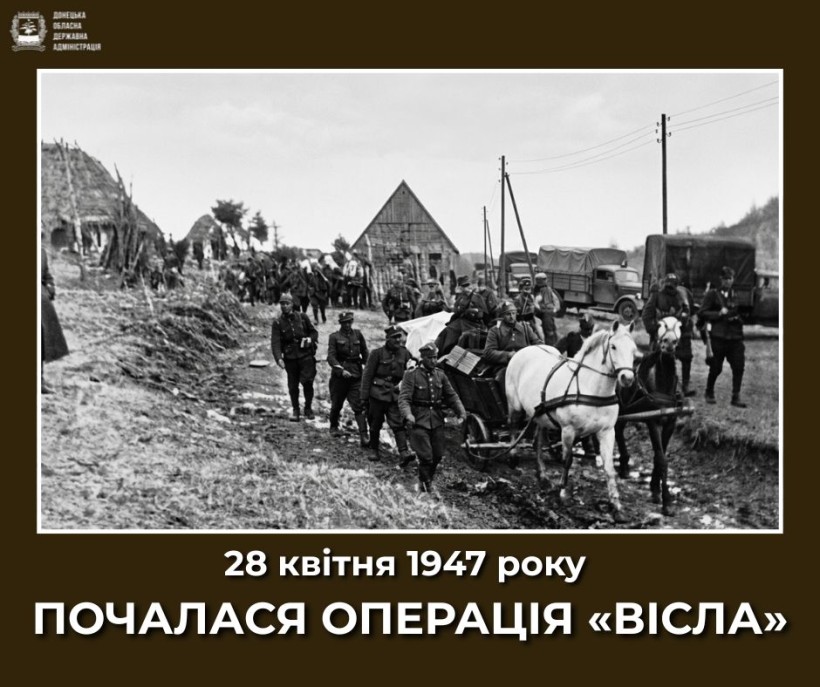
On April 24, 1947, the Presidium of the Council of Ministers of Poland adopted a resolution regarding Operation Vistula. At 4 a.m. on April 28, the task force began its operation. They proceeded as follows: at dawn, soldiers surrounded the villages in a tight ring and ordered residents “on the list” to prepare for the journey. The operation was often accompanied by violence: they conducted searches in homes, outbuildings, and yards, and sometimes even set Ukrainian homes on fire and destroyed ancient churches. People were given two hours (sometimes 15–20 minutes) to pack their belongings. They were allowed to take personal belongings, food, livestock, and supplies of grain and potatoes. Due to the rush and lack of transportation, the displaced people could only “grab” the bare essentials. Often, limits were set on the weight of luggage—up to 25 kilograms per person. After loading their belongings, the column of people, under armed guard, set off for the assembly point. Such “marches” sometimes lasted over 20 hours. People from several localities gathered at a single point and waited for transport to the loading railway station. Representatives of the Ukrainian intelligentsia and peasantry, suspected of aiding the UPA, were imprisoned in a concentration camp in Jaworzno, Kraków Voivodeship, established specifically for “suspicious” Ukrainians on the site of the former Nazi concentration camp “Auschwitz-Birkenau.”
In their “new” locations, the resettlers were given farms abandoned—and often ravaged—by their former German owners. Ukrainians were deprived of churches, schools, and other opportunities to develop their own social and cultural life. Polish authorities persecuted even the slightest manifestations of the everyday cultivation of Ukrainian national and cultural traditions.
On July 29, 1947, Operation Vistula ceased operations, transferring its authority to the Kraków District Operational Group. The deportation campaign lasted three months. As a result of these events, the Polish communist authorities eliminated the Ukrainian population in the country’s southeastern provinces, dispersing 140,575 Ukrainians—as well as Poles married to Ukrainians—across western and northern Poland. A total of 315 people were arrested and convicted, of whom 173 were executed. By the end of 1947, over 10,000 more people had been captured and deported. To completely prevent Ukrainians from returning to their homeland, they were prohibited from changing their place of residence.
By a government decree of August 27, 1949, Ukrainians were deprived of their rights to the farms from which they had been evicted and to the property left behind there.
The communist authorities attempted to justify this campaign by presenting it exclusively as an anti-insurgency operation. In reality, however, the main goal was the complete expulsion of the Ukrainian population, not merely the elimination of UPA units. Since, first, the Ukrainian underground at that time numbered about 2,000 people—10 times fewer than the troops of the “Vistula” Operational Group—and, second, the Operational Group’s troops were tied specifically to populated areas rather than to insurgent units, the main target of the operation was the civilian population. The operation’s planning documents stated that its goal was “the final resolution of the Ukrainian problem in Poland.”
On August 3, 1990, the Polish Senate condemned Operation Vistula. On April 27, 2007, Polish President Lech Kaczyński and Ukrainian President Viktor Yushchenko condemned Operation Vistula in a joint statement. Today, it is generally accepted that the operation was a crime of the communist regime and a crime against humanity.