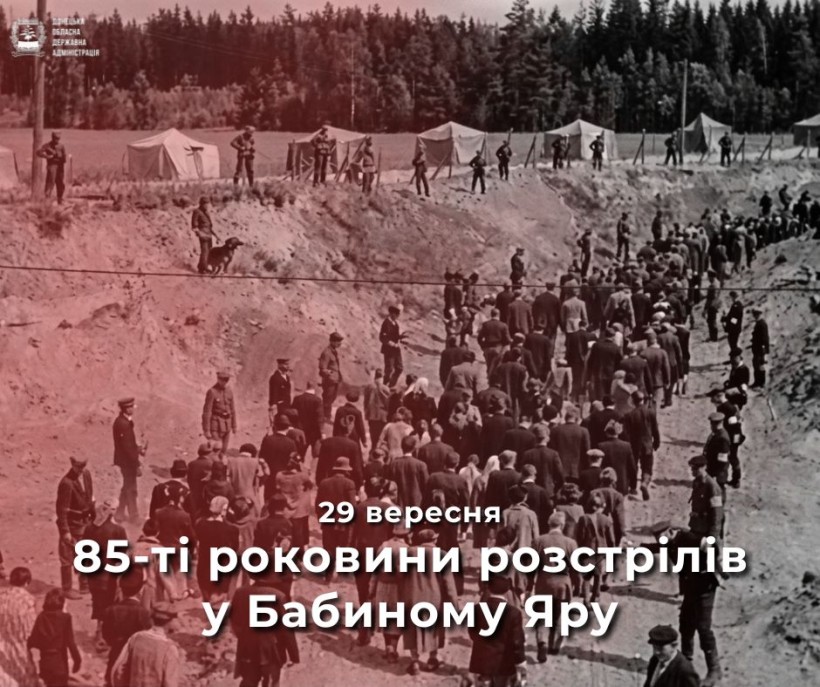
On September 29, Ukraine and the entire civilized world honor the memory of the victims of the Babyn Yar tragedy, which remains one of the deepest and most painful wounds in humanity’s collective memory, symbolizing the horrific catastrophe of the Holocaust and the ruthlessness of totalitarian regimes. Babi Yar is a mass grave for more than 100,000 civilians—including adults, children, the elderly, and prisoners of war.
This Kyiv site was transformed into a “conveyor belt of death” in September 1941, when, over the course of two days—September 29 and 30—Nazi occupiers executed nearly 34,000 Jews—residents of Kyiv. Children under the age of three, who were also mercilessly killed, were not included in these horrific statistics. People were marched there along the “road of death” on the Nazis’ orders, carrying documents, money, and valuables, which were taken from them and burned even before their execution.
The shootings at Babi Yar took place almost daily for over two years—from the Nazi and Allied invasion of Kyiv in September 1941 until the end of Hitler’s occupation of the city in November 1943—and became known as a symbol of the “Holocaust by bullets.” Over the course of two years of German occupation, Babyn Yar “claimed” the lives of about 100,000 people—Jews, Roma, Ukrainian nationalists, prisoners of war, patients at a psychiatric hospital, and concentration camp inmates. During this time, virtually the entire Jewish population of the city was exterminated.
Researchers have estimated that during the shootings, the punitive units took the lives of approximately 40–45 people every minute; the youngest victim was only three days old, while the oldest was 103 years old.
The Nazi operation at Babi Yar became one of the largest punitive actions of World War II. Most towns and villages in Ukraine have their own “Babyn Yar”—sites of Nazi shootings of Jews and other victims.
The tragedy of Babyn Yar is not only the physical extermination of people but also an attempt to erase the memory of them. As they left Kyiv, realizing that inevitable punishment awaited them for the atrocities they had committed, the Nazis tried to cover up the traces of their crimes: they forced prisoners at the Syrets concentration camp to dig up the graves and burn the bodies in huge open furnaces.
The Soviet authorities also tried to erase the memory of the tragedy. For decades, the Soviet leadership did not dare to call the extermination of the Jews what it really was—genocide. The victims of Nazi crimes were referred to as “Soviet citizens” or “civilians,” avoiding any mention of the fact that the overwhelming majority of those shot in Babyn Yar were Jews. Their only “crime” in the eyes of the Nazis was belonging to the Jewish people. Throughout the 1960s–1980s, Jews were forbidden from gathering at Babyn Yar to honor their deceased relatives, loved ones, friends, and compatriots. However, Babyn Yar remained not only a place of remembrance but also a symbol of defiance and an expression of dissent.
Honoring the memory of the victims of the Babyn Yar tragedy is not merely a tribute to the past. It is a stark reminder to the world of what xenophobia, racism, dictatorship, and the devaluation of human life lead to. At a time when Ukraine is once again forced to fight for its right to exist against a new totalitarian regime, when the names of cities such as Mariupol, Liman, Sviatohiria, Izium, Bucha, and Oleshky serve as reminders of the horrific crimes committed by Russia, the slogan “Never Again” rings out as a daily manifesto for the defense of humanity against absolute evil.