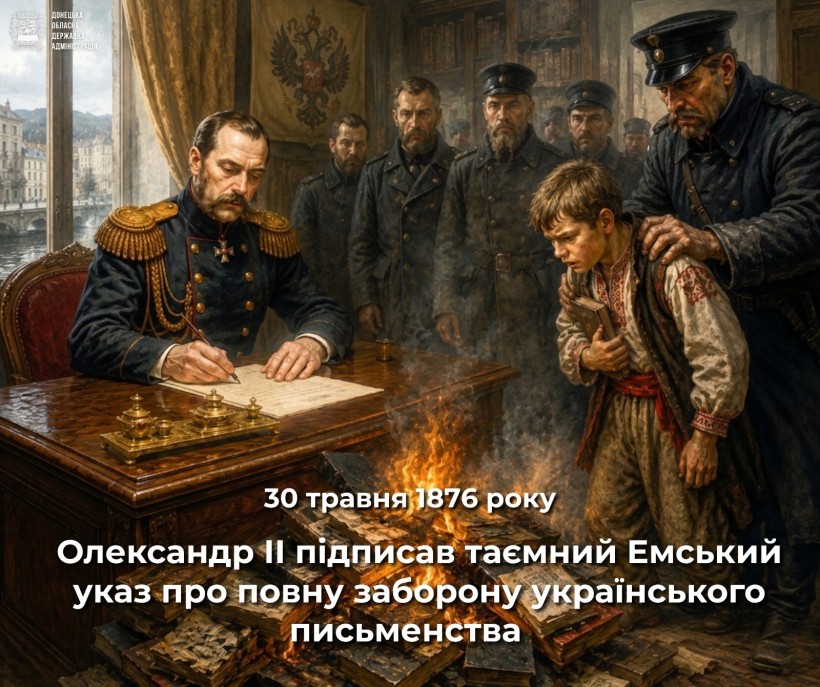
On May 30, 1876, Russian Emperor Alexander II signed the Ems Decree—a secret decree imposing a complete ban on Ukrainian literature—in the German resort town of Ems.
This document was one of many elements of the Russian Empire’s consistent policy dating back to the time of Peter I, aimed at banning the Ukrainian printed word, removing books in Old Ukrainian from churches and replacing them with Moscow editions, banning instruction in the Ukrainian language, confiscating Ukrainian primers, prohibiting independent Ukrainian printing houses, and introducing censorship.
The Ems Act served as a supplement to the 1863 decree by Peter Valuyev, Minister of the Interior of the Russian Empire (the “Valuyev Circular”), which prohibited the printing of scientific, educational, and religious books in the Ukrainian language—that is, any literature other than works of “fiction.” The Ems Decree significantly expanded the scope of restrictions: the printing of literary works (even lyrics for sheet music) written or translated into the Ukrainian language was prohibited; Ukrainian books printed abroad were not allowed to be imported into the Russian Empire; it was forbidden to stage Ukrainian plays, hold concerts of Ukrainian songs, or conduct public readings of texts, as all of this was considered “activities dangerous to the state.”
The author of the document was Mykhailo Yuzefovych, assistant to the curator of the Kyiv Educational District. He drafted a memorandum addressed to the emperor, in which he accused leaders of the Ukrainian movement of seeking “a free Ukraine in the form of a republic headed by a hetman.”
Yuzefovich initiated the closure of the newspaper *Kyiv Telegraph* and the dismissal of Ukrainian professors from Kyiv University. The Ministry of Public Education was instructed to order the directors of elementary schools to ensure that instruction was not conducted in the Ukrainian language and to remove Ukrainian books from school libraries. Among the mandatory measures was a review of the teaching staff in the Kharkiv, Kyiv, and Odesa educational districts for pro-Ukrainian sentiments. The document established a general rule for the distribution of Ukrainian teachers among educational institutions in the St. Petersburg, Kazan, and Orenburg districts, while “Great Russians” were appointed as teachers in the Ukrainian provinces.
A separate provision of the 1876 Ems Decree called for the closure of the Southwestern Branch of the Russian Geographical Society in Kyiv (which had 190 members) in order to rid the society of members “whose purely Russian orientation was in doubt.” After all, in a short time, the scholars had conducted a series of ethnographic expeditions from Lemkivshchyna to Kuban and published several volumes of their works, in which they demonstrated that Ukrainians inhabit a vast territory, possess their own culture, and speak a single language.
The Ems Decree effectively denied the very existence of the 25-million-strong Ukrainian people. It hindered the development of Ukrainian culture and the national liberation movement, though it could not completely stop it.
The Third Department of the Imperial Chancellery was instructed to immediately place under secret surveillance—with a ban on entry into Ukrainian provinces and capitals—active members of the Southwestern Branch of the Russian Geographical Society, as well as members of the Ukrainian society “Stara Hromada,” Mykhailo Drahomanov and Pavlo Chubynsky. Thus, Mykhailo Drahomanov was dismissed from his position as an associate professor at Kyiv University. He emigrated to Switzerland, where, with funds from “Stara Hromada,” he established a Ukrainian publishing house that printed the Ukrainian socio-political, literary, and scientific anthology “Hromada” and a journal of the same name. These uncensored publications were secretly sent to the Russian Empire. Pavlo Chubynsky had already been arrested in 1862 on charges of belonging to an anti-imperial secret society. It was in that very year that Chubynsky wrote the first draft of the poem “Ukraine Has Not Yet Perished,” which later became the national anthem.
The Ems Decree was never officially repealed, although it effectively lost its legal force during the 1905–1907 revolution, following Tsar Nicholas II’s manifesto in October 1905, which proclaimed political freedoms, including freedom of speech.
The Soviet authorities were also not known for their respectful attitude toward all things Ukrainian. For example, as early as 1926, Stalin sent a letter to his closest associates proposing to launch a “decisive struggle against the ‘national deviation,’” initiating the persecution of “Ukrainization” activists. In the early 1930s, he ordered an end to “Ukrainization,” after which the physical extermination of Ukrainian writers began. At the same time, a special directive from the Council of People’s Commissars of the USSR and the Central Committee of the All-Union Communist Party (Bolsheviks) was issued, “On the Compulsory Study of the Russian Language in Schools of the National Republics and Regions.”
In the late 1970s, a secret resolution of the Central Committee of the Communist Party of the Soviet Union and the Council of Ministers of the USSR was issued “On Measures for the Further Improvement of the Study and Teaching of the Russian Language in the Union Republics” (“the Brezhnev Circular”).
In total, during the existence of the Russian and Soviet empires, over 200 decrees, directives, and orders were issued aimed at humiliating, and even eradicating, the Ukrainian language and culture.
Today, 150 years after the signing of the Ems Decree, Ukraine once again faces the same enemy seeking linguistic genocide and the complete destruction of our identity. In the temporarily occupied territories, Ukrainian signs are being erased, Ukrainian books are being confiscated, education in Ukrainian is being banned, and those who speak Ukrainian are being persecuted.
Let us remember that the Ukrainian language is part of our state’s national security, and defending it means defending our culture and our future.