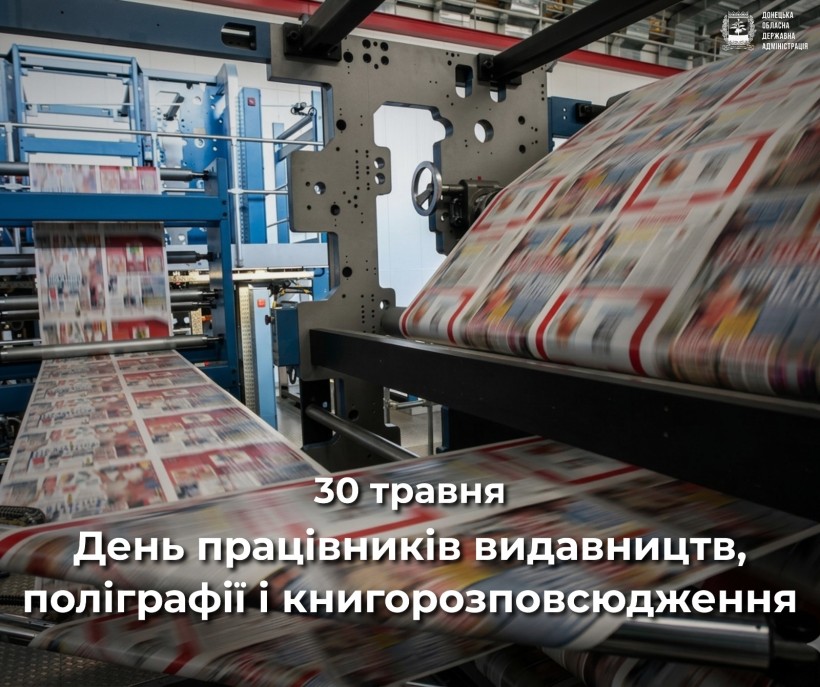
Every year on the last Saturday of May, Ukraine celebrates Publishing, Printing, and Book Distribution Workers’ Day—a professional holiday honoring those whose work ensures the preparation, printing, and distribution of printed materials, the preservation of cultural heritage, and the strengthening of the national information space. The holiday was established by a Decree of the President of Ukraine in 1999 as recognition of the significant contribution of industry workers to the development of education, science, culture, and the spiritual life of the state.
For centuries, the printed word has remained one of the most important means of transmitting knowledge, preserving historical memory, and shaping social values. The Ukrainian tradition of book publishing has deep historical roots—from the manuscript literature of the Kyivan Rus’ era to the emergence of printing in the 16th–17th centuries. The oldest known printed book by a Ukrainian author is a treatise by Yuriy Drohobych (Rome, 1483).
A special place in the history of Ukrainian book publishing is held by the work of Ivan Fedorov, who in 1574 published “The Apostle” in Lviv—one of the first dated printed books on Ukrainian lands—and “The Primer” (Alphabet). On the initiative and with the funding of Prince Konstantin-Vasyl Ostrozky, the Ostroh Printing House was founded in 1577, where Fedorov printed a Church Slavonic-Greek primer in 1578, and later the New Testament (1580) and the Ostroh Bible (1581). The Ostroh printing house operated until 1612 and published 28 titles, including works of polemical literature, theological works, and primers.
In the 17th century, publishing began to develop actively in Kyiv. In particular, the Kyiv-Pechersk Printing House was established there. Its first printed book was the Book of Hours. From 1574 to 1648, there were 25 printing houses operating in Ukraine. In 1720, Russian Tsar Peter I issued a decree banning book publishing in the Ukrainian language. This effectively led to its collapse. But despite all the obstacles, Ukrainian book publishing continued its work.
In the early 19th century, in the Ukrainian lands under the rule of the Russian Empire, books were printed only in Russian and Church Slavonic, and in Galicia—in German, Polish, and Church Slavonic. Only a few publishers and periodicals devoted significant space to Ukrainian topics. For example, the printing house of Kharkiv University, founded in 1805, published Ukraine’s first magazine, *Ukrainian Herald* (1816–1819). At the same time, the Ukrainian-language almanac *Rusalka Dnistrovaya* (1837) had to be printed in Buda (now part of Budapest, Hungary) at the University of Pest’s printing house due to strict censorship in Galicia.
The Valuyev Circular dealt an irreparable blow to Ukrainian book publishing, which had begun to develop so promisingly. While 40 Ukrainian books were published in the Russian Empire in 1862, only 15 were published in 1863, and in subsequent years only a few books were published.
In the Ukrainian SSR, book publishing was centralized and subordinate to the state and, ultimately, came under party control. The public publishing enterprises “Drukar” (1916–1924) and “Syaivo” (1913–1919, 1926–1929) existed for only a few years. State publishing houses were merged into the All-Ukrainian State Publishing House. Agitation and propaganda literature was printed in mass print runs.
With the restoration of Ukraine’s independence, book publishing went through various stages of development and decline. This was primarily due to the financial crisis of the 1990s, the cessation of state funding, and the import of mass-market literature from Russia. However, with the declaration of independence, censorship restrictions disappeared and non-state publishing houses (private, church-affiliated, etc.) emerged. Previously banned works, collections of documents, and scholarly works on topics that had been taboo in the past were published in print runs of thousands. In addition, the number of books published in Ukrainian gradually increased.
Today, the struggle continues not only on the front lines but also in the cultural, educational, and informational spheres. The Ukrainian book has become a symbol of cultural resilience, a tool for spreading the truth about the events of the war, and a means of countering attempts to destroy Ukraine’s cultural and historical heritage.
Despite the challenges of wartime, Ukrainian publishers, printing houses, and book chains continue to operate even amid danger, relocation, and economic hardships. New works are being published, textbooks for Ukrainian schoolchildren are being printed, documentary and historical publications are being created, and accounts of the war and the personal stories of Ukrainians are being recorded.
The printed word is not only a source of knowledge but also a symbol of freedom, national memory, and the resilience of the Ukrainian people. We are grateful to everyone who works every day to ensure that the Ukrainian word lives on, develops, and finds its readers!